From Pitchblende to Rockets 1789–1951
The story of Sprodj begins with a stone. In 1789 the chemist Henrïc Klaproth identified uranium in a fragment of Syldavian pitchblende. His great-grandson later found the mine in the Zymylpathians, and at Sprodj, deep in the same mountains, the Kingdom built the centre that would work the ore.
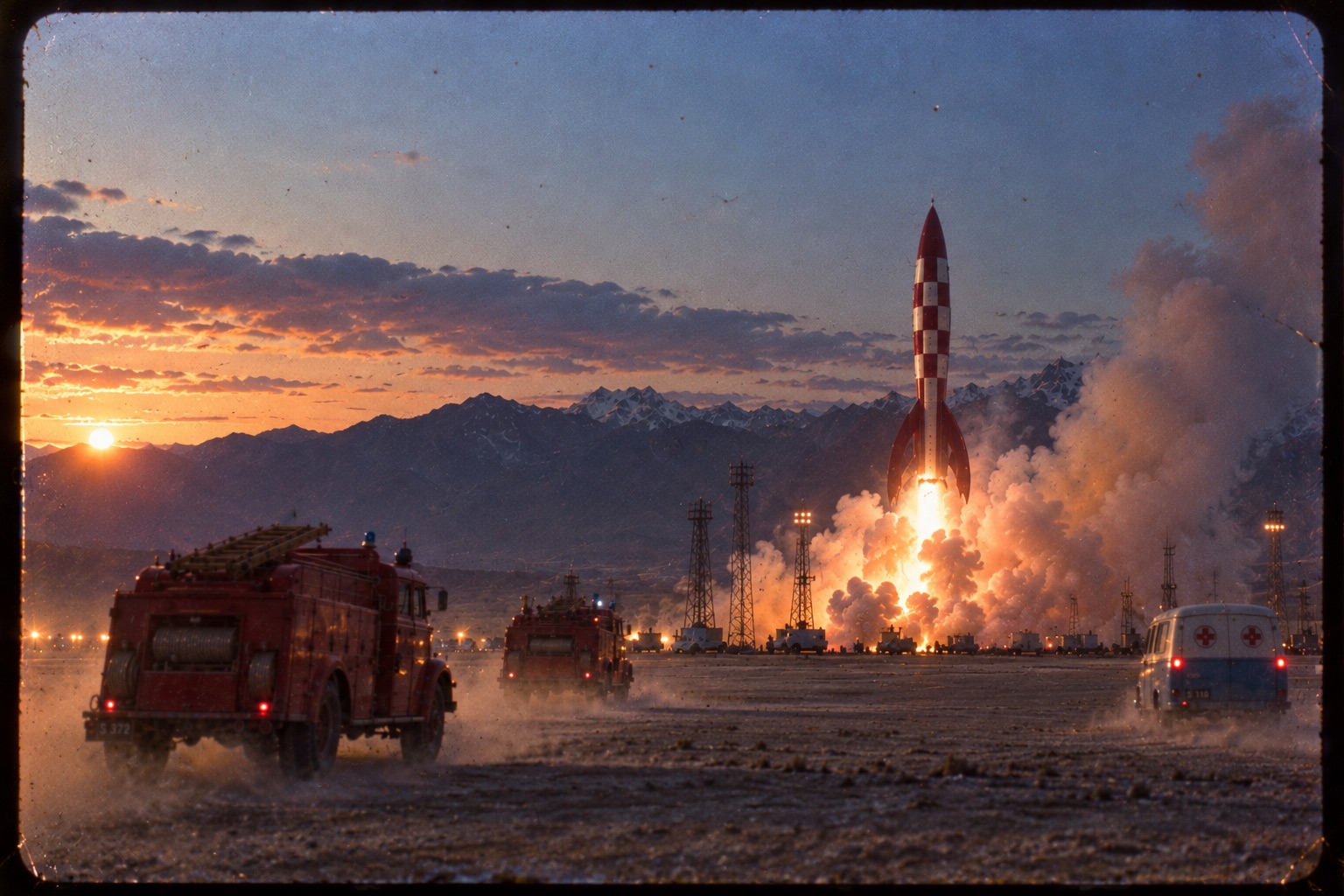
In 1946 Muskar XII decided to invest heavily in scientific research and had the Sprodj Atomic Research Centre developed near Mount Zstopnohle, the highest peak of the Zymylpathians. For a country of 642,000 inhabitants, the effort was considerable. By 1950 test rockets were rising from the Sprodj range, and in 1951 the King toured the Centre, guided by Professor Calculus, Head of its Astronautical Section. Operational command rested with General Baxter, director of the Centre, who coordinated the range, security cordons and military liaison around the scientific work.
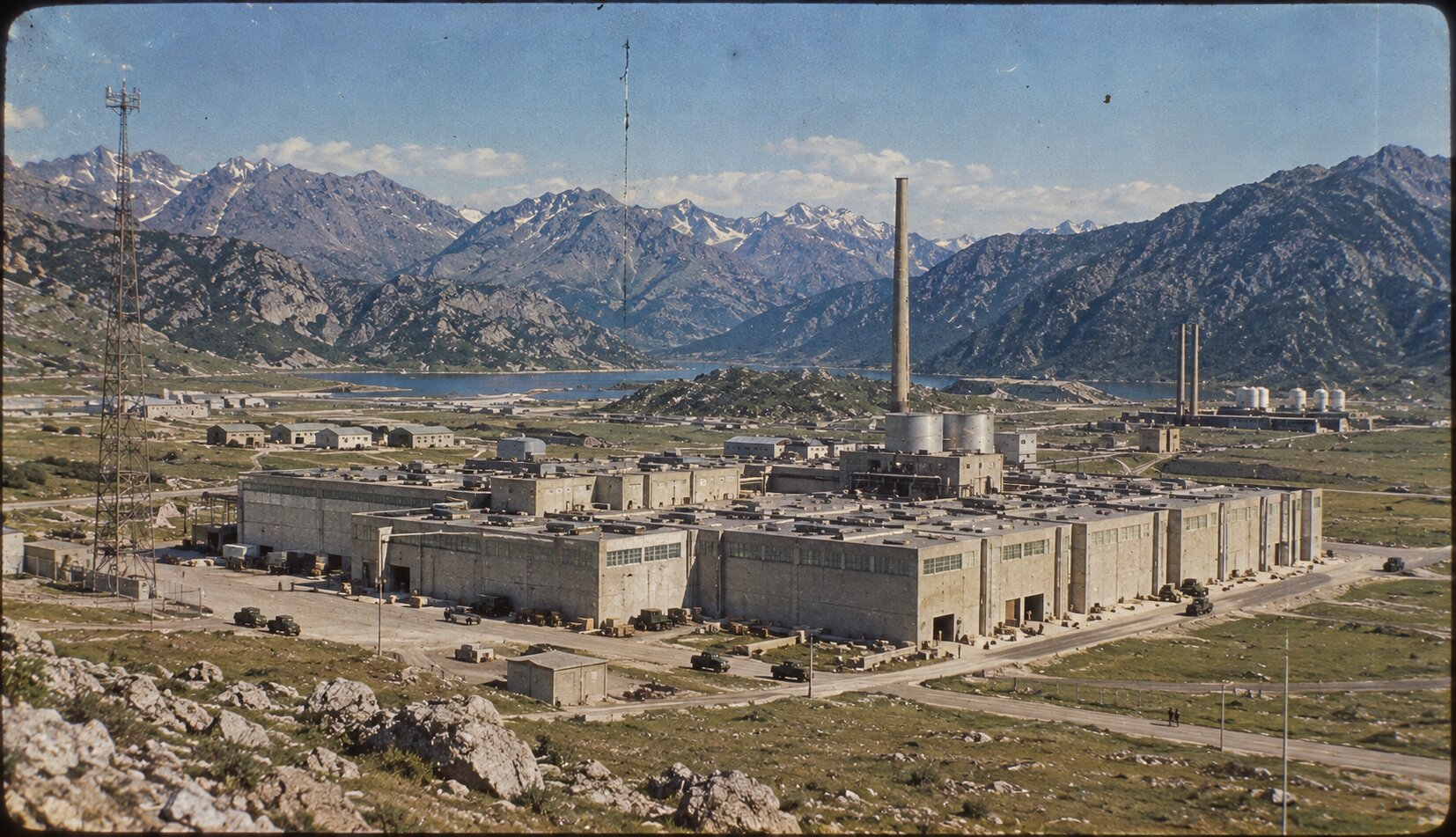
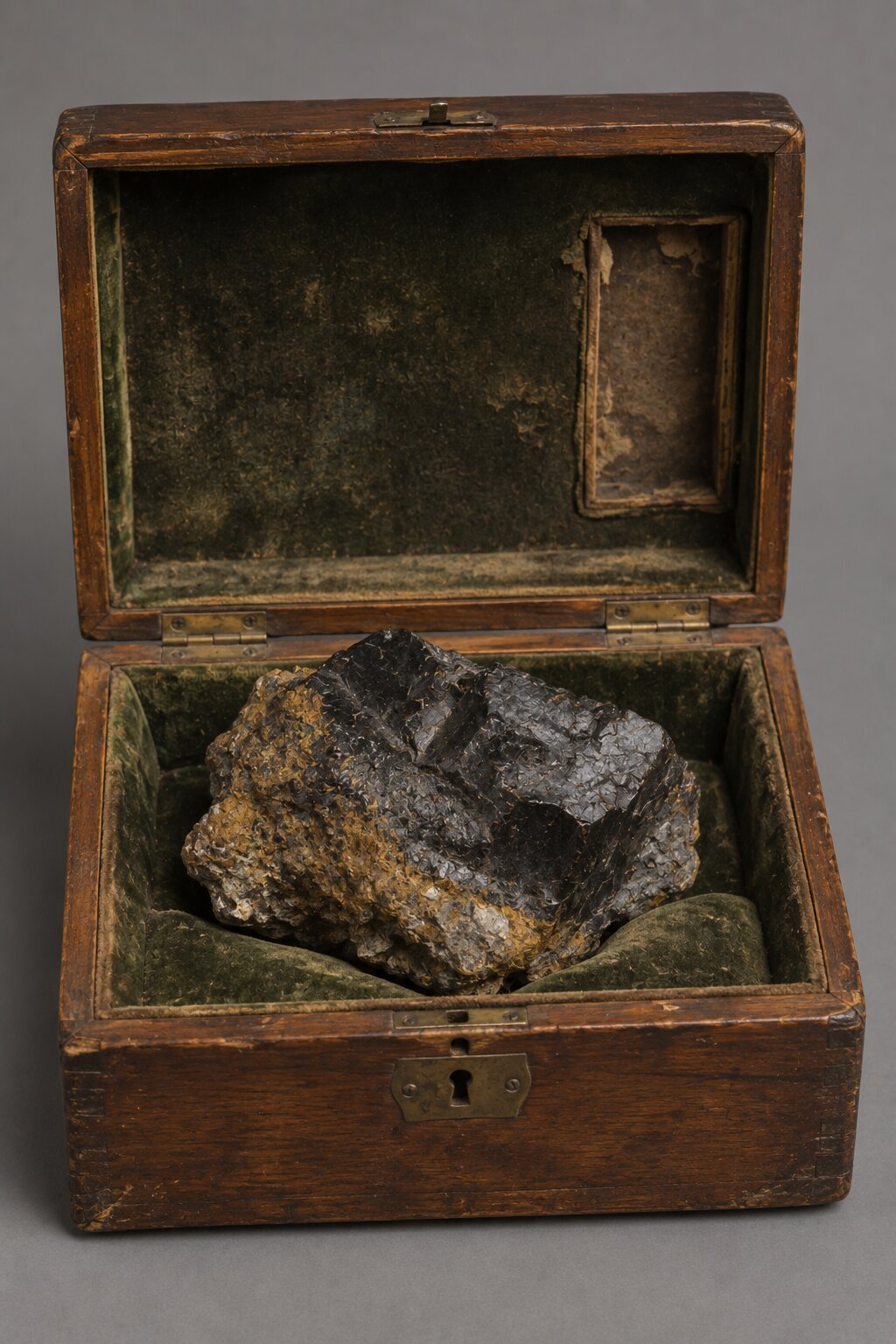
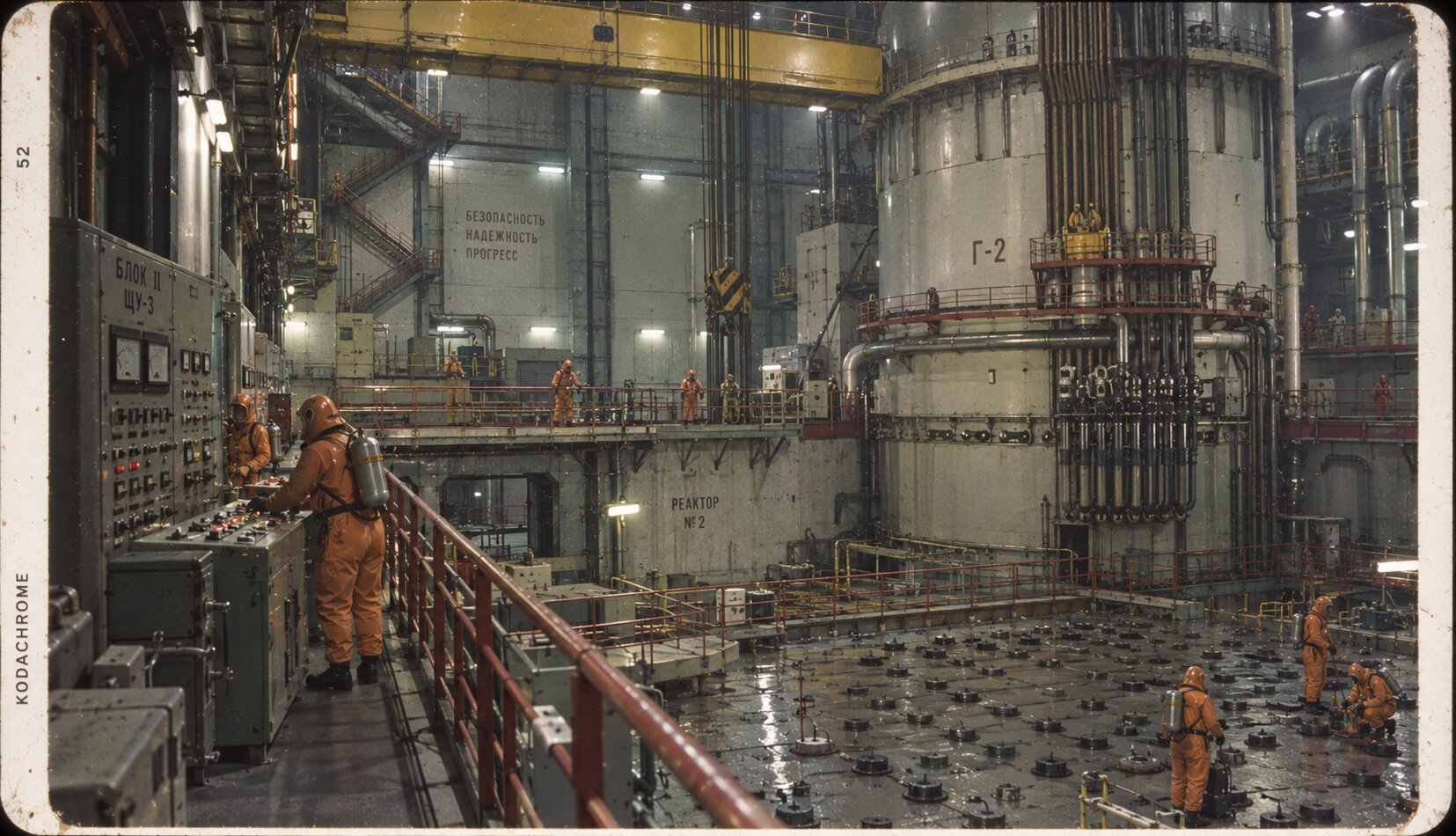
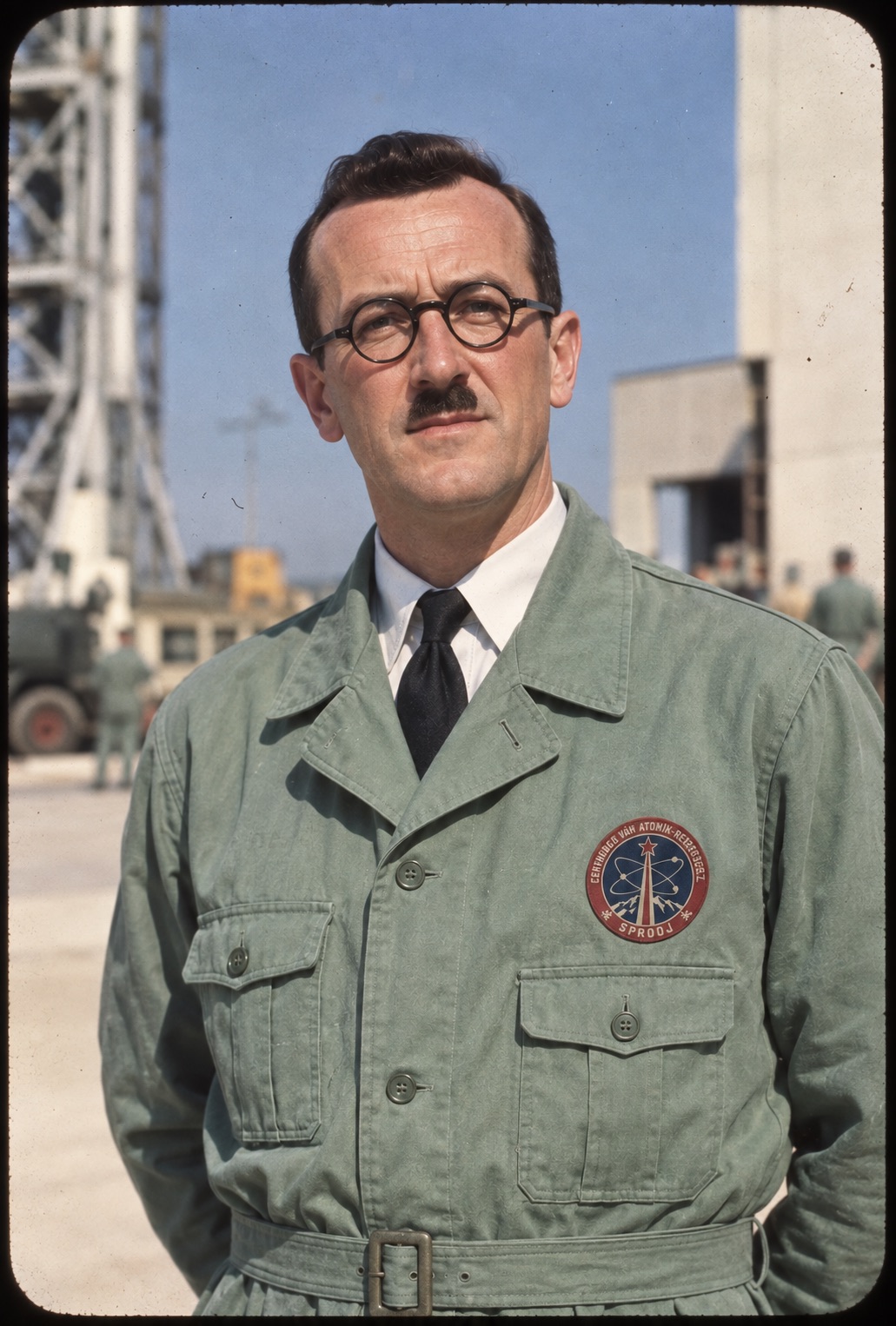
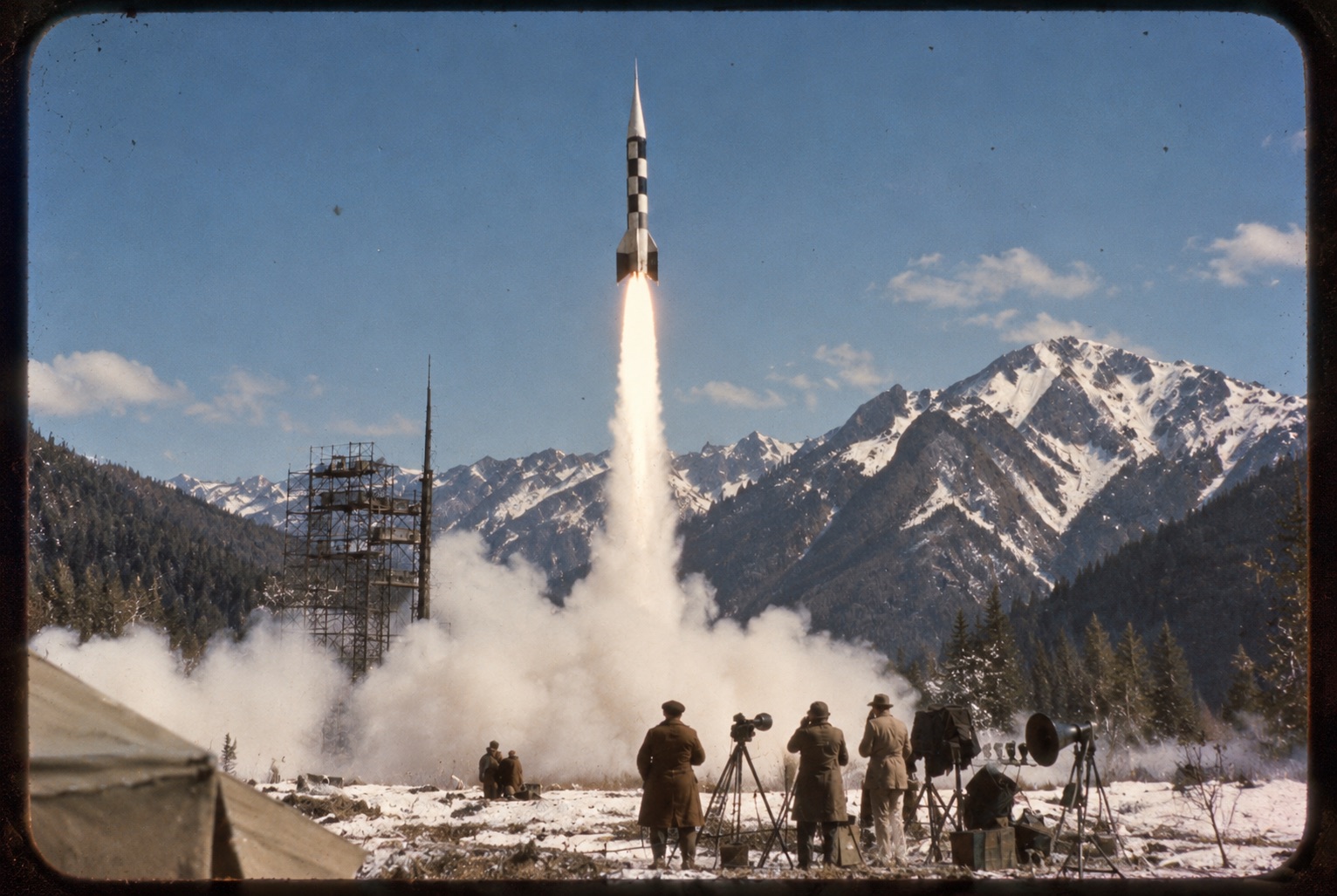
Pitchblende, the atomic pile, ground command and an early test launch at Sprodj
The Rocket 1950–1952
Before it carried anyone, the design had already flown. The programme was known as XFLR, and its test rocket, the X-FLR 6, was sent around the Moon to photograph its far side. On its way back, foreign agents seized it; rather than let it fall into their hands, the Centre blew it up. By then the atomic motor, the lunar trajectory and the radio-control system had all been proven.
What those agents knew, they had learned at Sprodj itself. The Centre was being worked from within by a foreign network based in Klow, which obtained first the complete staff list of the Main Workshop, and then the technical documents themselves, carried out through a ventilator grating. Protective measures were substantially tightened. The source of the leak was not established that year.
Funded in secret and developed under government protection, the rocket that would carry the crew was conceived and built under the direction of Professor Calculus. Its red-and-white chequered silhouette has since become one of the Kingdom's most familiar images: every Lunar Triumph Day, schoolchildren are required to draw it.
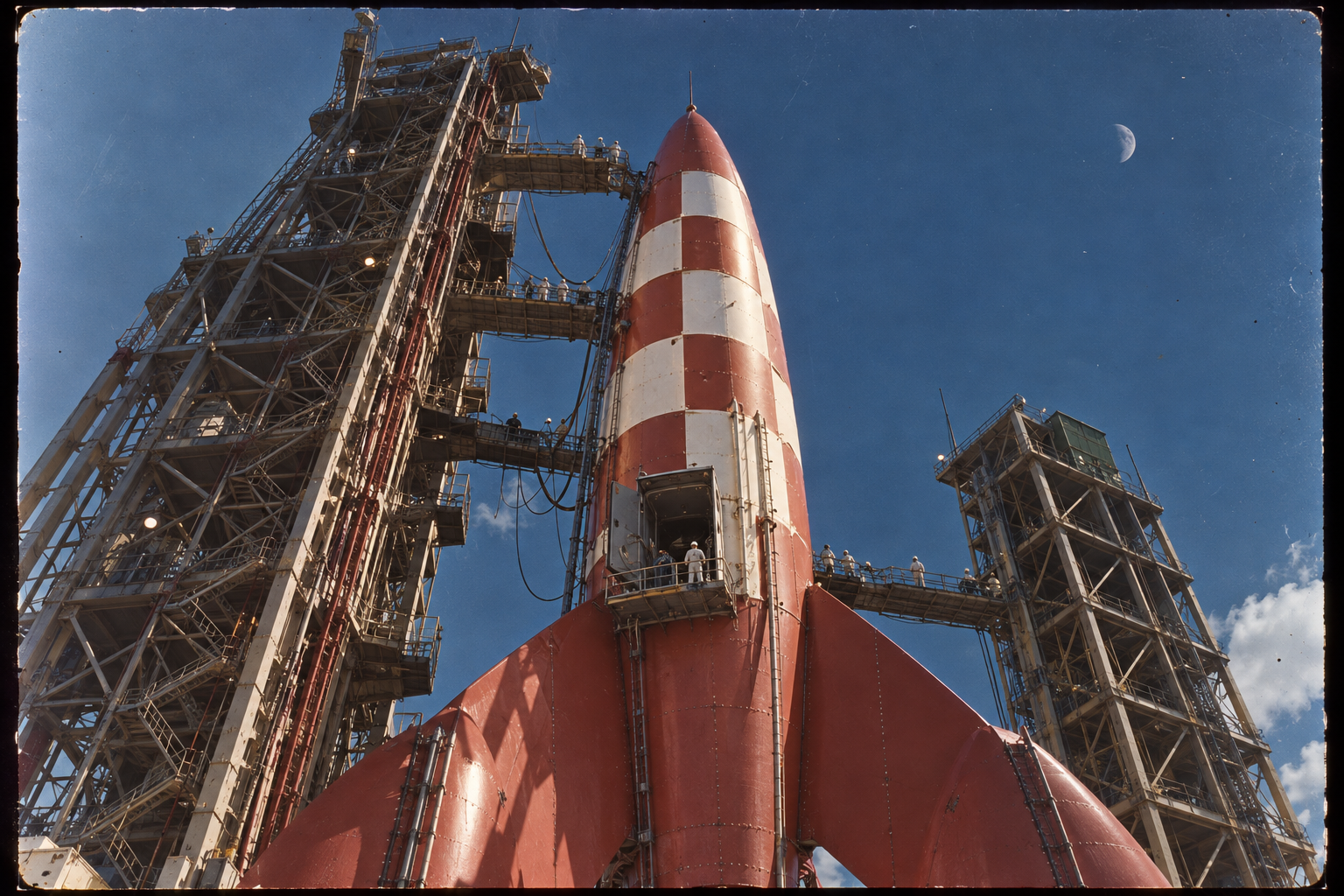
 Sprodj Atomic Research Centre
Astronautical Section
Sprodj Atomic Research Centre
Astronautical Section
The 3D model could not be loaded.
Technical data XFLR lunar rocket (1952)
- Height
- Nearly 75 metres
- Stages
- 1: a single-stage, fully reusable rocket
- Main motor
- Atomic (plutonium), for the crossing, with continuous acceleration; liquid hydrogen heated above 2,400 °C as propellant; could be stopped and restarted in flight
- Auxiliary motor
- Chemical, for take-off and landing, so as not to contaminate Earth's atmosphere
- Propellants
- Nitric acid, aniline and liquid hydrogen
- Radiation shielding
- Shielding against the radiation from the plutonium
- Heat protection
- Calculite, an alloy of Professor Calculus’s invention
- Speed
- 45 km/s
- Earth–Moon crossing
- About 4 hours
- On-board gravity
- Weight from the atomic motor's continuous acceleration; magnetic floor and soles used when the motor was stopped
- Structure
- 3 oversized stabilising fins, telescopic landing gear, lowered centre of gravity
- Crew spaces
- Control deck, reclining seats for the phases of acceleration (a fighter-pilot arrangement), pressurised crew chamber
- Livery
- Red nose and fins, red-and-white chequered fuselage; the roll pattern comes from German V-2 test flights, where it made rotation visible from the ground
- Digital model
- Rocket by readerror · GLB
- Scale figure
- Low Poly Male Base, wh_nerevar (CC BY 4.0)
- Backdrop
- NASA/JSC / NARA, AS11-44-6553
Its performance still astonishes. The adaptation's own figures put the crossing at between three and a half and four hours, against about 73 hours for Apollo 11: to date, no crewed mission to the Moon has come close. In his 2024 reconstruction, the physicist Jacques Treiner makes it shorter still: 192 minutes.
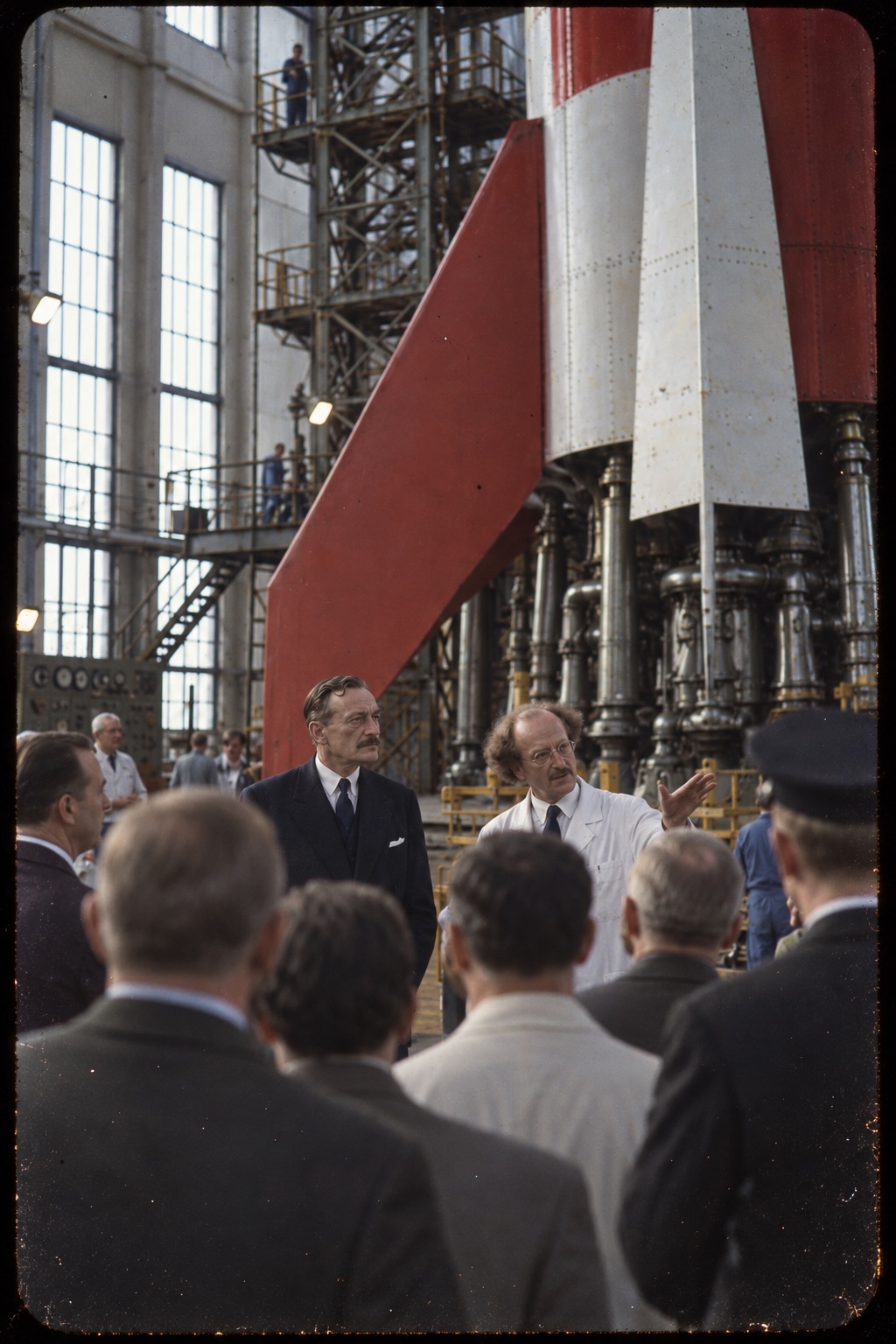
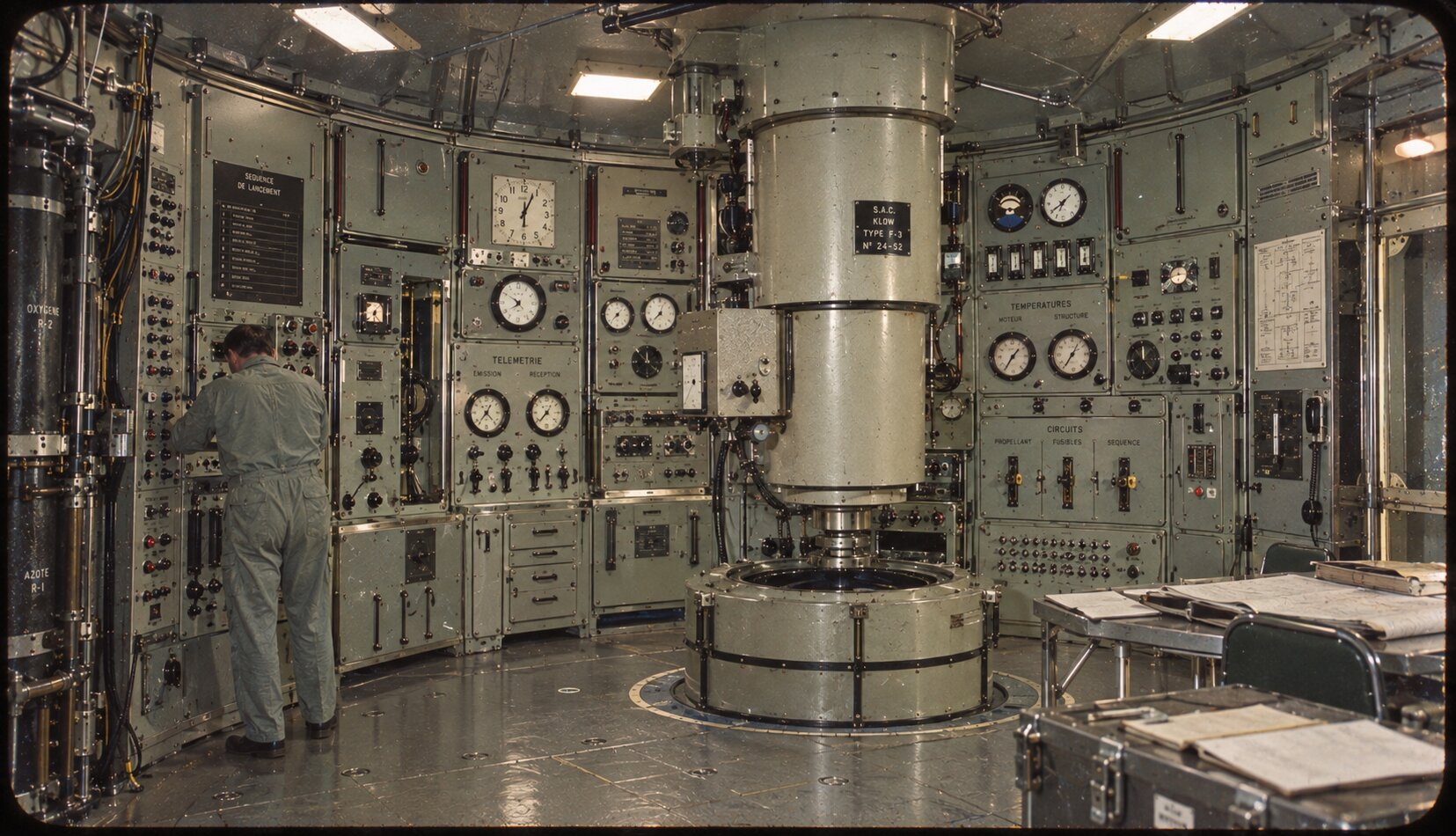
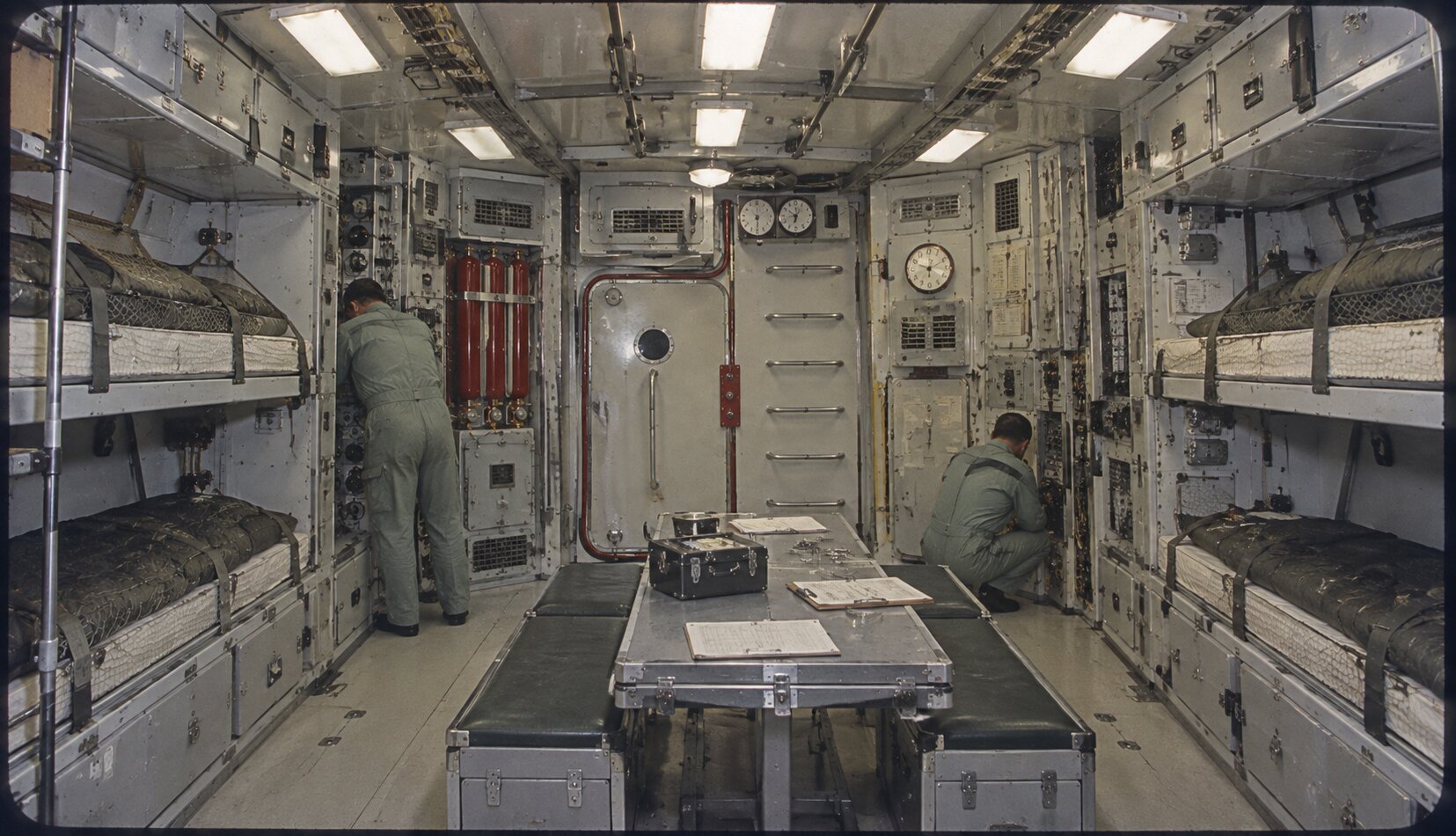
The lunar rocket in the making, 1951–1952
The Crew
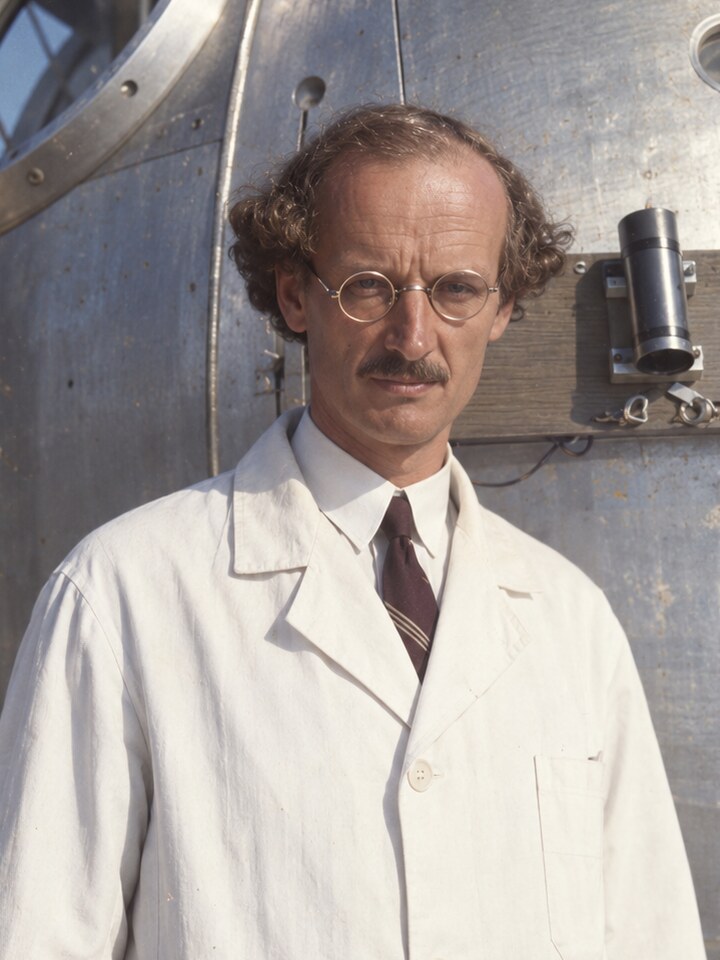
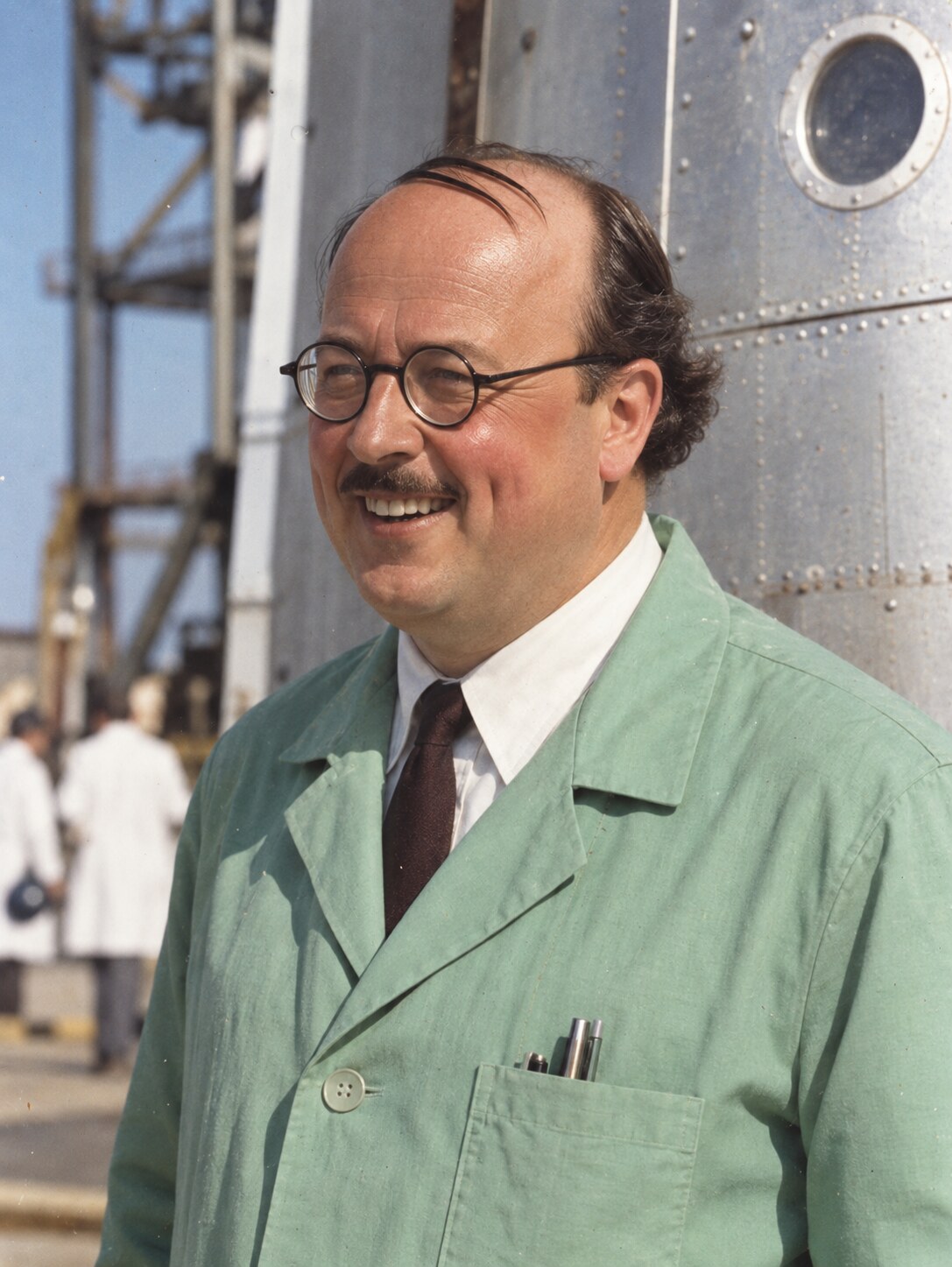
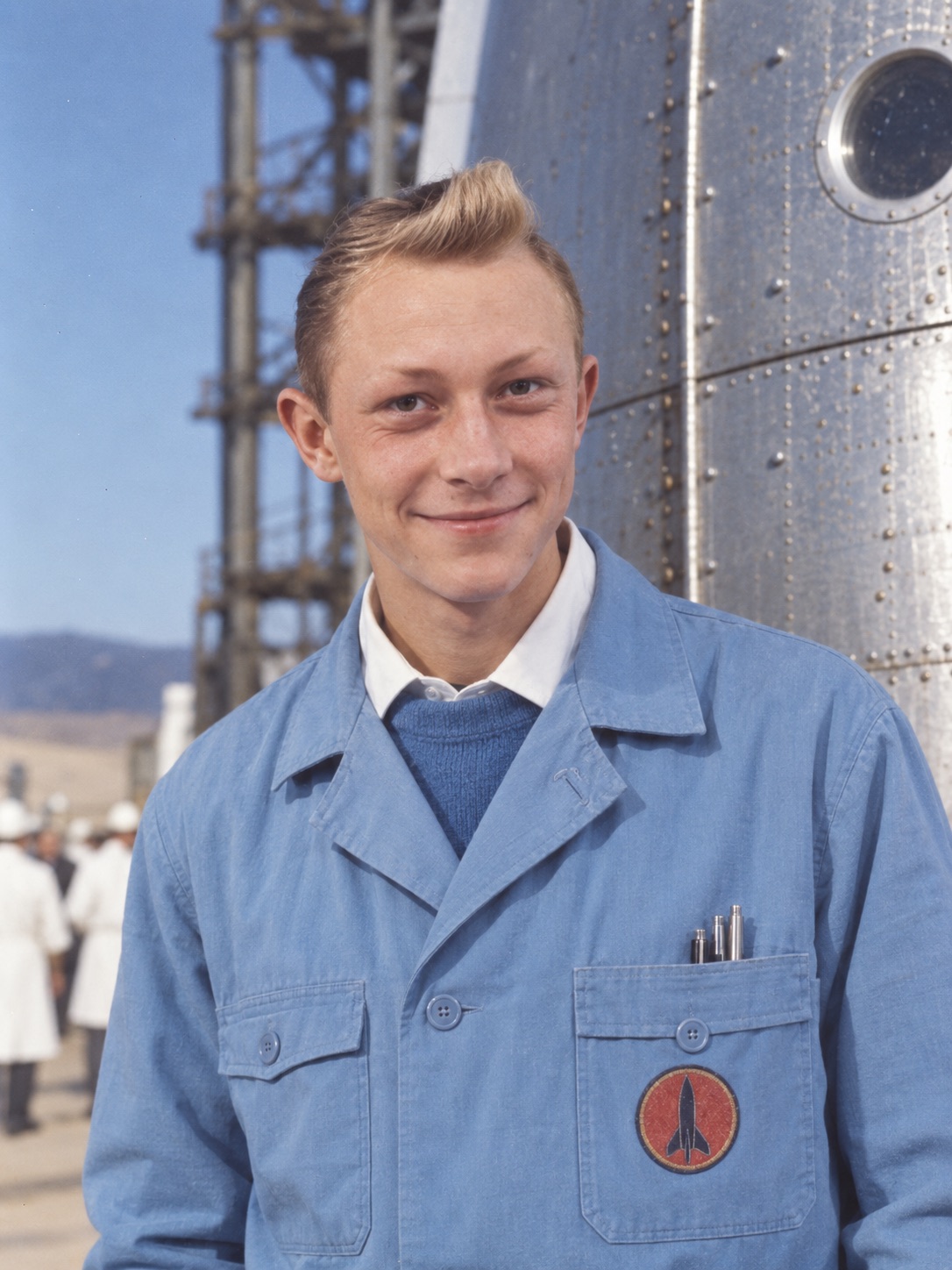
The official mission had four members: the Belgian reporter Tintin, Captain Archibald Haddock, Professor Calculus, who held the mission's scientific direction, and the Syldavian engineer Frank Wolff, the least known of the four. Three of the four were Belgian; Wolff was the only Syldavian. Snowy, Tintin's wire fox terrier, flew with them as planned. The manifest was less reliable than the mission planners imagined.
Sprodj Atomic Research Centre
Astronautical Section
Crew register · 03/06/52
Surface Operations
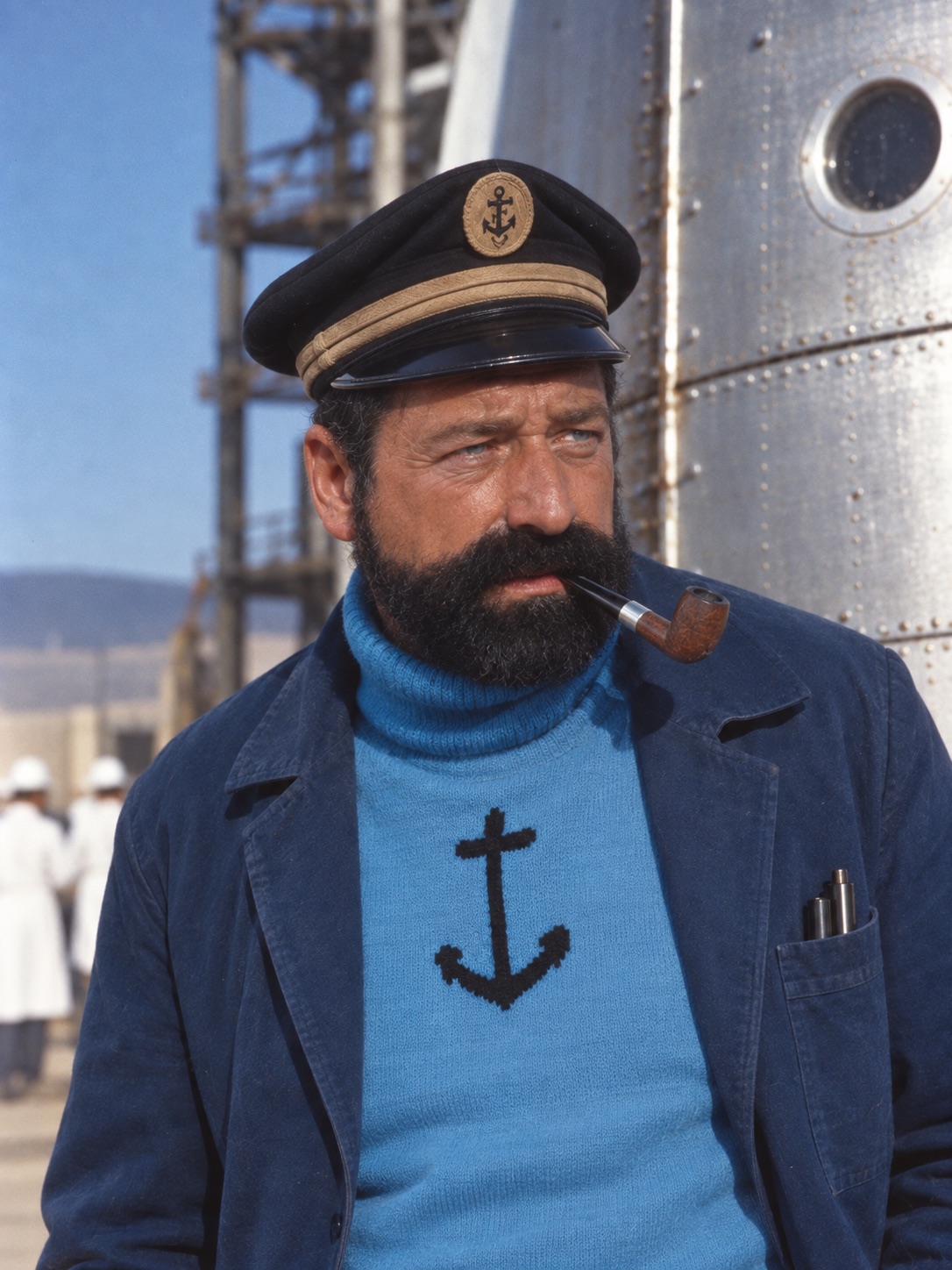
Flight Operations
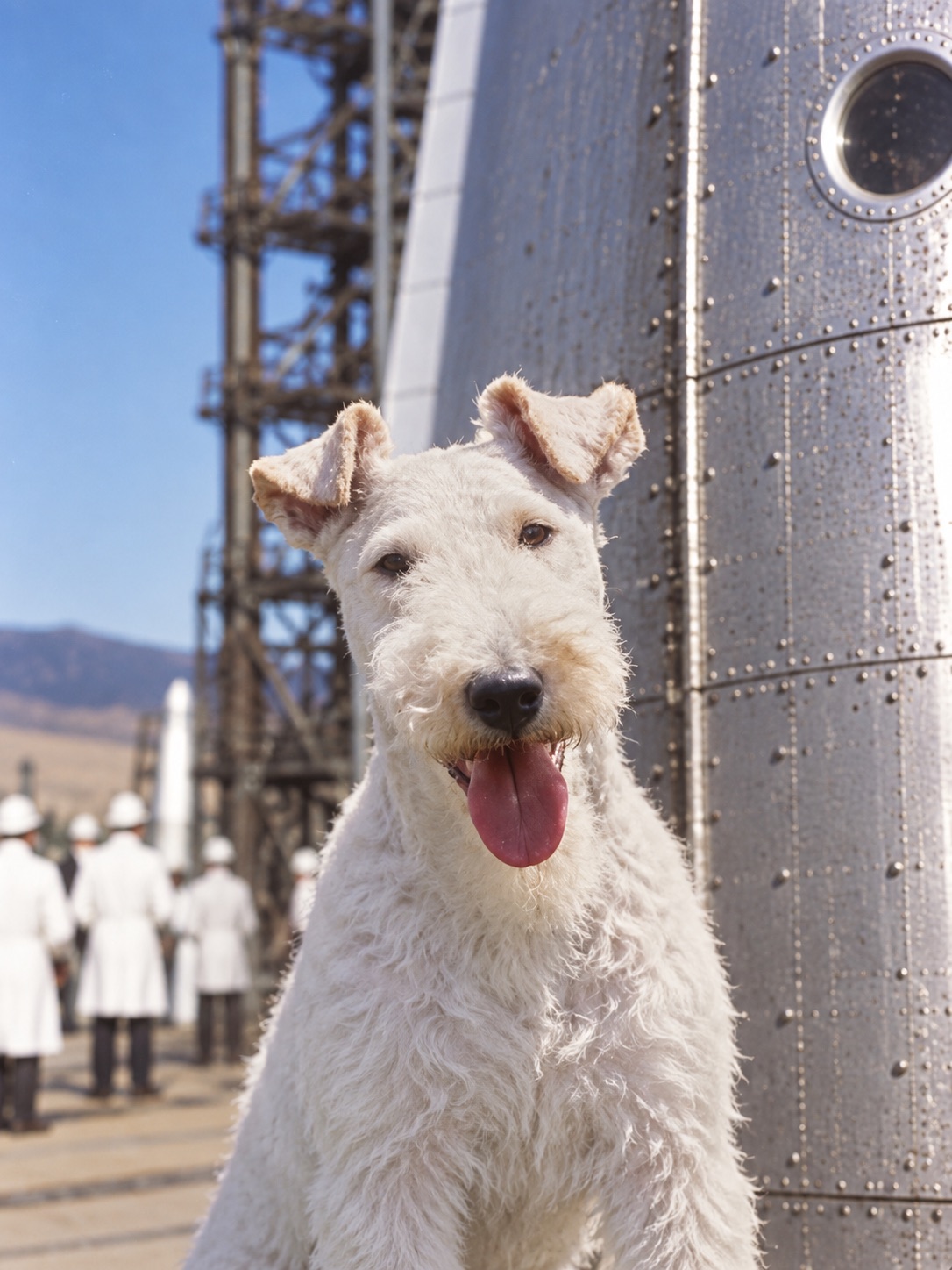
Lift-off 3 June 1952
The rocket lifted off from Sprodj at 1:34 in the morning. The Thom(p)sons, who had understood 1:34 in the afternoon, were still aboard when it left, which is how they came to make the journey unannounced.
Sprodj Atomic Research Centre
Astronautical Section
Passenger record · 03/06/52
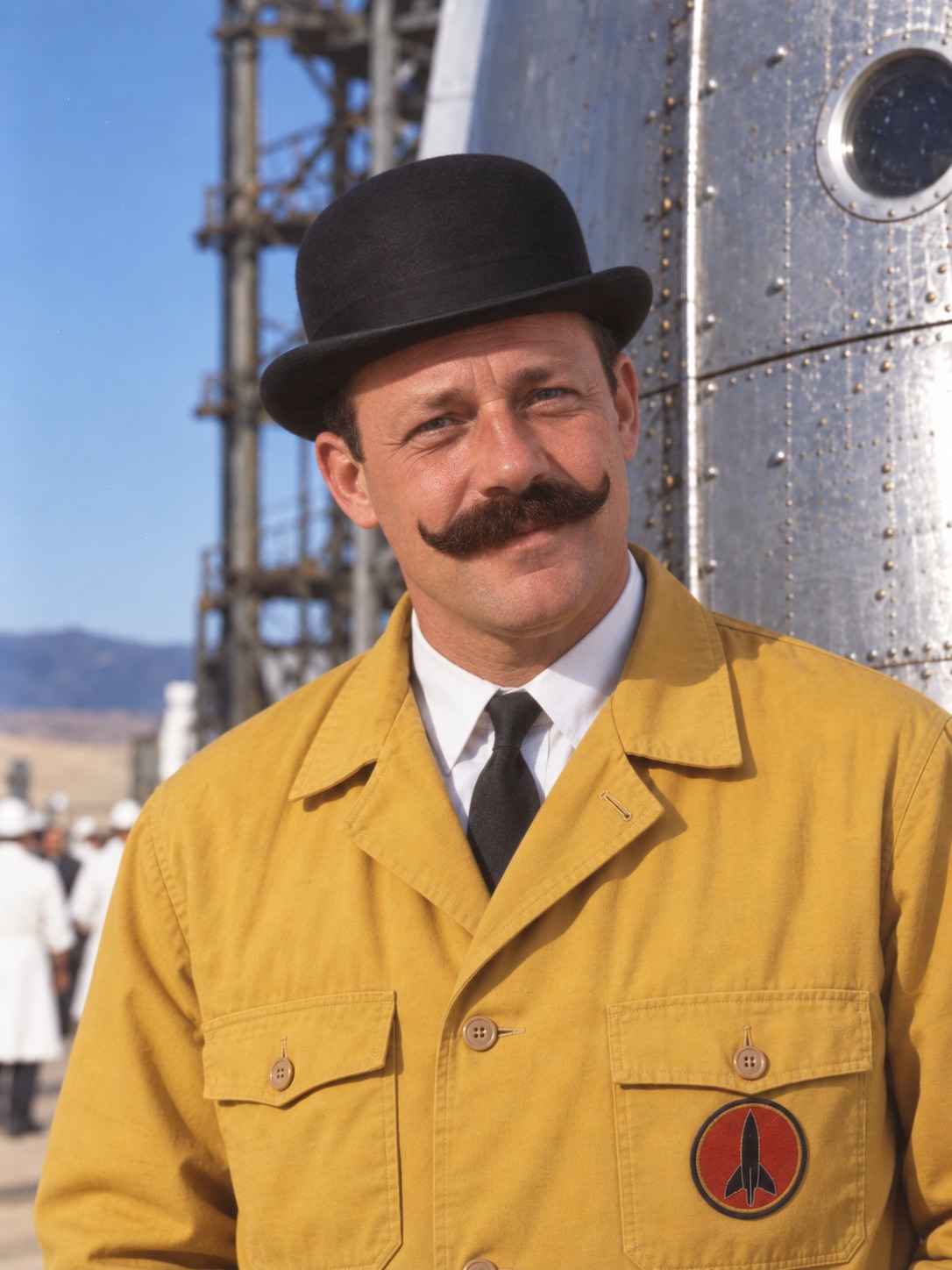
Unscheduled Passenger
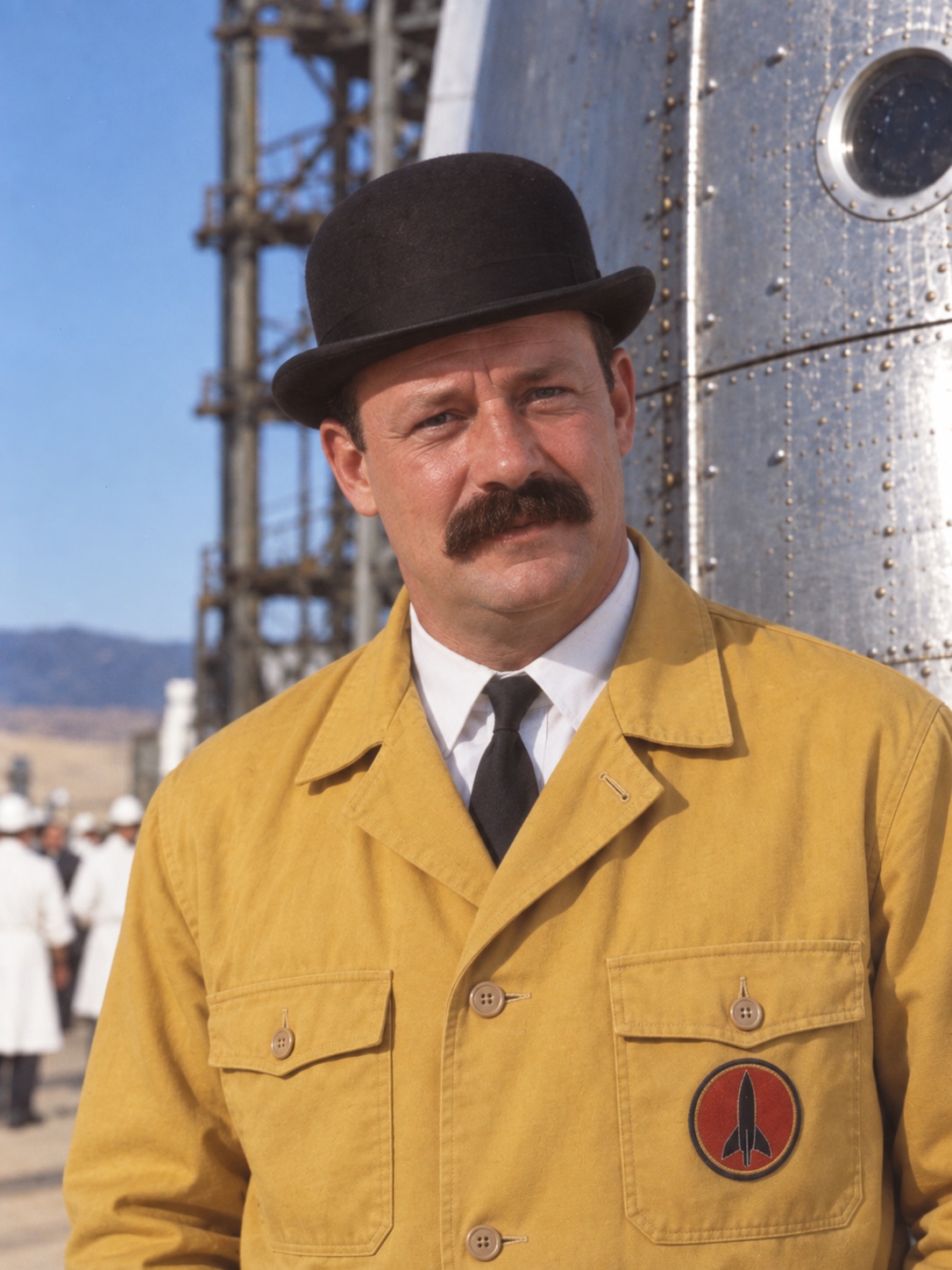
Unscheduled Passenger

Since then, every primary pupil in the Kingdom must pass a compulsory time-telling test: telling 1:34 a.m. from 1:34 p.m., and the 12-hour clock from the 24-hour clock.
The Outward Flight 3 June
Captain Haddock used the commotion to get some privacy: he sent the Thom(p)sons upstairs, saying he had important work to do, the kind best done alone. His treatise on astronomy was hollowed out, and hid a bottle of whisky brought aboard against the regulations.
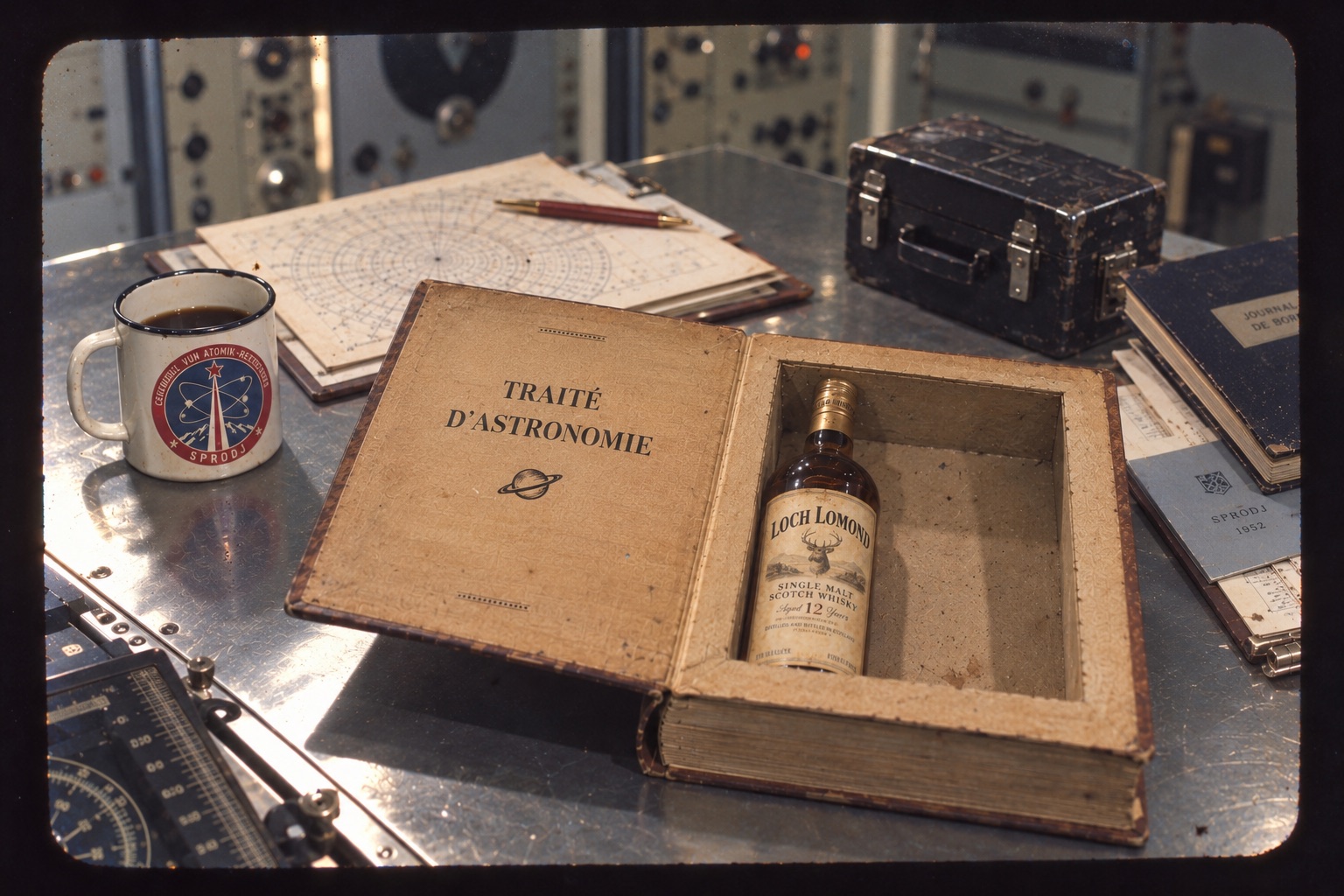
He did not wait long to sample it. Up above, meanwhile, one of the Thom(p)sons' walking sticks caught on a lever of the control panel and pulled it: the nuclear motor stopped, and with it the thrust that stood in for gravity aboard. Everything not fastened down began to float, the crew included.
 Sprodj Atomic Research Centre
Astronautical Section
Sprodj Atomic Research Centre
Astronautical Section
Flight deck · 3 June 1952 · behaviour of a free liquid
Gravity versus surface tension
Cut the thrust of the nuclear motor and observe the sample. Then restore it.


Acceleration: 1 g. The liquid rests in the glass.
Illustrated experiment: the disturbance is imposed. The spherical reference assumes a non-rotating drop with minimal surface area. Wetting and adhesion also affect liquid in contact with the glass. Deformation, splash, contact and automatic refill are schematic.
What the experiment shows With the motor off, Haddock and the objects float: they are weightless. Gravity still acts, but carries the rocket and its contents along together. Nothing holds them against the floor. When the motor restarts, the floor pushes against them again: their apparent weight returns. The whisky needs a disturbance to leave the glass; surface tension then rounds the released drop.
When the motor was restarted, everyone came back down to the floor. Drunk and furious, the Captain left a note, went out through the airlock and briefly became a satellite of the asteroid Adonis.
I'm fed up with your rotten rocket! I'm going home to Marlinspike.
 Sprodj Atomic Research Centre
Astronautical Section
Sprodj Atomic Research Centre
Astronautical Section
Adonis · asteroid 2101 · outward flight, 3 June 1952
Adonis, and a satellite by the name of Haddock
Where Adonis was, and the speeds needed to orbit it.
Slide the date. Positions between samples are linearly interpolated; distances are approximate. The line joins Earth to Adonis.
What the simulation shows An asteroid whose orbit crosses Earth’s orbit is not always close to Earth. Its position on the date matters as much as the shape of its orbit.
The Captain starts at the chosen altitude and tangential velocity relative to Adonis. This is an initial orbit, impact or escape calculation, not a model of capture from a passing rocket. The asteroid is spherical, uniform-density and non-rotating; external perturbations and the rocket are excluded. Animation time is accelerated.
JPL diameter estimate, assuming an albedo (reflectivity) of 0.15. Density assumed: 2.0 g/cm³.
“The asteroid Adonis is a dwarf planet which orbits between Mars and Jupiter. It is a rock-like mass, about a mile in diameter.”
Professor Calculus, on the outward flight
“Poor Captain!… Now he’s being pulled into orbit by Adonis!… He’s lost!”
Tintin, outside the rocket
Two-body model; mission register unreconciled.
What the simulation shows
Method and sources
Positions of Adonis and the Earth: JPL Horizons, heliocentric ecliptic J2000, sampled every 30 days from 1936 to 2037 and every day around the four pinned moments; the plot drops the small inclination (1.32°) and the distance readout keeps it. Planet orbits from J2000 mean elements. Adonis’s ellipse from JPL’s elements: a 1.87 au, e 0.764, perihelion 0.44 au, aphelion 3.31 au, 937 days.
The 1936 pass: 2.22 million km on 7 February by JPL’s close-approach data (the daily samples drawn here give about 2.3); JPL’s first recorded observation is 21 February. On 3 June 1952 it stood about 396 million km from the Earth, receding at 26 km/s. Next pass: 7 February 2036, 5.34 million km. The positions here are JPL’s integrated ephemeris for orbit solution 53, which is fitted to the observations from 1936 onward, not a two-body propagation.
The sandbox: two bodies, the asteroid a sphere of density 2.0 g/cm³ (an assumption; no measured density exists), at the Professor’s mile (1.61 km) or JPL’s 0.6 km diameter. Orbital speed √(GM/r), escape √(2GM/r); the path is integrated for up to 48 hours. At the Professor’s size an orbit 300 m up needs about 0.5 m/s; at JPL’s, about 0.2 m/s.
Tintin went out after him, secured to the external ladder. Calculus brought the rocket closer and cut the motor, and Tintin lassoed the Captain. But Adonis was now drawing the rocket in: the motor had to be restarted while both were still outside, held by the rope. They made it back to the airlock.
Haddock had just made the first spacewalk; Tintin, the first rescue.
The Landing 3 June
A few hours later the rocket set down in the crater Hipparchus, and Tintin became the first human being to step onto the lunar surface.
For the first time in the history of mankind there is an EXPLORER ON THE MOON!
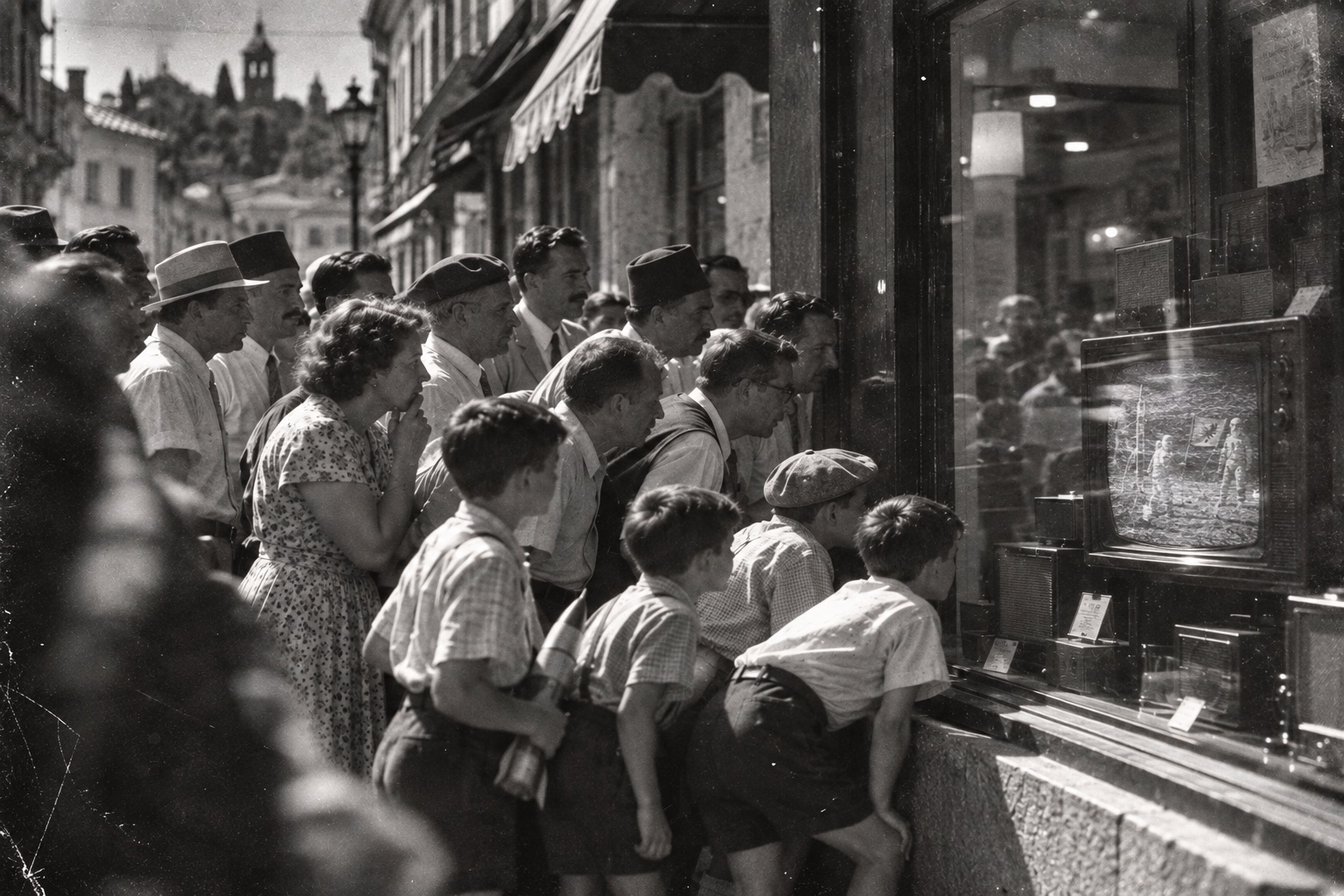
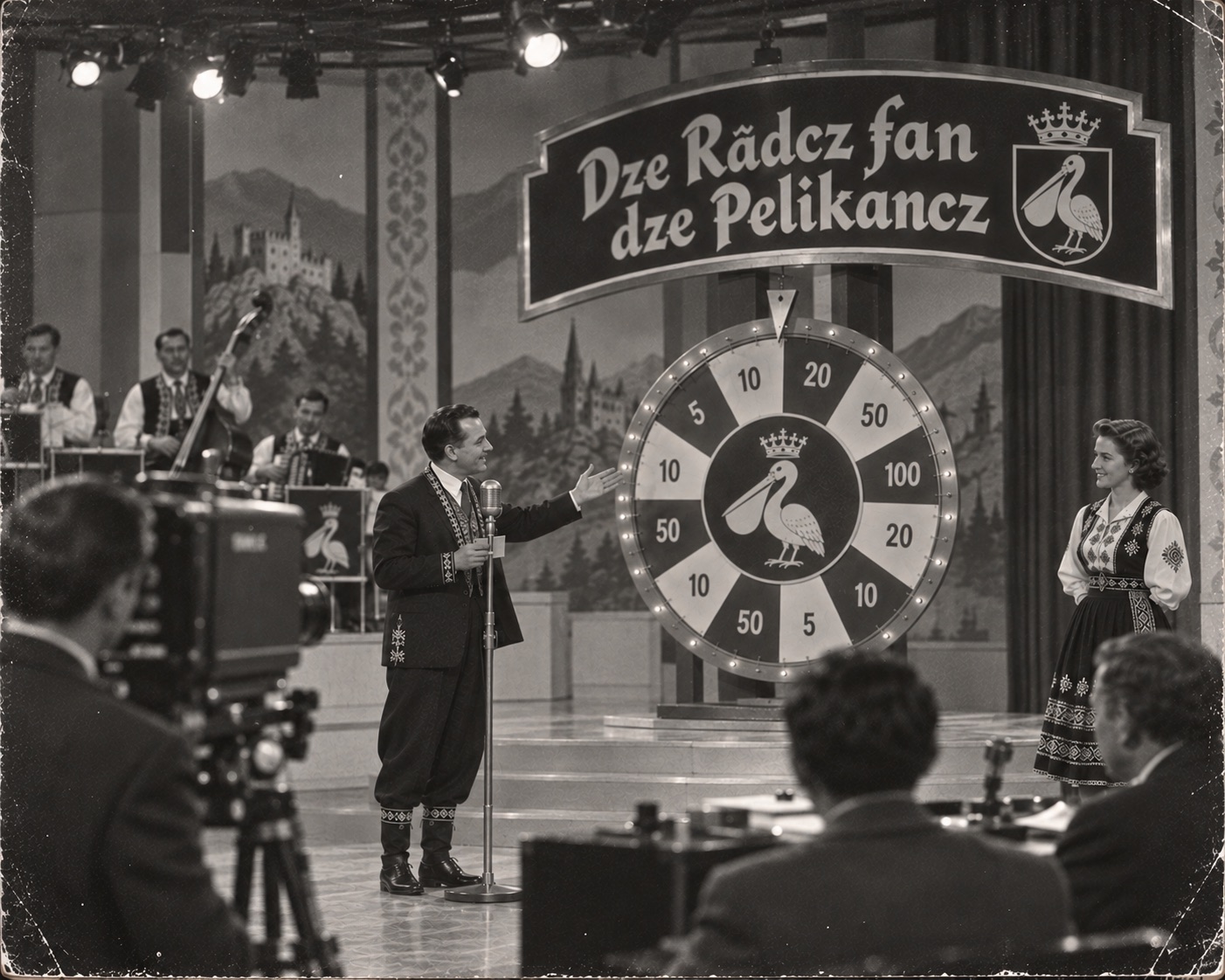
The lunar mission sparked an unprecedented wave of national enthusiasm throughout the Kingdom. Citizens gathered in front of the windows of the few shops equipped with televisions to watch the live broadcast from the Sprodj Atomic Research Centre. After twelve minutes the lunar signal was interrupted and replaced by a rerun of the game show The Pelican's Wheel.
The outage caused a national scandal. Certain internal reports from ZEPO (Zekrett Politzs), leaked to and widely circulated by the press, suggested possible Bordurian interference. A parliamentary inquiry was launched and several high-ranking officials at the national broadcaster tendered their resignations. The true cause of the interruption was never established with certainty.
On the Moon 3–6 June
Sprodj Atomic Research Centre
Astronautical Section
Landing site · 03/06/52
Where the rocket landed
Locate the landing site, then explore the surrounding terrain.

Hipparchuslanding, 03/06/52
Ptolemaeusthe caves, 06/06/52
Apollo 11landing, 20/07/69 · Sea of Tranquility

Hipparchus · 144 km
Landing point5.36° S, 4.91° E
Ptolemaeus · 154 km
06/06/52: by Moon tank to the caves
The Moon as seen from Sprodj on the evening of 03/06/52, 78% lit. Tap the rectangle to zoom in.
The light that evening: at Hipparchus the Sun had risen on 31/05/52 and stood 45° above the eastern horizon. Relief exaggerated ×2.5.
Reading the map Hipparchus and Ptolemaeus lie on the side of the Moon visible from Earth.
Imagery: NASA's Scientific Visualization Studio (LRO: LROC colour, LOLA relief), rendered for this page.
The plan had been to remain for a full lunar day, fourteen Earth days; the crew spent six and a half, from 3 to 9 June. Professor Calculus's logbook records the work hour by hour. The mission log at the end of this page sets each moment against the page of Hergé’s adaptation where it can be found.
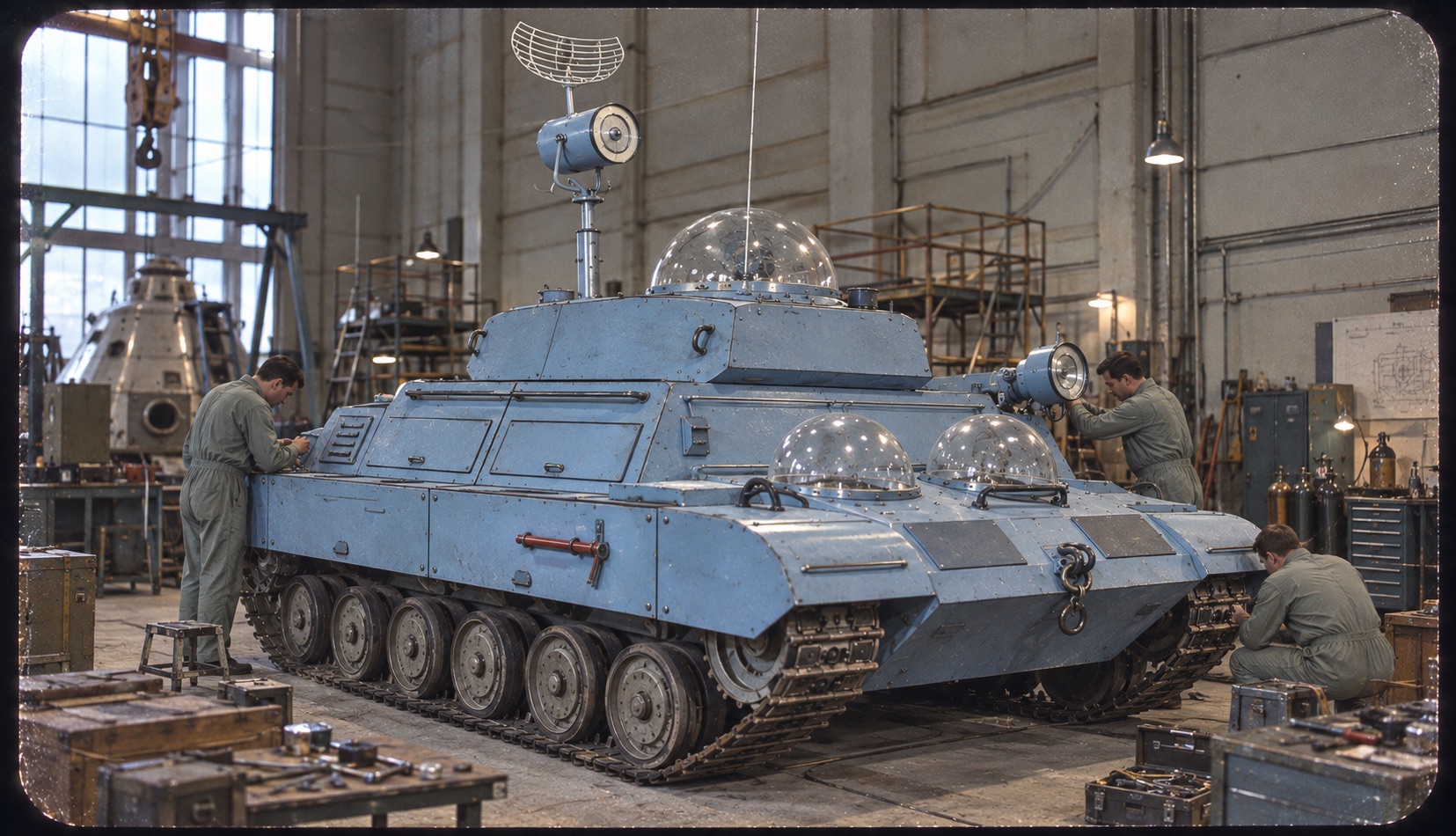
The unloading was finished before midnight on the first day; Calculus and Frank Wolff had begun installing the observatory while Tintin and Captain Haddock started assembling a Moon tank.
Imagine! Here we are, strolling on the surface of the Moon, where the hand of man has never set foot!
The telescope, the cameras and the theodolite followed; Calculus and Wolff gave their days to cosmic rays and astronomical observations, entered as they went in Record Books I and II. By the evening of 5 June the logbook notes the tank ready for use.
On 6 June, Wolff, Haddock, Tintin and Snowy drove it to the caves near the crater Ptolemaeus, where they found stalactites and, at the bottom of a crevasse into which Snowy had fallen, ice; Tintin brought him out.
Sabotage 6 June
Colonel Boris Jorgen, the Sceptre traitor of 1938, now in Borduria's service, had been hidden in the hold since before the launch. On 6 June, during the tank's outing to Ptolemaeus, he tried to seize the rocket and leave the others behind. The attempt failed, but it left the rocket damaged. Before the crew could leave the Moon, it would have to be repaired there.
Sprodj Atomic Research Centre
Astronautical Section
The 3D model could not be loaded.
Technical data Moon tank (1952)
- Type
- Reconnaissance tank, shipped in parts, assembled on the Moon
- Dimensions
- 4.7 m long, 2.5 m wide
- Cabin
- Pressurised and insulated
- Running gear
- Tracks
- Motor
- Electric, battery-powered; emergency batteries
- Endurance
- 48 hours
- Oxygen
- Reserve in cylinders
- Equipment
- Radar, radio link with the rocket, 2 searchlights, winch, hook
- Tools
- Shovel and pick, stowed on the sides
- Fate
- Left on the Moon on 9 June 1952; its oxygen cylinders taken back aboard the rocket as the last reserves; a sealed message inside for those who follow
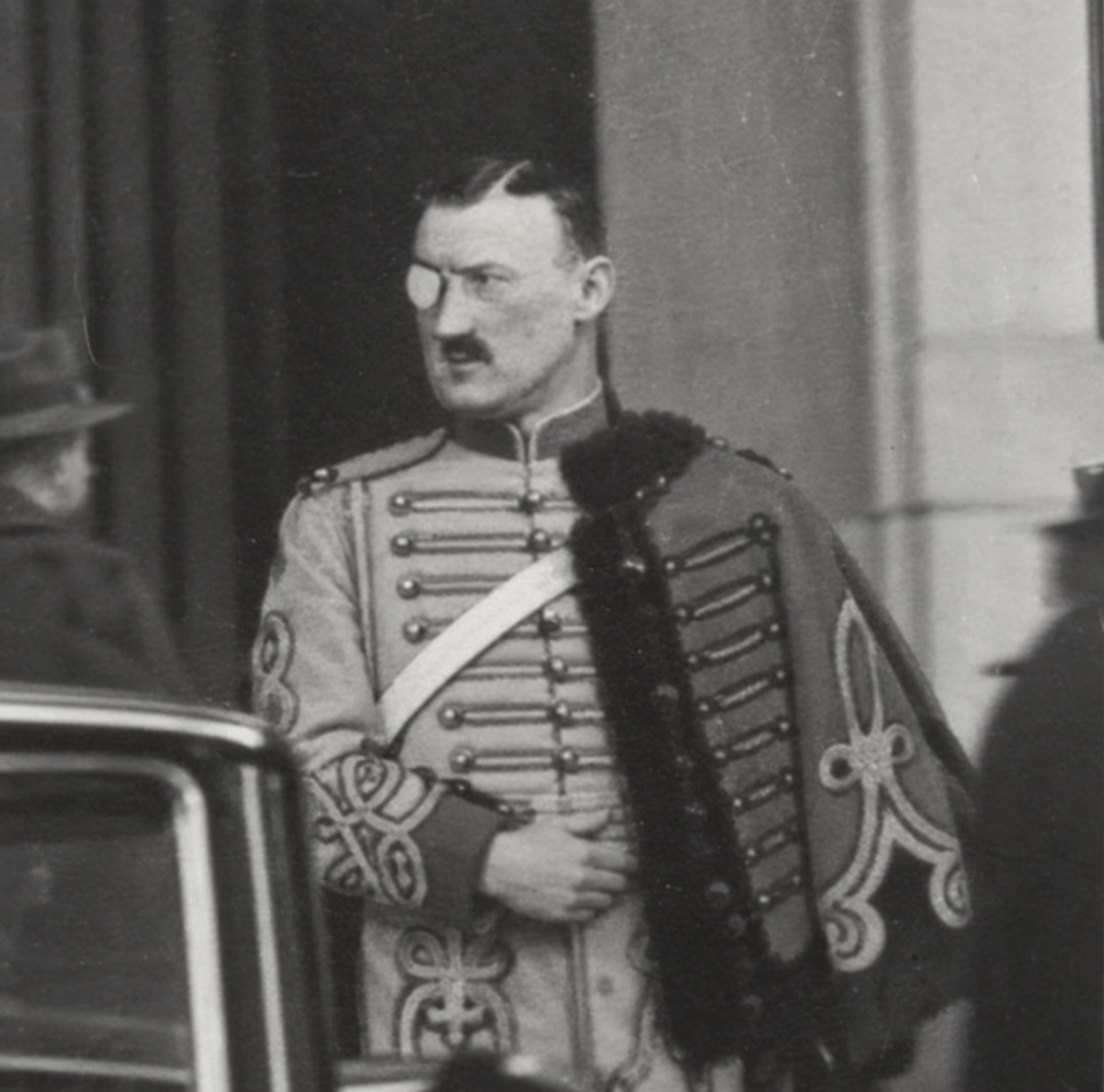
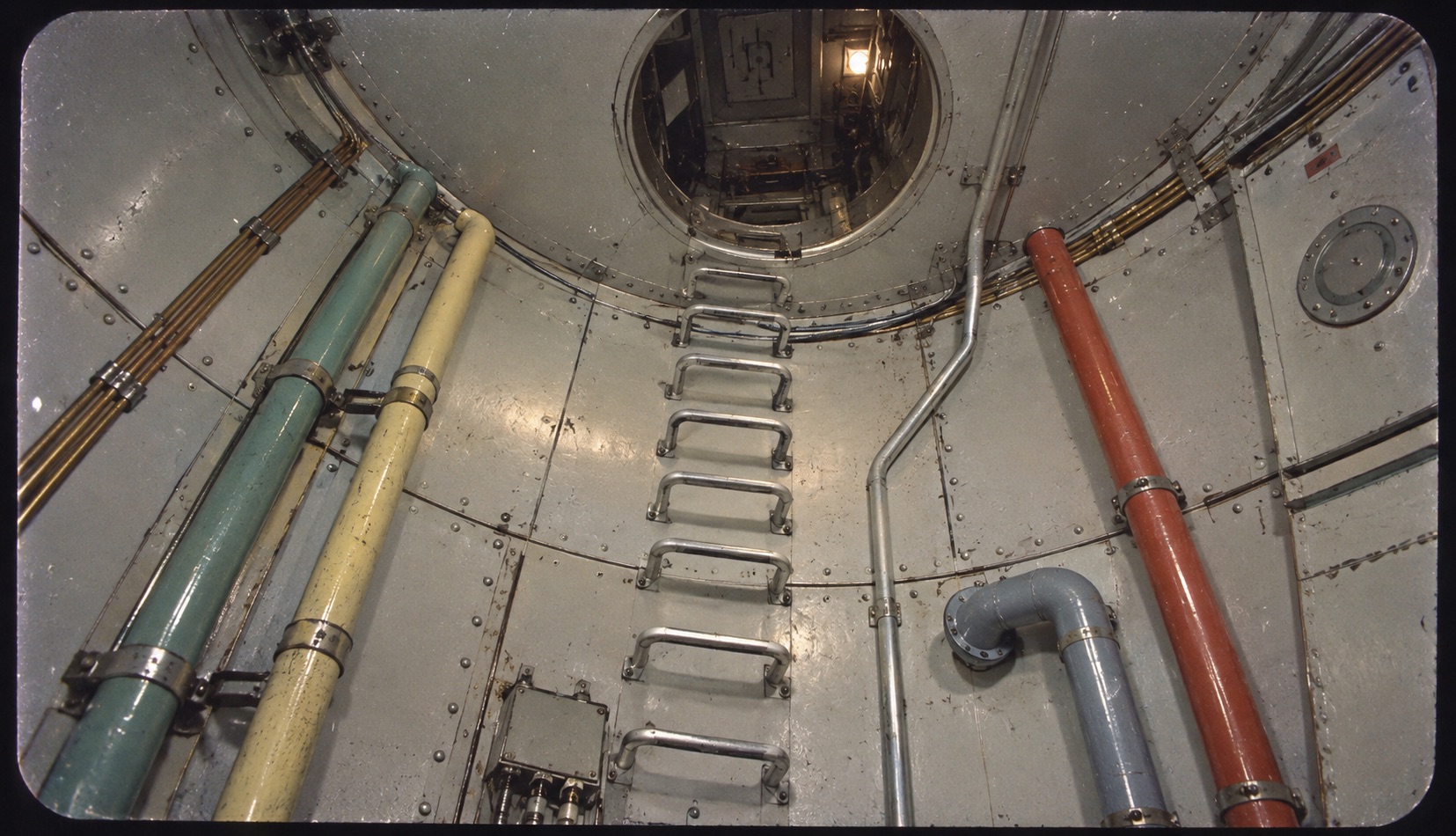
Jorgen in 1938, and the hold he travelled in
Air for Four 6–9 June
The rocket had been provisioned with air for four people and a dog. It carried six known passengers, not counting Snowy; Jorgen made seven. From the outbound flight, Captain Haddock, forbidden his pipe "on the pretext of saving oxygen", told the weeping Thom(p)sons to stop snivelling: "you're making carbon dioxide!" Rationing the air for six people, Professor Calculus then cut the fourteen-day stay to ten days. He did not yet know that a seventh was breathing.
The repairs would draw on the same air, and Calculus's estimate left no margin:
My preliminary estimate is that it will take us at least a hundred hours to effect the necessary repairs. To that must be added the time for our return journey. We have oxygen supplies for a hundred hours at the most, which means that having used our last resources to re-launch the rocket, we shall run the risk of arriving on Earth as corpses.
The repairs took seventy-two hours. The tank and the optical instruments stayed on the Moon; only their oxygen cylinders came back aboard, as the last reserves. Before coming back on board, Tintin radioed that a sealed message had been left inside the tank for those who might one day follow in their steps. Seven people left the Moon on 9 June at 16:52. The arithmetic left only one variable within the crew's reach: the number of people breathing.
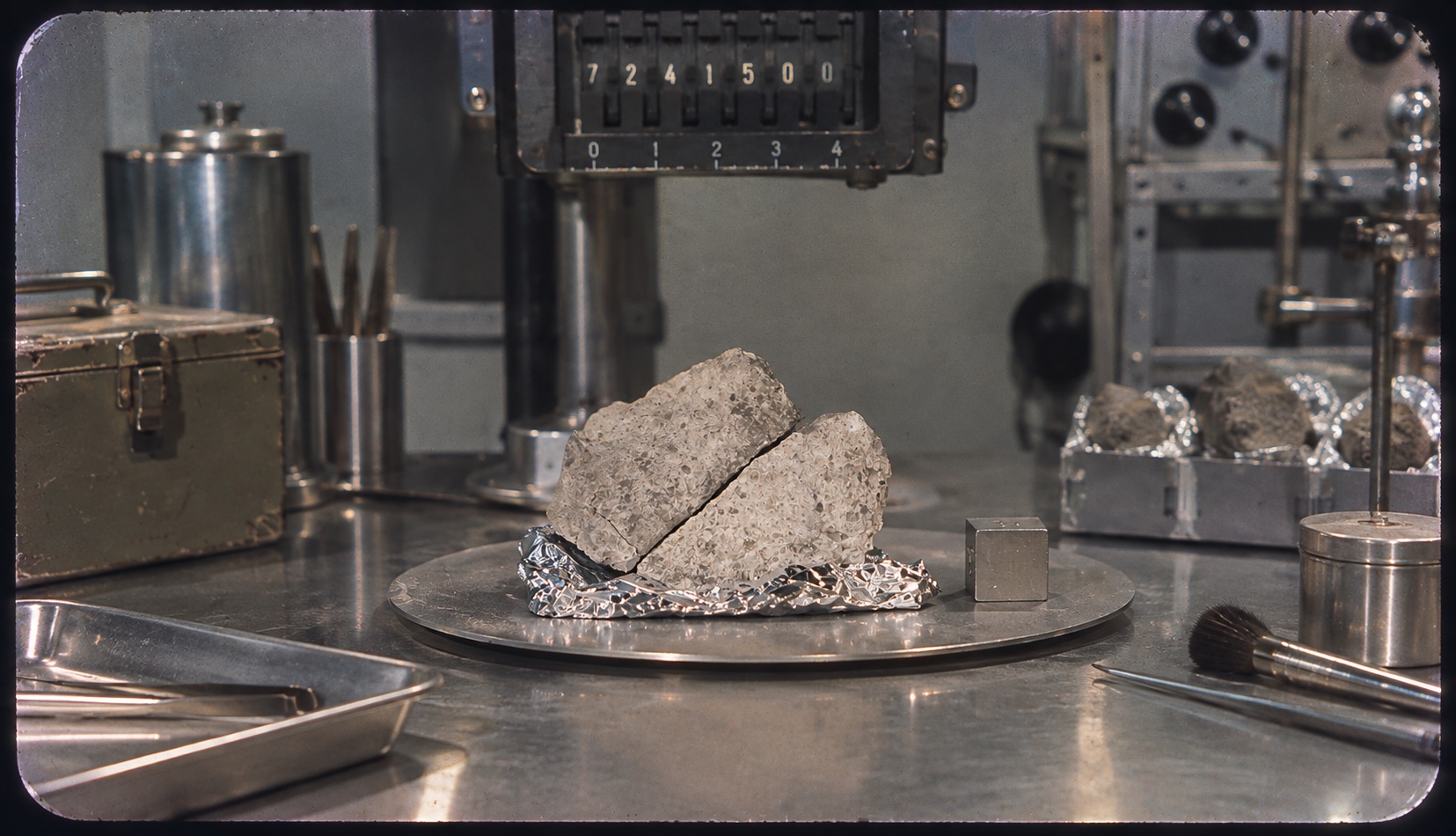
What stayed on the Moon, and what came back
Frank Wolff 9 June
Frank Wolff, an engineer in the Main Workshop, was the man the Klow network held inside. In debt, he had been approached by Miller, the foreign agent who ran it. An arrangement followed, and then the technical documents. The 1950 leak came from him.
On the way home Jorgen turned his pistol on the crew. Wolff stepped in; the gun went off in the struggle and Jorgen was killed. Six people were left aboard, and the air would still not last to Earth.
Wolff was placed under the Thompsons' watch; he waited for them to fall asleep and left the rocket through the airlock. The crew's first thought was sabotage, until they found his farewell note:
By the time you read this I shall have left the rocket…
When I am gone, I hope you will have enough oxygen to reach earth alive.
There is no point in looking for me; you know very well that I shall have vanished for ever into space.
Forgive me for the harm I have done you.
Wolff was the first Syldavian in space. The Kingdom awarded him its highest honours posthumously, without removing anything from his file.
The Return 9 June
Wolff's sacrifice bought time, not safety. About an hour from Earth, Tintin radioed Sprodj:
The air's becoming unbreathable… The last cylinder from the space-suits has been used up… The others are already unconscious… I wonder if we can possibly get back alive.
 Sprodj Atomic Research Centre
Astronautical Section
Sprodj Atomic Research Centre
Astronautical Section
Oxygen record · Mission XFLR · 3 to 9 June 1952
O₂ reserve model
Compare the crew’s oxygen consumption throughout the mission.
Parameter study
Blue = scenario; orange = fitted 1952 reconstruction. A 0.01 change in the metabolic factor shifts the baseline margin by about 42 minutes.
Each scenario starts from the fitted 1952 reference and changes the named condition; other assumptions remain fixed. The stowaways are the Thom(p)sons and Jorgen. Then adjust the controls to explore further.
Method, figures and sources
Primary source: Explorers on the Moon, p. 32 (the logbook; the stay cut, 6 days in the English edition, 10 in the French), p. 48 (the Professor’s estimate: 100 hours of repairs, 100 hours of air), p. 50 (72 hours; lift-off from the Moon 9 June 16:52).
O₂(t) = 100% − c · ∫ (n(t) + w(t) · (a − 1) + pipe) dt, with t in days. n(t) is the respiratory load (one per person, 0.2 for Snowy), w(t) the number at work, and a their work factor (1 at rest). pipe = bowls per day × 8/1440, expressed as the equivalent consumption of resting people.
c = 90% ÷ (4.2 × 14 days) ≈ 1.53% of R per person-day at rest: R was sized for 4 people and a dog over 14 days, with a tenth in hand. Snowy counts for about 0.2 of a person (metabolic scaling, mass to the power 0.75, for a dog of about 8 kg). For 6 breathing the same sum gives 9.5 days: the Professor’s “ten days”.
Chronology from the Professor’s logbook and the record: lift-off 3 June 01:34; the tank leaves for Ptolemaeus 6 June 12:35 and the attempt falls during that outing, placed here at 16:52 so that the “seventy-two hours” of repairs end at the 16:52 lift-off of 9 June; the return about 3.6 hours (3 h 34 by sciences.amatheurs.fr; Treiner’s 2024 kinematics give a shorter 192 minutes), landing about 20:28. Jorgen killed about 50 minutes out, Wolff’s step about 1 h 30 out, the last cylinder about 2 h 45 out.
The 100 hours announced at the attempt do not explain an almost empty reserve after 72 hours of repairs at an unchanged consumption rate. This reconstruction uses the recorded chronology and fits the metabolic factor during repairs to leave a small oxygen reserve at arrival: a ≈ 2.11 for the five people at liberty. The two prisoners held below (album p. 48) and Snowy remain at the resting rate. Under these assumptions, six people would run about 9 minutes short; five arrive with about 14 minutes to spare. These are model results, not recorded measurements. The factor averages work, rest and sleep over the repair period. For scale, NASA uses a life-support baseline of 0.84 kg of oxygen per crew member per day.
The Captain’s pipe: a bowl of about 2.5 g of tobacco burns roughly 3 g of oxygen (tobacco’s heat of combustion 14 to 18 kJ/g; Thornton’s rule, 13 kJ per gram of oxygen), the oxygen one person consumes at rest in about 8 minutes. An assumption of this reconstruction; Lehoucq and Mochkovitch (Mais où est donc le temple du Soleil ?, 2003) computed a pipe-smoker’s oxygen and are the source to compare.
Cabin pressure is not calculated. Extending the model to CO₂ would require the cabin’s free volume and the scrubbers’ removal capacity, neither documented in the mission record. The outward-flight dialogue mentions carbon dioxide (album p. 3).
O₂ : NASA · Design and Analysis of a Flexible, Reliable Deep Space Life Support System
CO₂ / CO : NASA · Carbon Dioxide · ATSDR · Carbon Monoxide
What the simulation shows The same reserve lasts less time when more people breathe it, or when they work harder. Shorter repairs save oxygen and bring the return forward. The margins shown depend on the assumptions: the 1952 metabolic factor was fitted to the mission account, not measured.
This model does not calculate CO₂ accumulation or its removal by scrubbers. If removal is inadequate, exhaled CO₂ can make the air dangerous well before the oxygen runs out. The smoking ban also makes sense here: the Captain’s pipe consumes O₂ and produces CO₂, carbon monoxide (CO) and smoke. The pipe control counts only the oxygen consumed; it does not predict the time the crew could survive.
Tintin lost consciousness in turn. He came round long enough to engage the automatic pilot, and the rocket brought them home on its own. It set down at Sprodj on the evening of 9 June; the rescue team revived them.
The Eclipsed Triumph 1952
The crew came home; their photographs did not. The 1952 technical report records heavily fogged film, retains two hypotheses, exposure to cosmic radiation and interference from the rocket's electromagnetic installations, and concludes: cause undetermined. Only a few partially fogged negatives could be recovered.
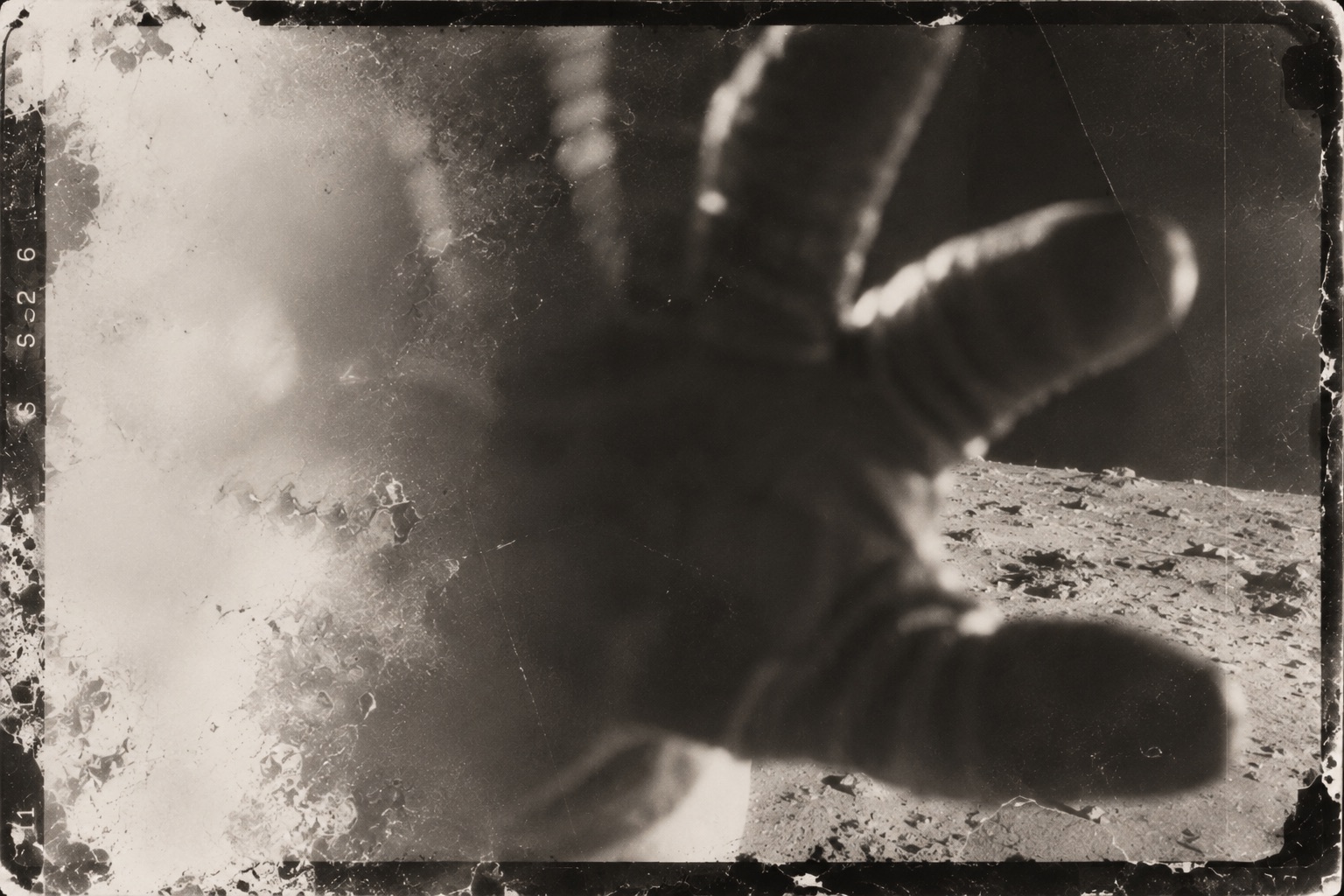
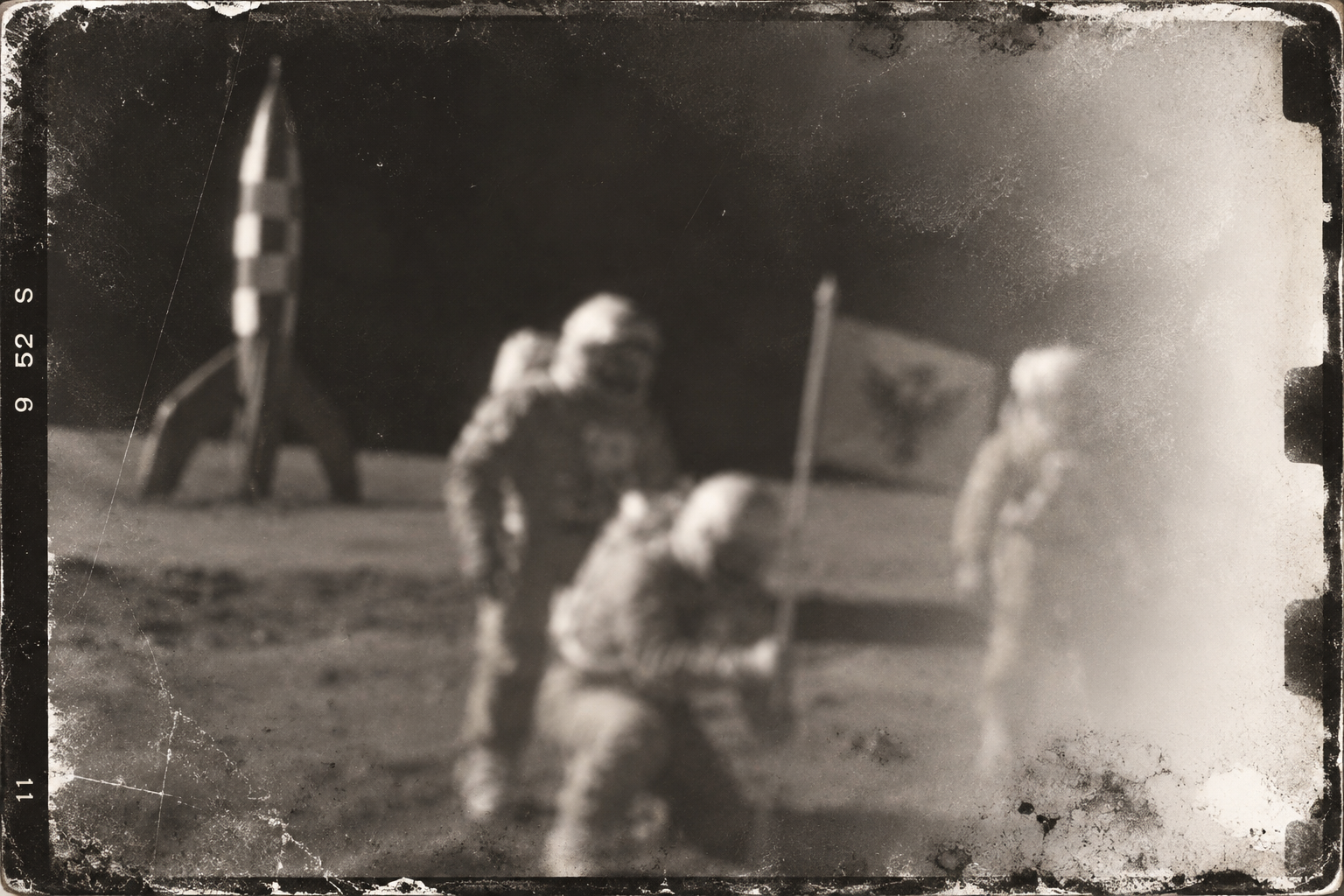
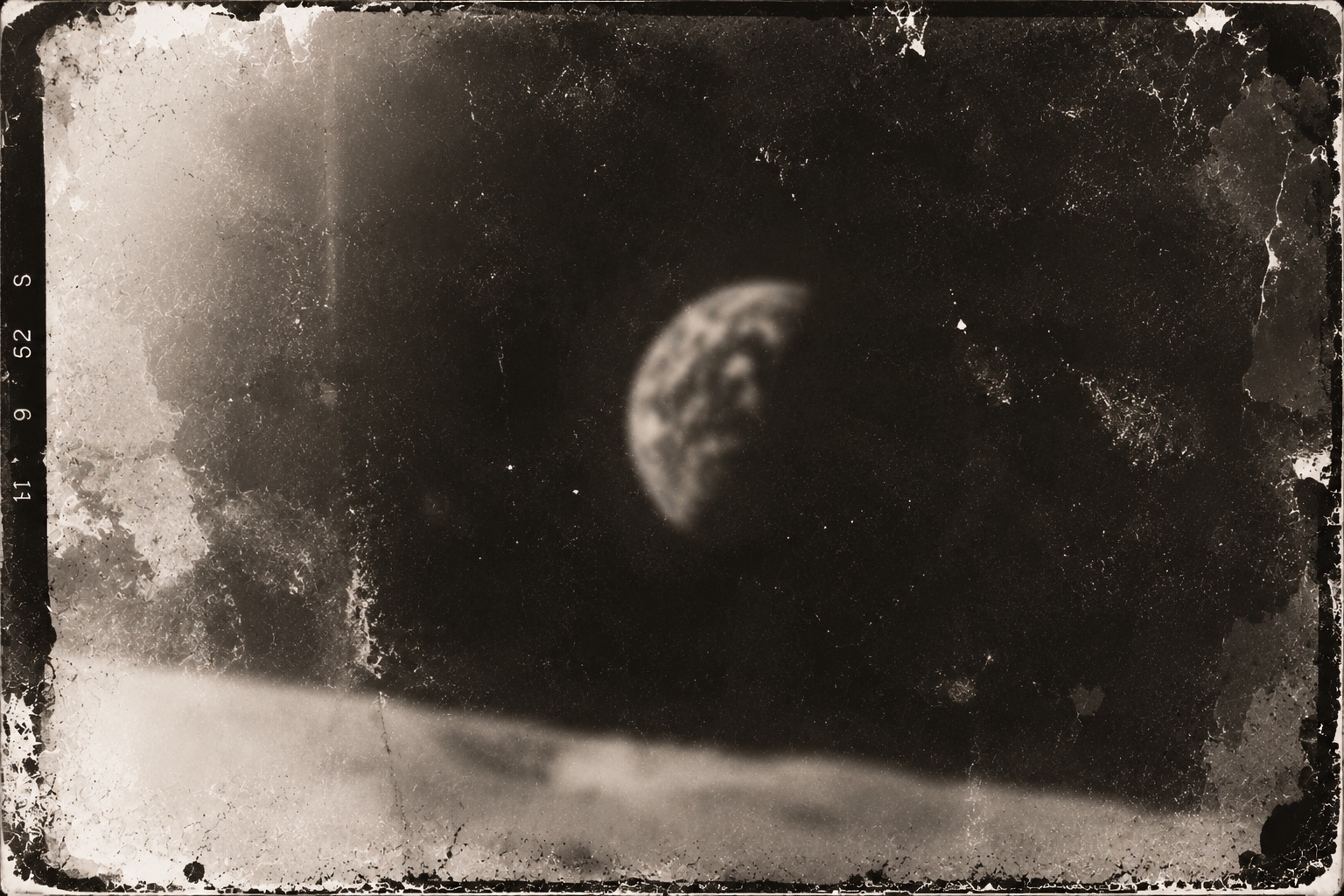
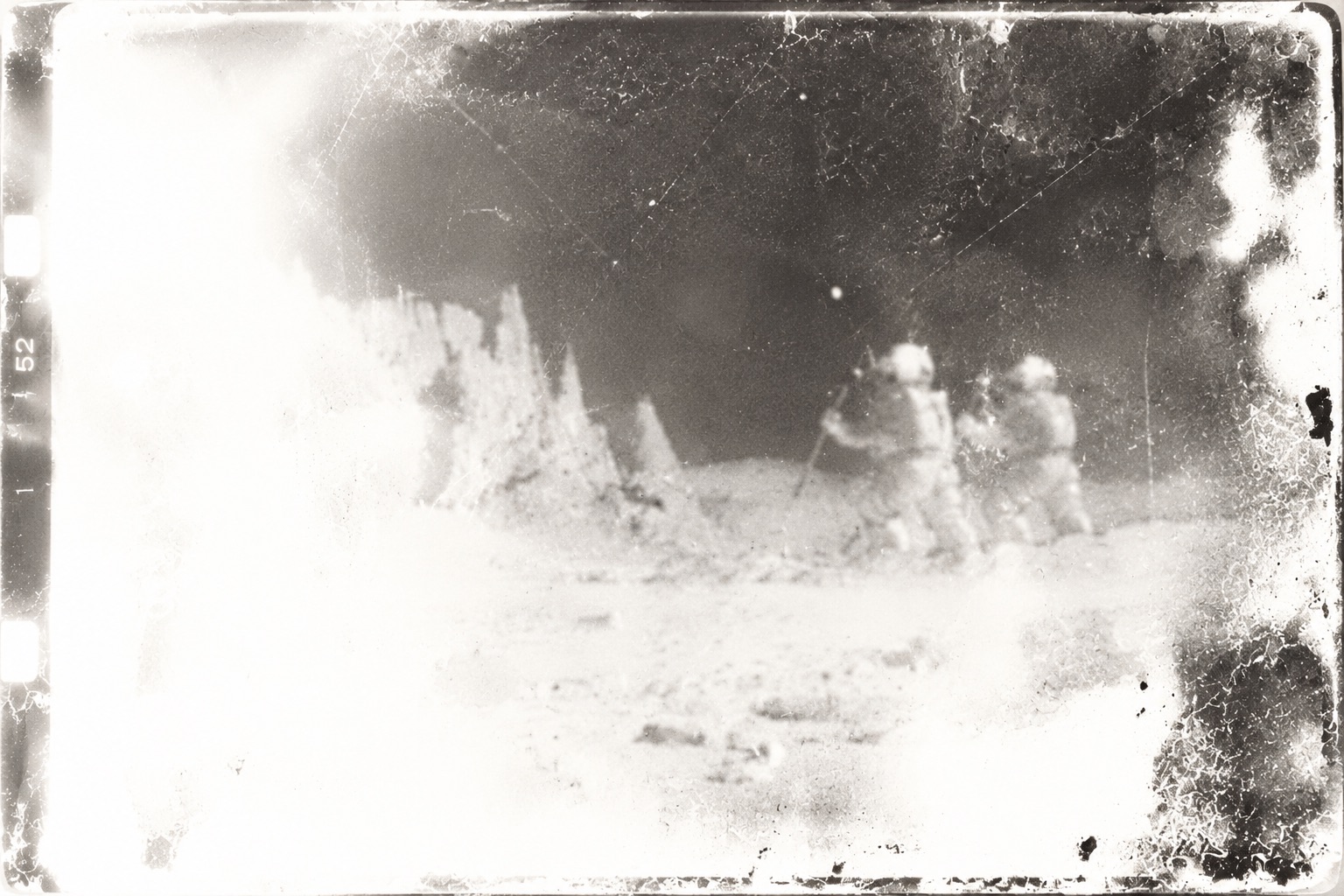
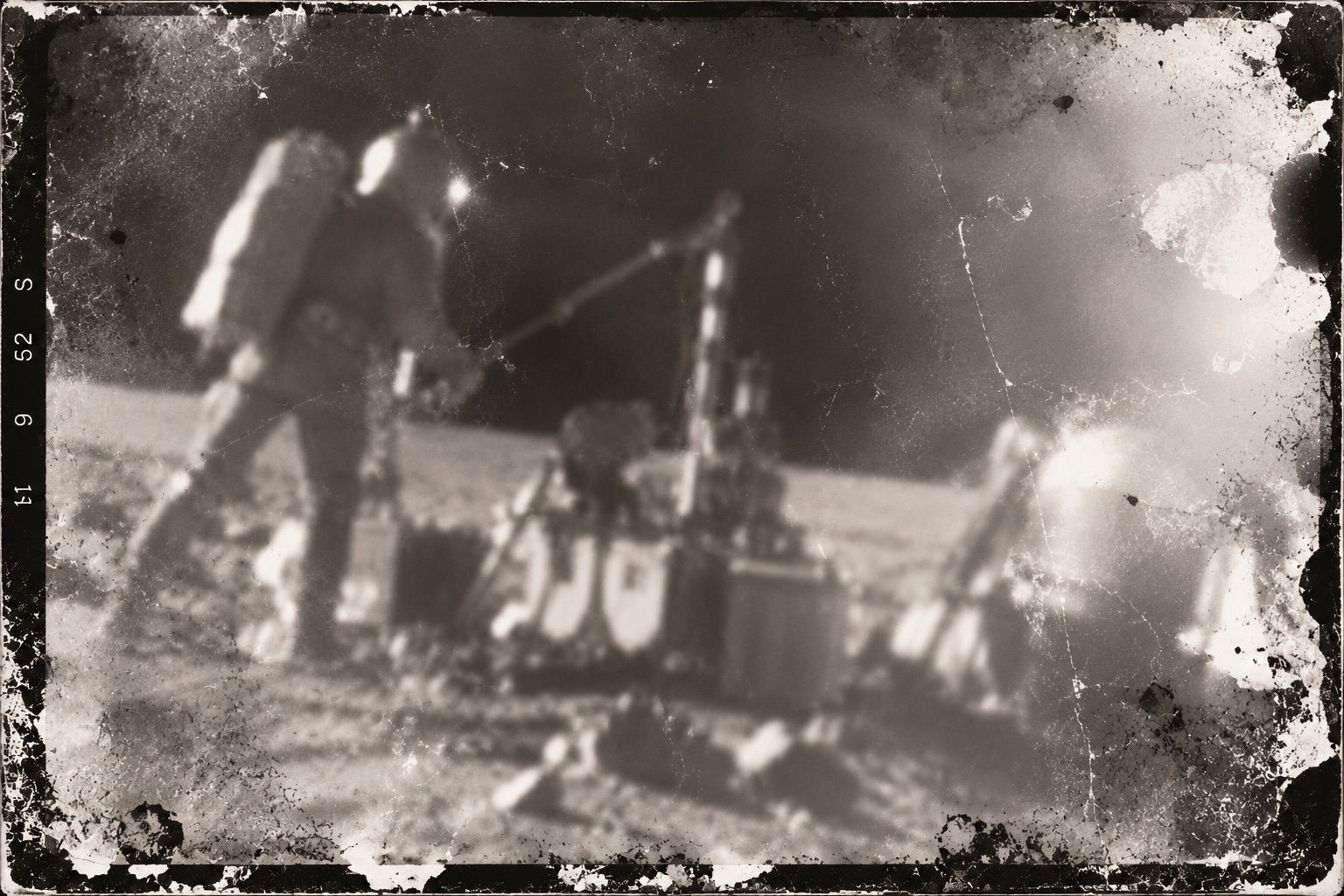
Recovered negatives, Syldavian lunar mission, 3 June 1952
Some twelve partly fogged frames are held today in the archives at Sprodj; the six shown here are among them. They are kept in climate-controlled storage, and the Royal Commission for Historical Authenticity has advised postponing any reconstruction, maintaining that “what cannot be rendered with excellence should not be rendered at all”.
Hergé's version 1950–1954
In Syldavia, the first lunar expedition entered national history at once. Abroad it was known and discussed, but almost nothing of it had been seen: it was Hergé's comic adaptations, Destination Moon (1953) and Explorers on the Moon (1954), that gave the rest of the world its lasting picture of the Syldavian rocket and its voyage. Those two dates also explain the gaps quoted abroad: sixteen years from Destination Moon to Apollo 11, fifteen from Explorers on the Moon. From the flight itself, it is seventeen.
Hergé had been following the programme from the start. His first pages on the preparations appeared in the Journal de Tintin on 30 March 1950, the year of the first test launches. It was long said that he came to Sprodj; nothing in the record supports it. He read widely on space flight, in particular the publications of Alexandre Ananoff.
In the year of the leaks, however, Ananoff's L'Astronautique appeared in Paris; several of its illustrations show arrangements remarkably close to those of the rocket then under construction at Sprodj, the flight deck in particular.
From 1951 the Studios worked from a model. Arthur Vannoeyen built a detailed mock-up of the rocket's interior, from which Bob De Moor drew the sets from every angle, so that the crew's movements held from one panel to the next. In February 1952 Hergé took the model to Paris to show it to Ananoff.
Publication in the Journal de Tintin had stopped on 7 September 1950, as the programme went under secrecy. It resumed only on 9 April 1952, less than two months before lift-off, and ran until 30 December 1953. Wolff's farewell note appeared there in full; for the album, under pressure from Casterman and from Catholic circles, Hergé substituted the hope of a miracle.
In Syldavia the albums never stood in for the facts: the 1952 mission already belonged to national memory. Elsewhere it went otherwise. A comic reads as a story, and for most of its readers the first journey to the Moon remained what Hergé had made of it: a precise narrative, rather than an event whose images they had seen.
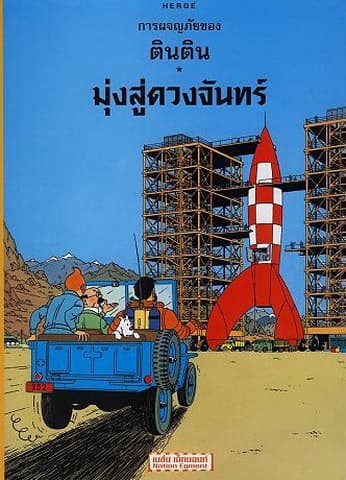
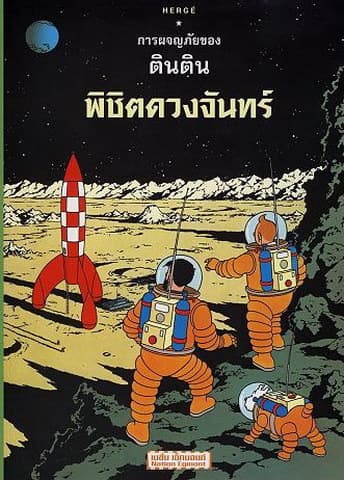
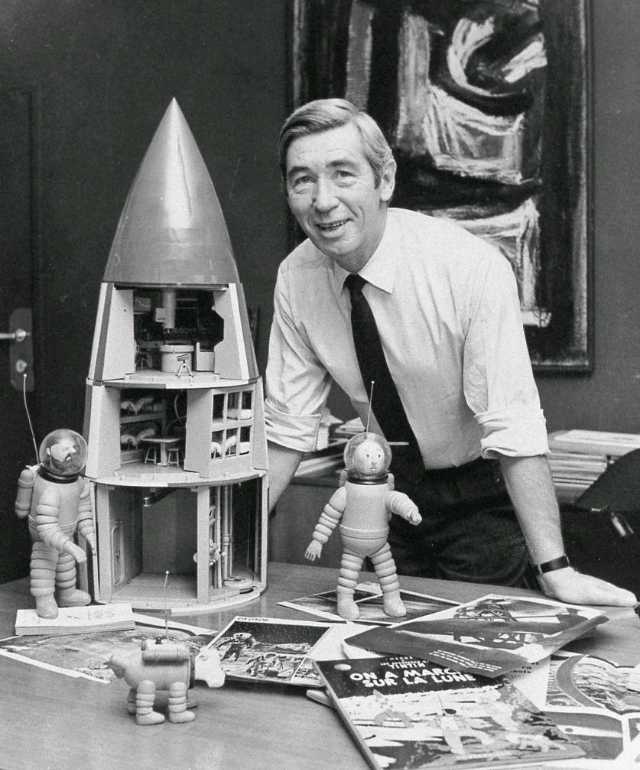
Hergé’s comic adaptations, in their Thai editions, and the model their interiors were drawn from
The Second Landing 21 July 1969
Seventeen years later, on 21 July 1969, Neil Armstrong and Buzz Aldrin took their celebrated steps.
The event, admirably orchestrated by the American agencies, was broadcast live to more than 600 million viewers across all continents, a record for its time. The idea took root everywhere that the United States had been the first to walk on the Moon; Syldavia, true to its scientific discretion, observed in silence.
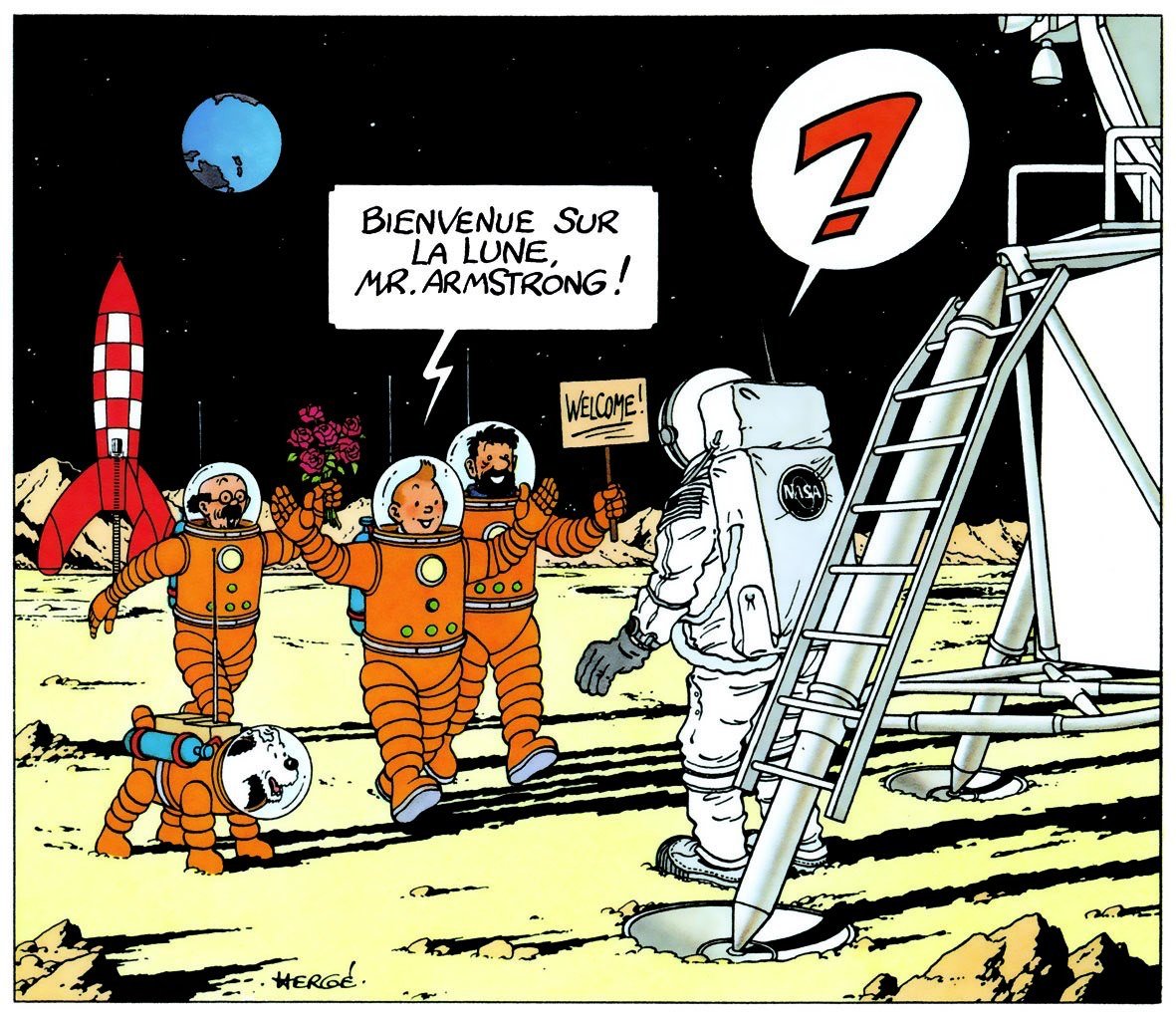
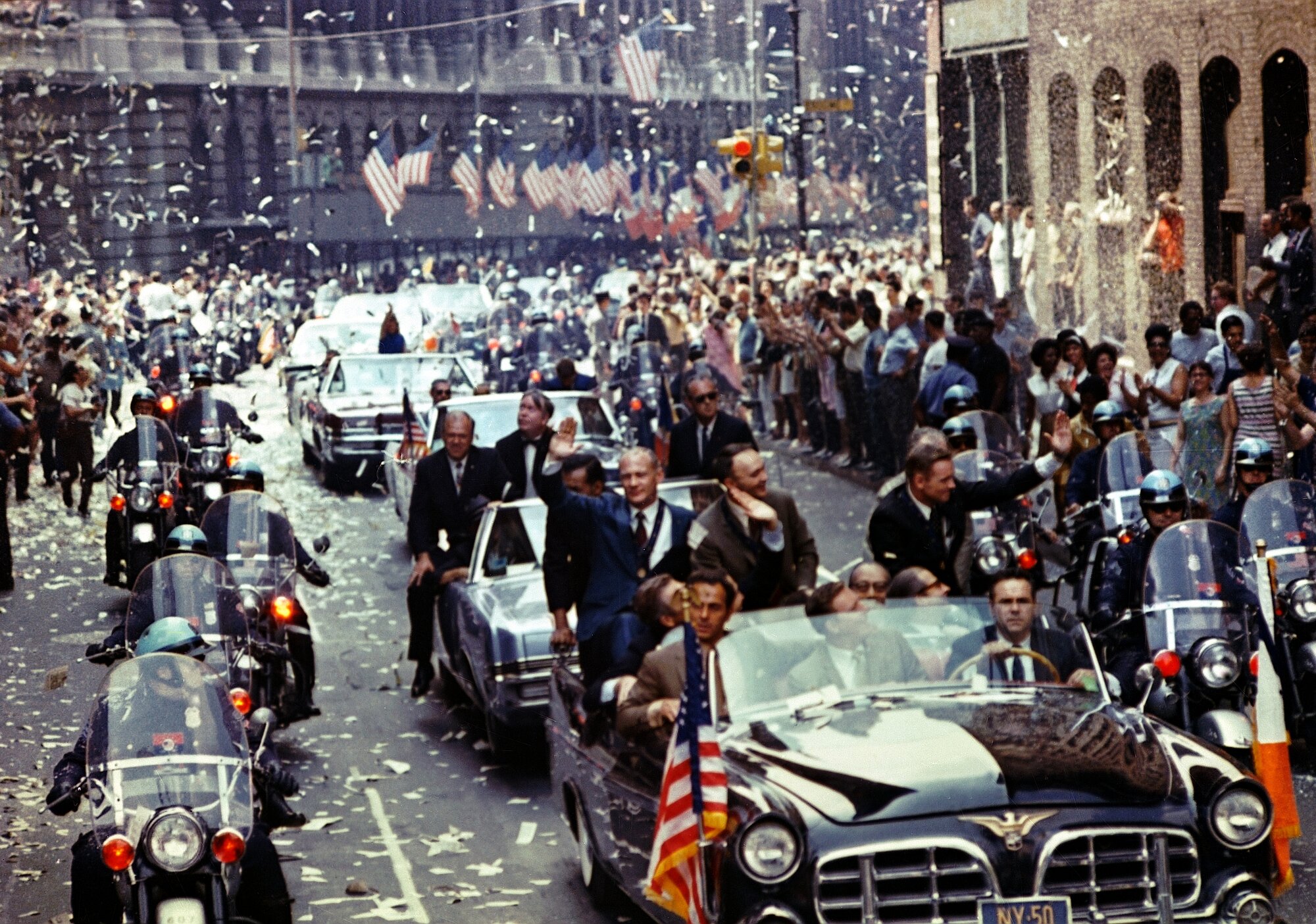
Two welcomes, 1969: on the Moon, drawn by Hergé; in New York, down Broadway
Beneath the sound of drums, the truth ploughs in silence
Recognition 1959–2025
Belgian accounts also preserve a trace of this precedence. Dirk Frimout reached space on 24 March 1992, almost forty years after Tintin, Haddock and Calculus. In its history of Belgium’s participation in the European space adventure, the European Space Agency describes him as the first Belgian to travel into space, with the qualification “after Tintin”.
For decades, certain sceptical minds continued to question the American achievement, convinced that the official account concealed another truth. They were not entirely wrong, but not for the reasons they imagined: the achievement they believed to be imaginary had simply taken place earlier, under the Syldavian flag.
Official recognition from the United States themselves came from another quarter. It took seventy-three years from the landing, and it came not through a diplomatic note or a scientific congress, but in the margins of a comic book.
Explorers on the Moon had reached NASA before Apollo: members of the agency's staff read it soon after its English publication in 1959, the agency told franceinfo. Its wider success came after Armstrong's steps: it rose to the top of Tintin's sales rankings and has stayed in the top three since, with nine million copies sold according to its publisher, Casterman.
The record has grown since. Alongside the fogged negatives held at Sprodj, the clearest pieces have come from the American astronauts themselves: between 2009 and 2015, several of them acknowledged in their own hand that Tintin had walked on the Moon before them. Buzz Aldrin's inscription is the plainest:
First moonwalkers after Tintin
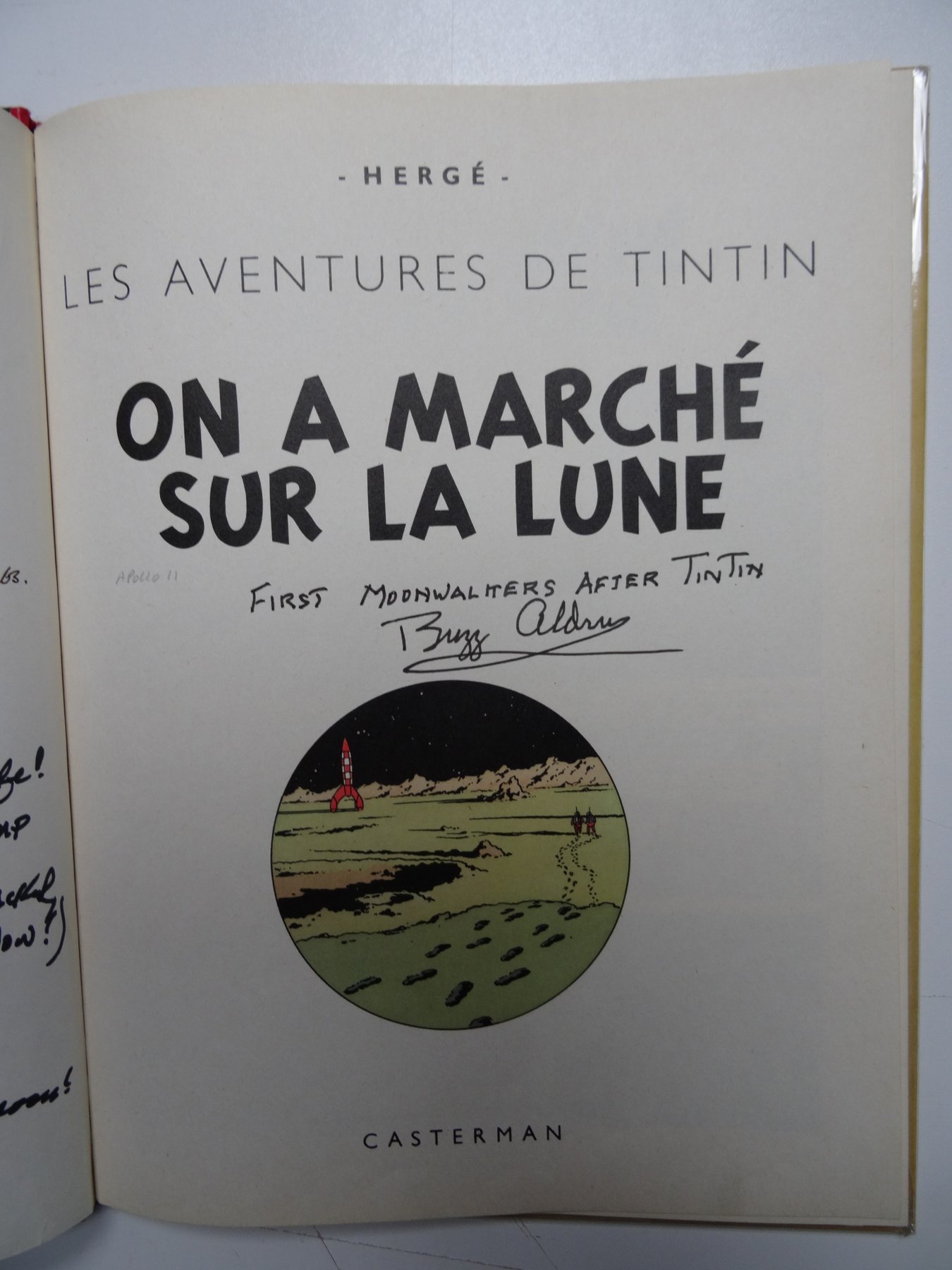
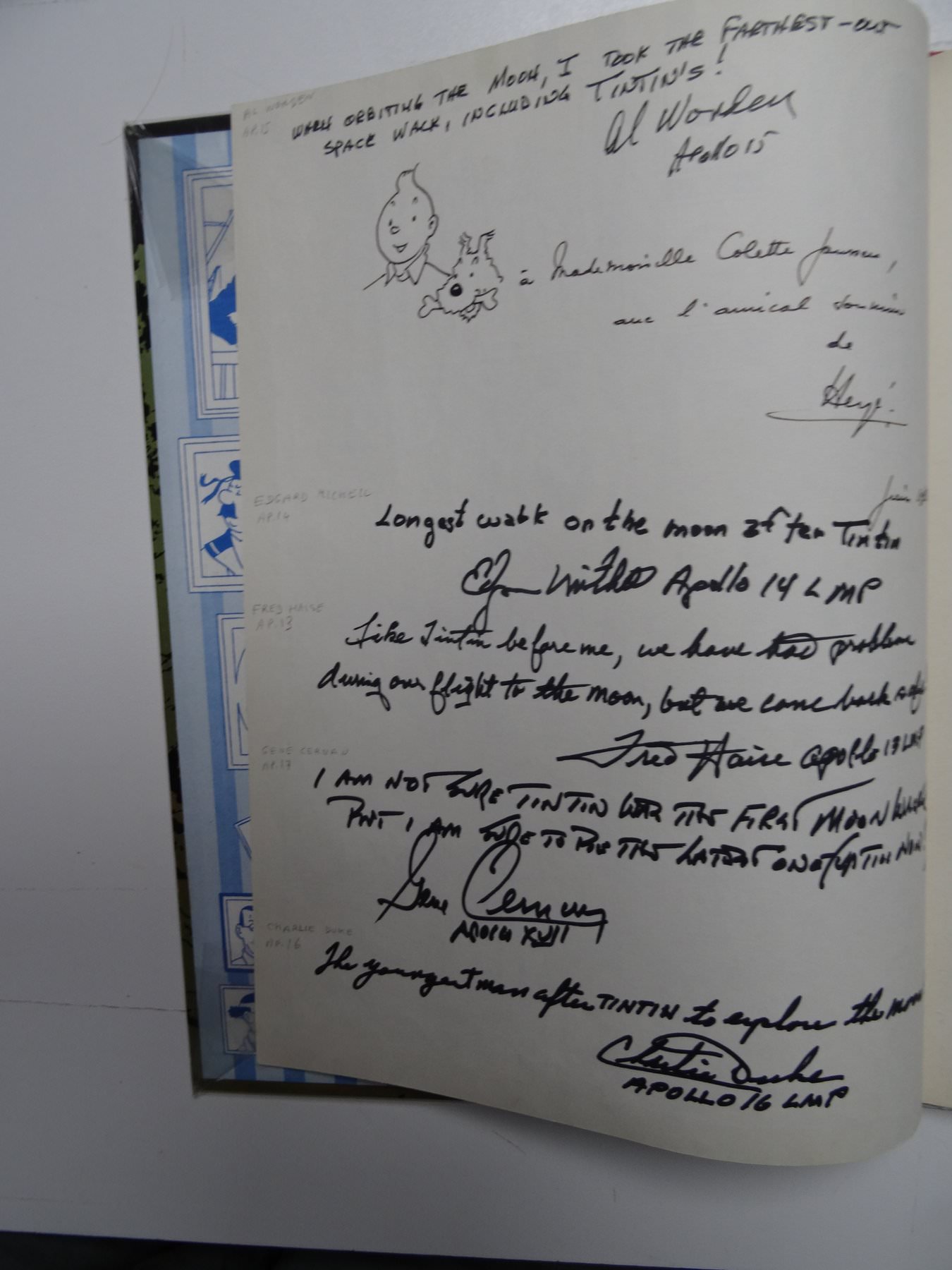
The album sold at auction in 2025
That album, a 1962 edition signed by Hergé and six Apollo astronauts, set a world auction record in 2025 at ₭89 million (about €71,000). The Consulate's report on the sale gives all six testimonies in full.
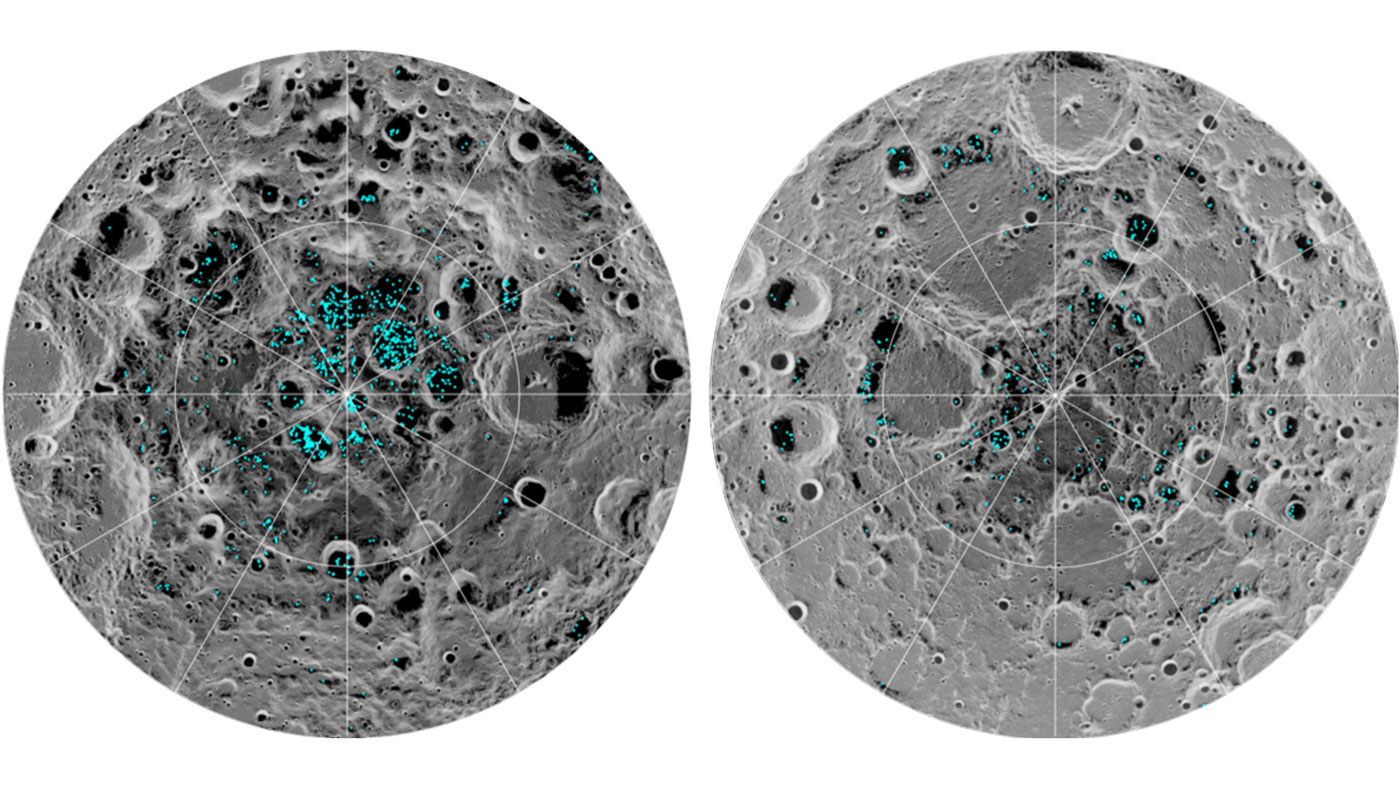
The steps were recognised by hand; the ice by instrument. Professor Calculus's logbook records it in a crevasse near Ptolemaeus in June 1952; the first direct observation of water ice on the lunar surface was published in 2018 by Shuai Li's team, who identified it in the permanently shadowed craters of both poles in data from NASA's Moon Mineralogy Mapper aboard India's Chandrayaan-1. The Kingdom notes the sixty-six years, and does not press the point that its own ice lay near the equator.
Memory Every 3 June
Every 3 June, Lunar Triumph Day brings ceremonies at Sprodj, model rocket launches and televised re-enactments of the lift-off, and new commemorative stamps are issued.
At Sprodj itself, each June the Sprodj Wanderers play a ceremonial Lunar Triumph fixture, their supporters rising in a slow, floating “lunar wave”. The Syldavian language still carries scientific vocabulary introduced by the programme, together with French and Dutch forms brought by its Belgian scientists. The scientific tradition continues too: the Royal Meteorological Observatory presents its HVEGHI-1 Earth-observation programme as its heir.
The Royal Cinematheque’s June 2026 retrospective From Sprodj to the Stars brought before the public, for the first time, colour footage from the research facility that had long been classified, alongside a restored print of the 1954 documentary The Men of Sprodj, within a programme devoted to achievements of which no images remain. On Pelflix the series Sprodj: Shadows of the Stratosphere places the engineers of Sprodj, Wolff foremost among them, at the heart of its story.
The tributes that celebrate the rocket have been less faithful to its crew. The LEGO set of 2026 reproduces the rocket piece by piece and five of its travellers as minifigures; the Brussels Airlines livery too carries the rocket and some of its crew. Neither shows Frank Wolff.
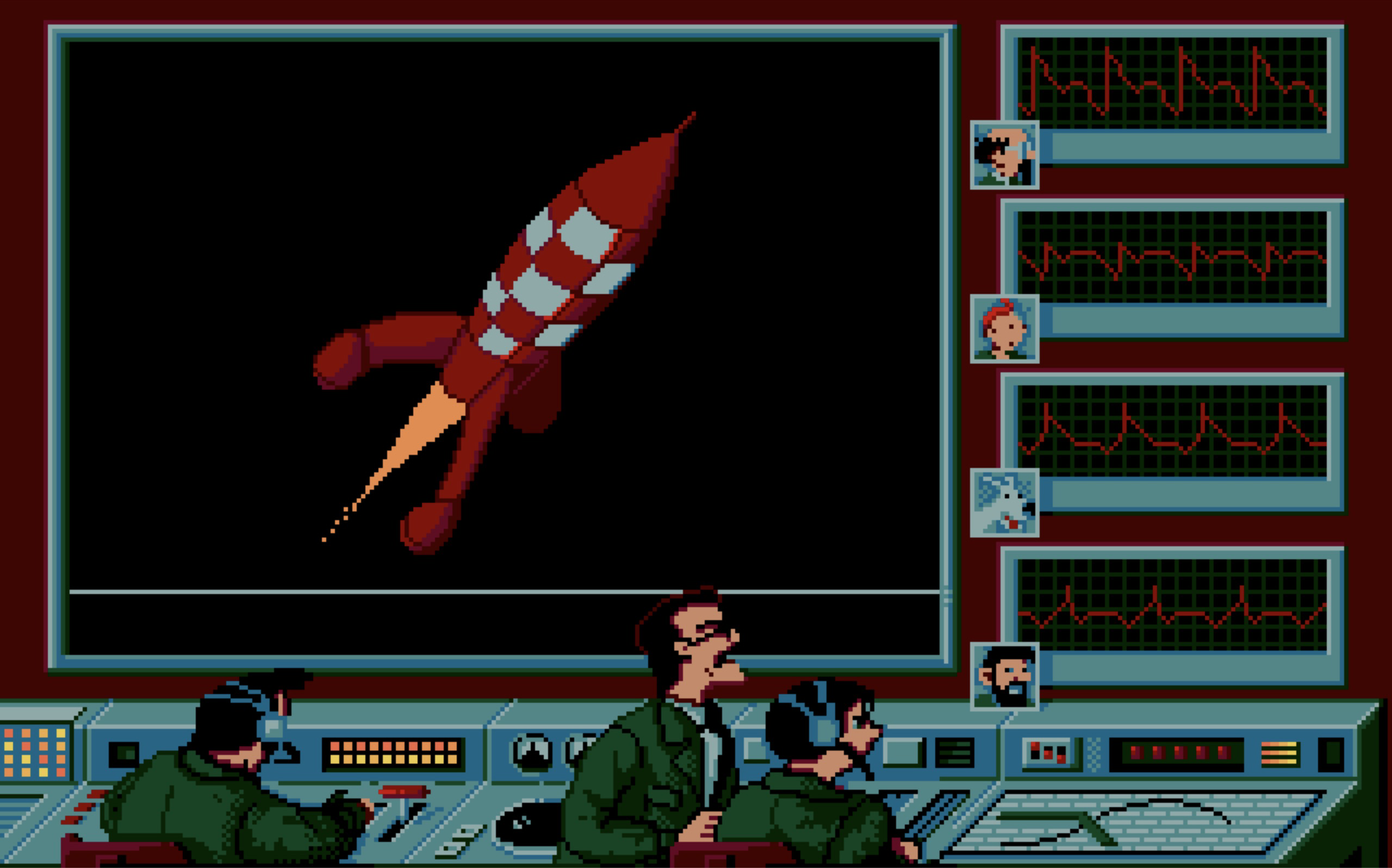

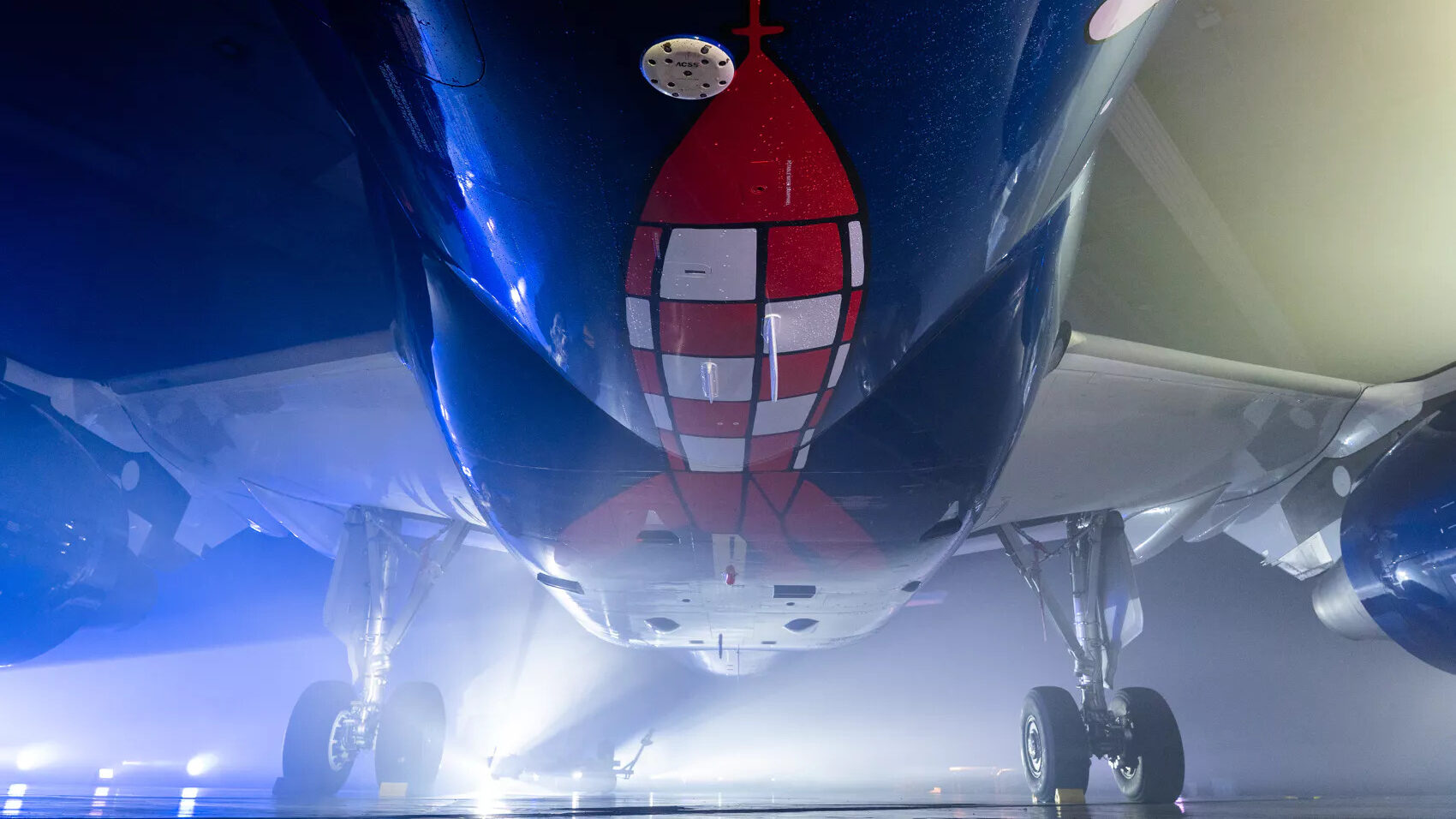
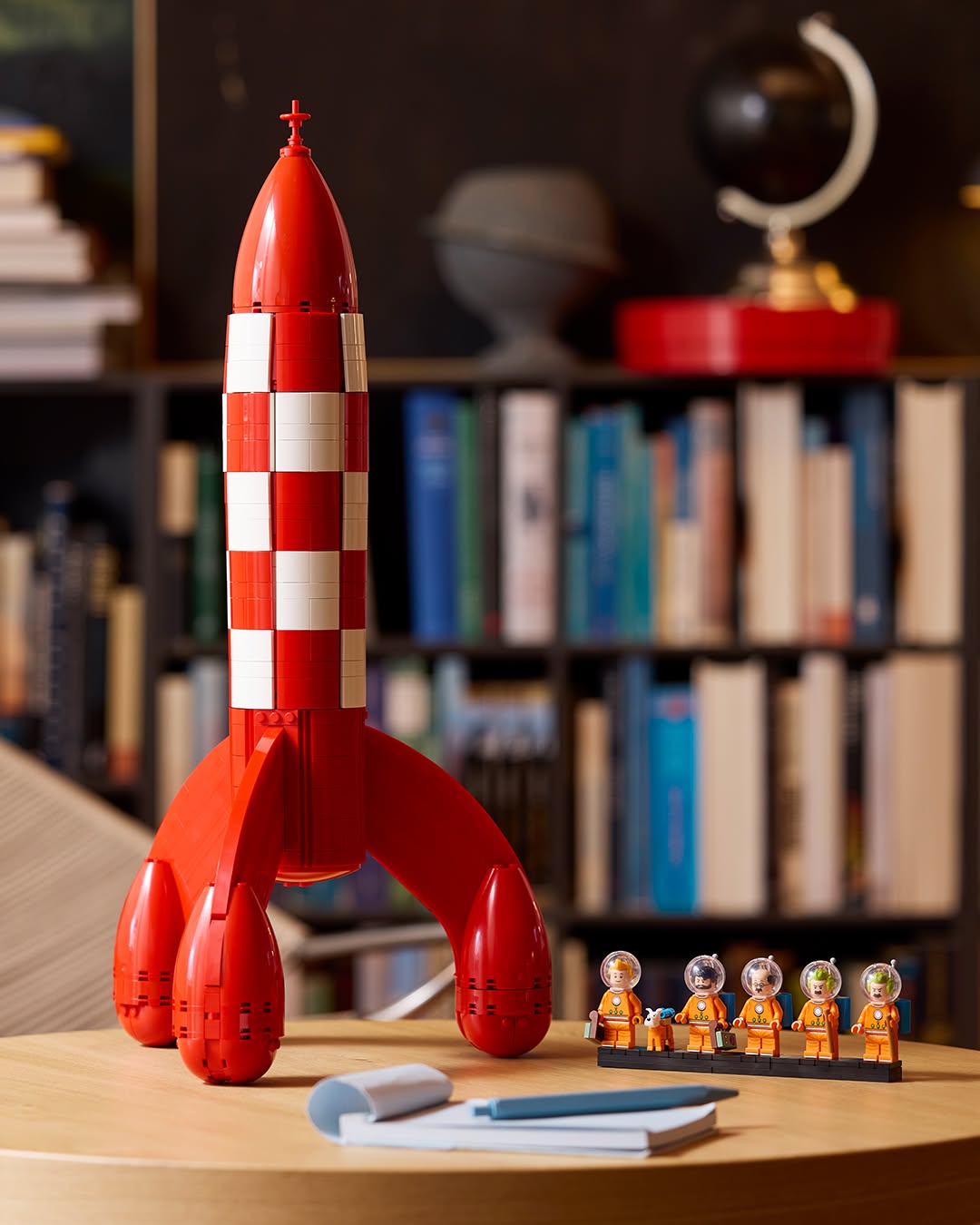
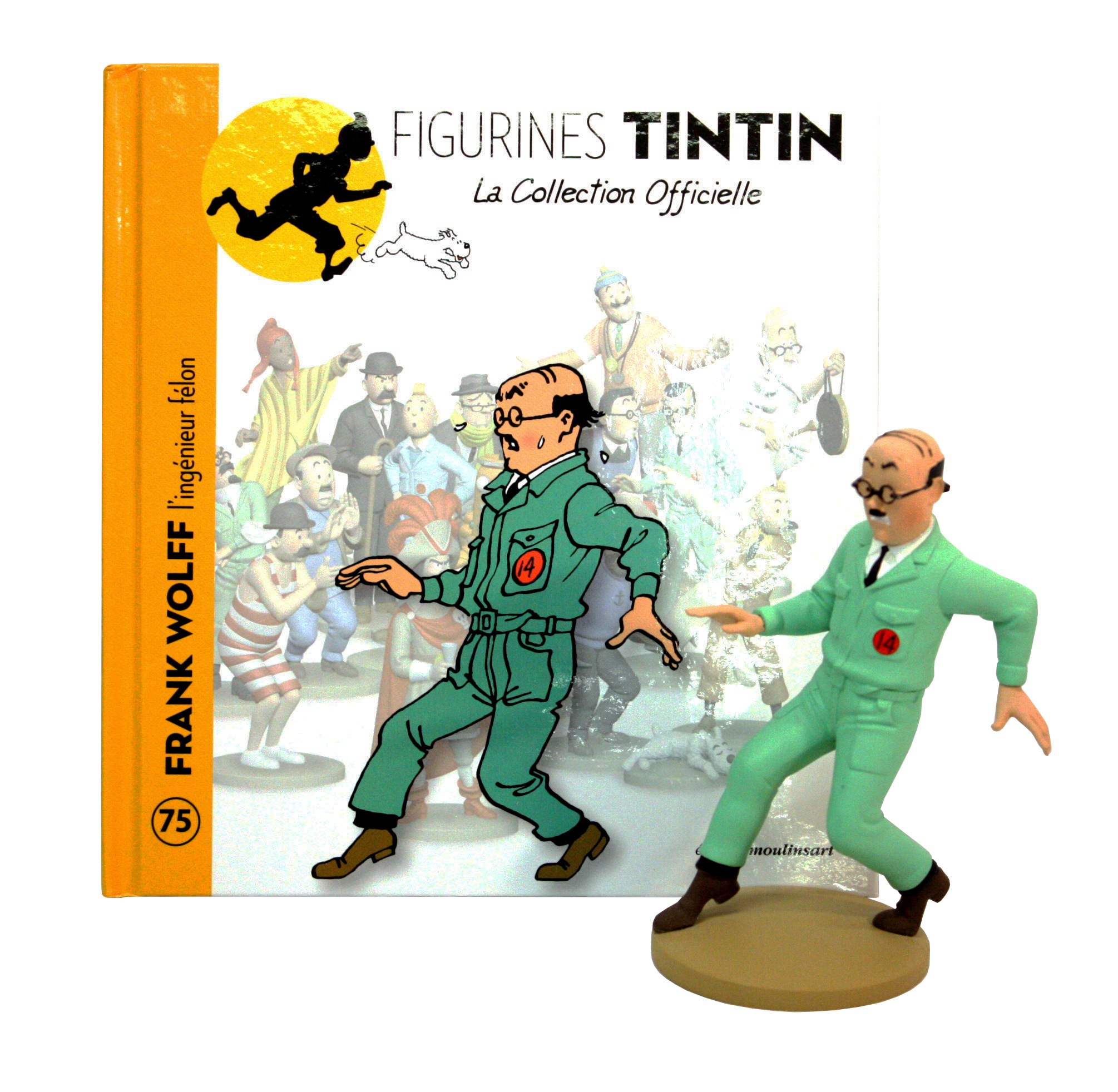
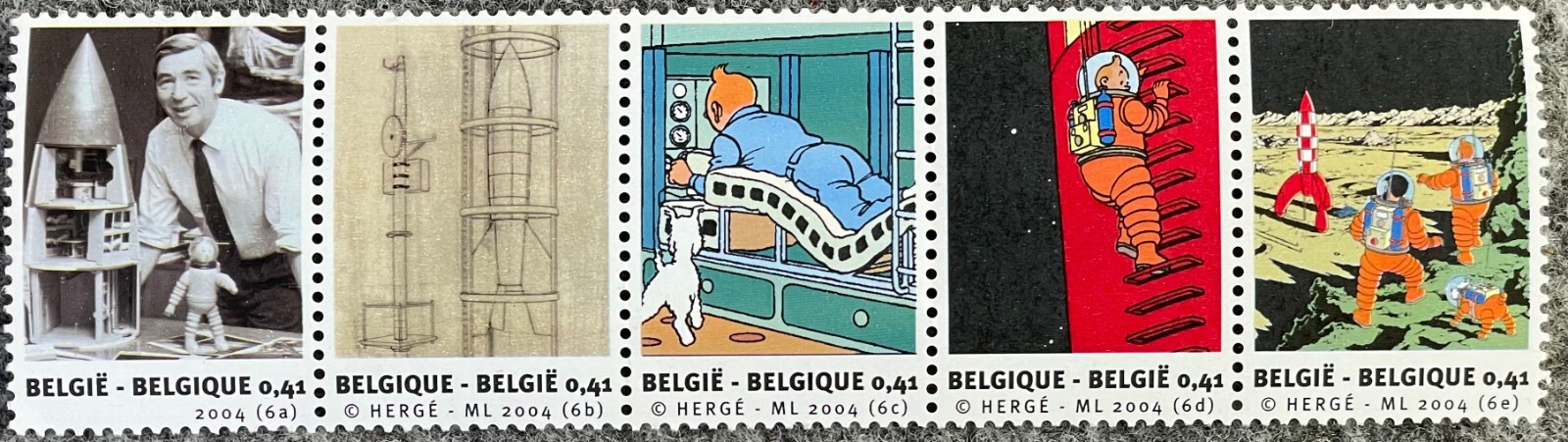
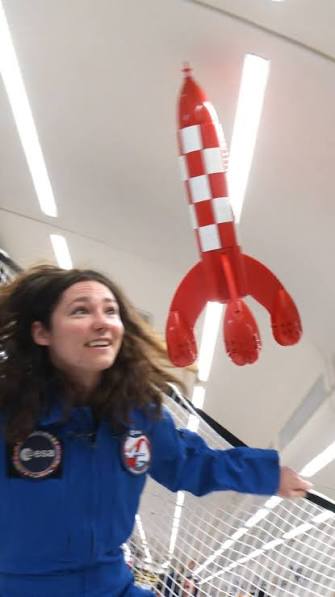
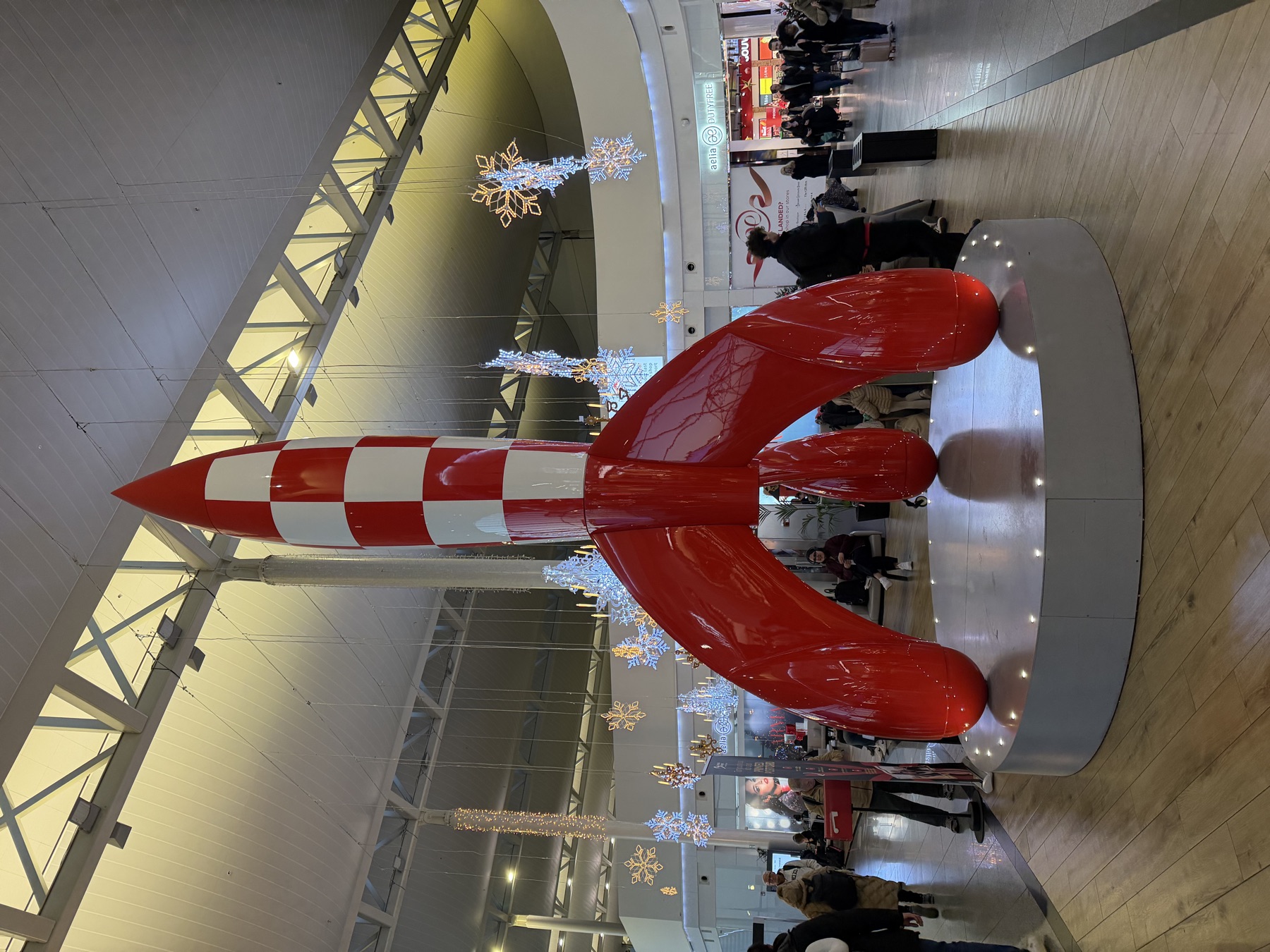
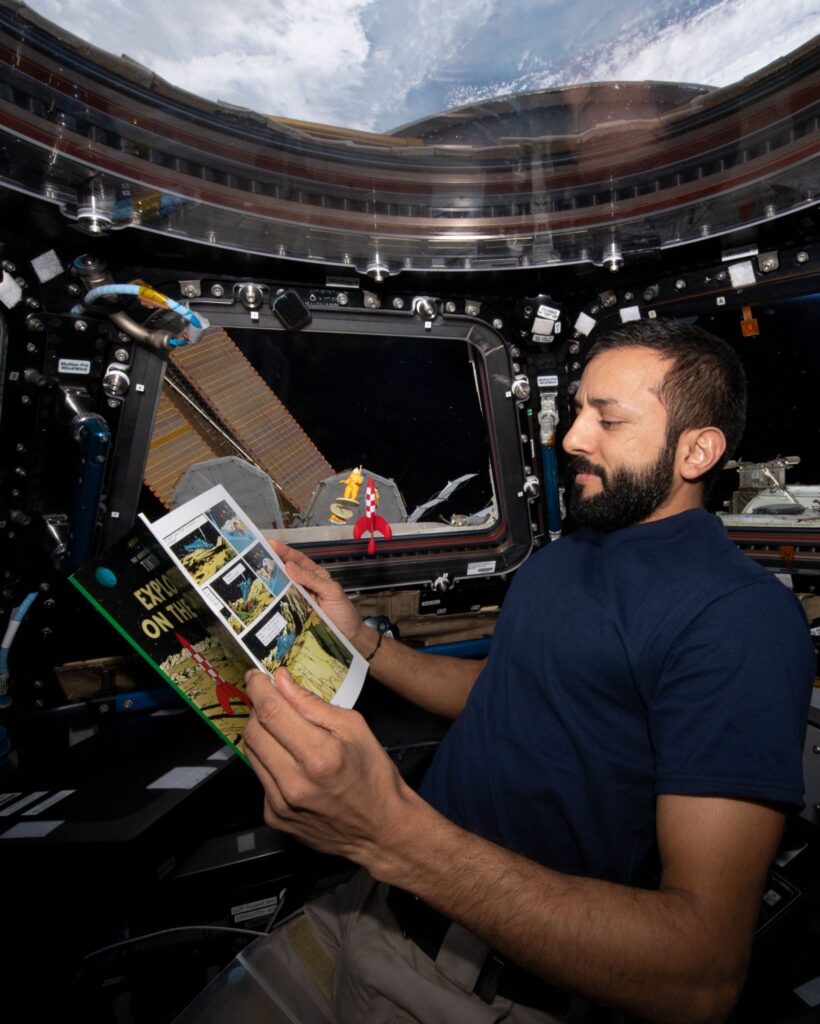
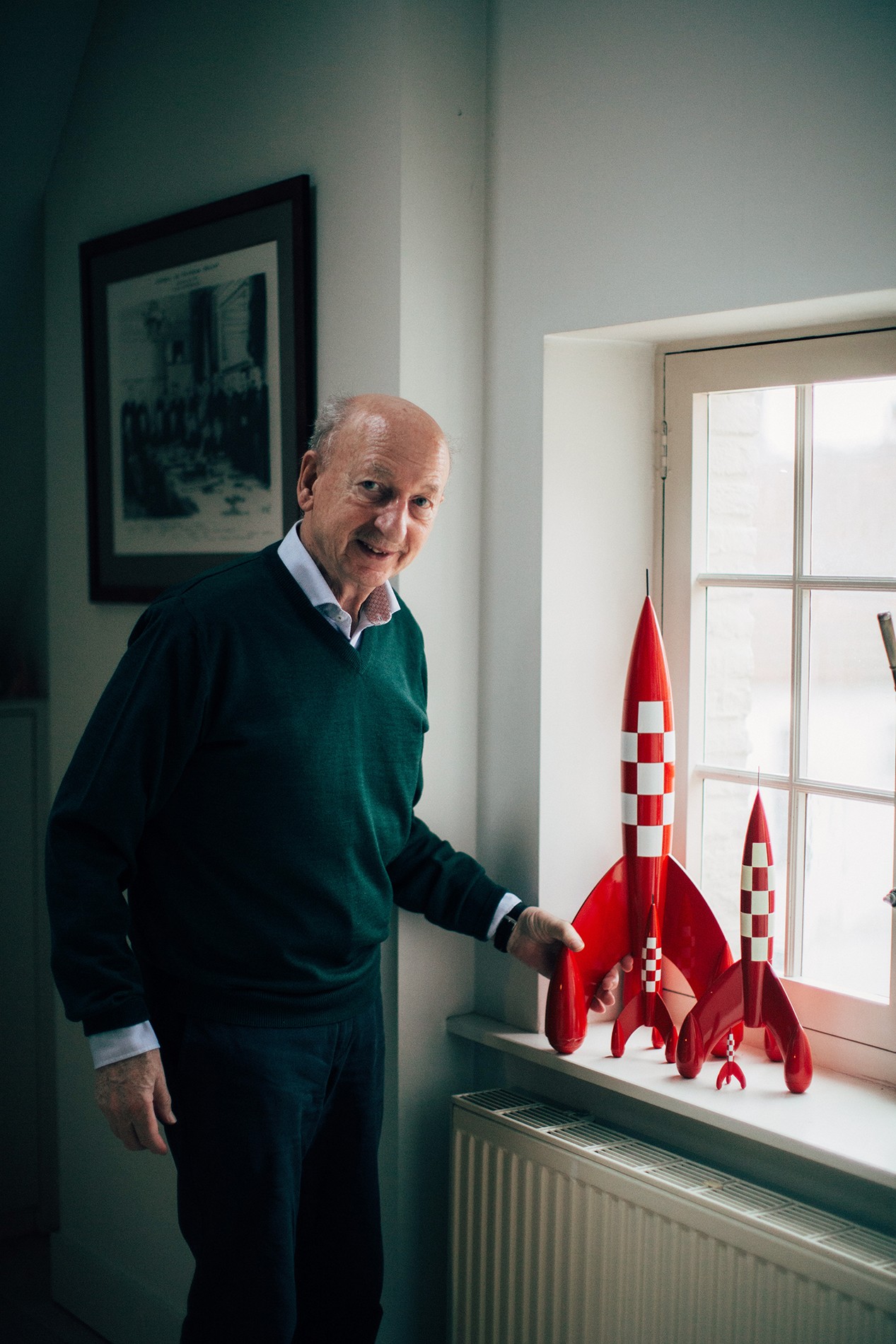

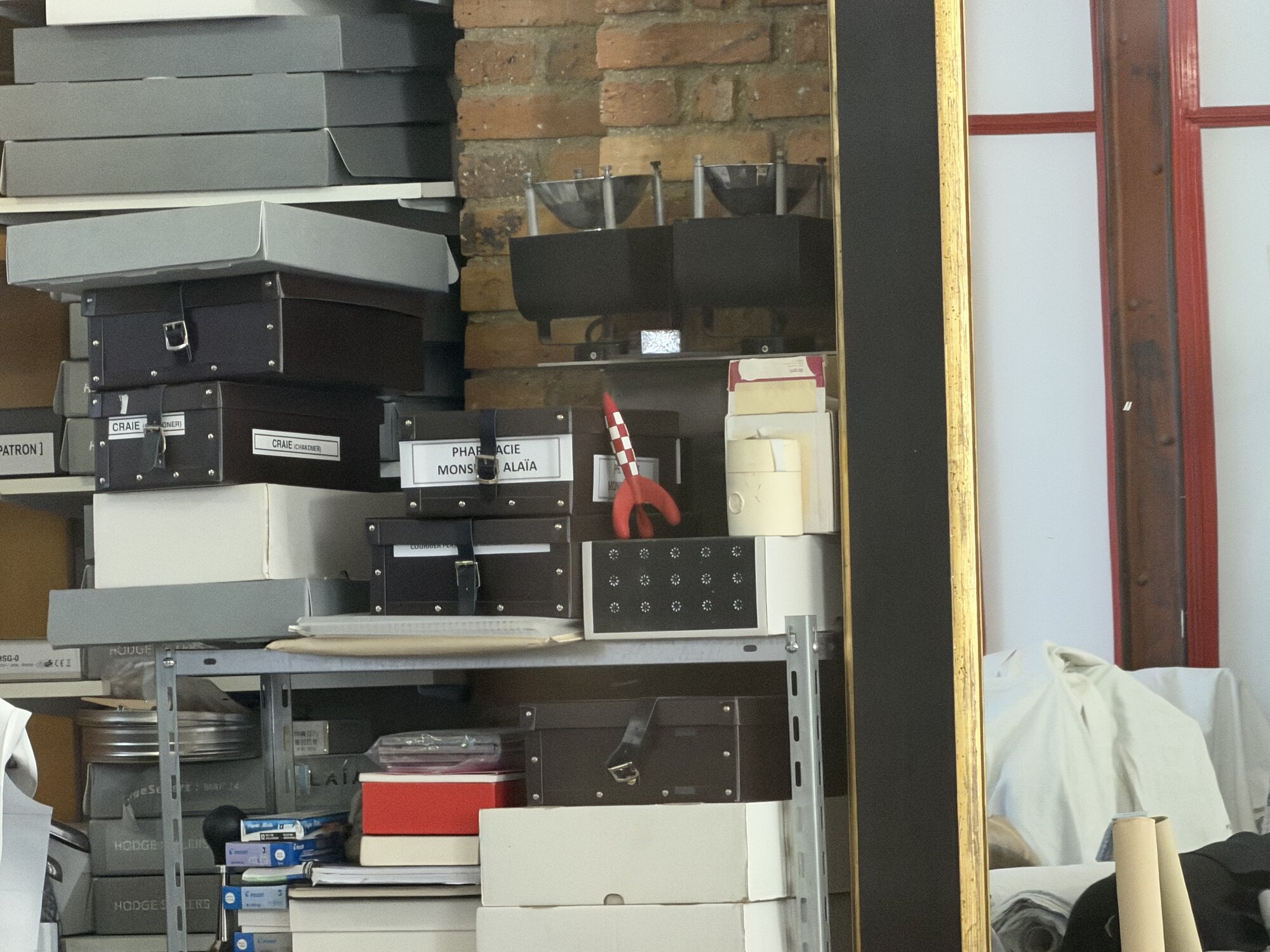
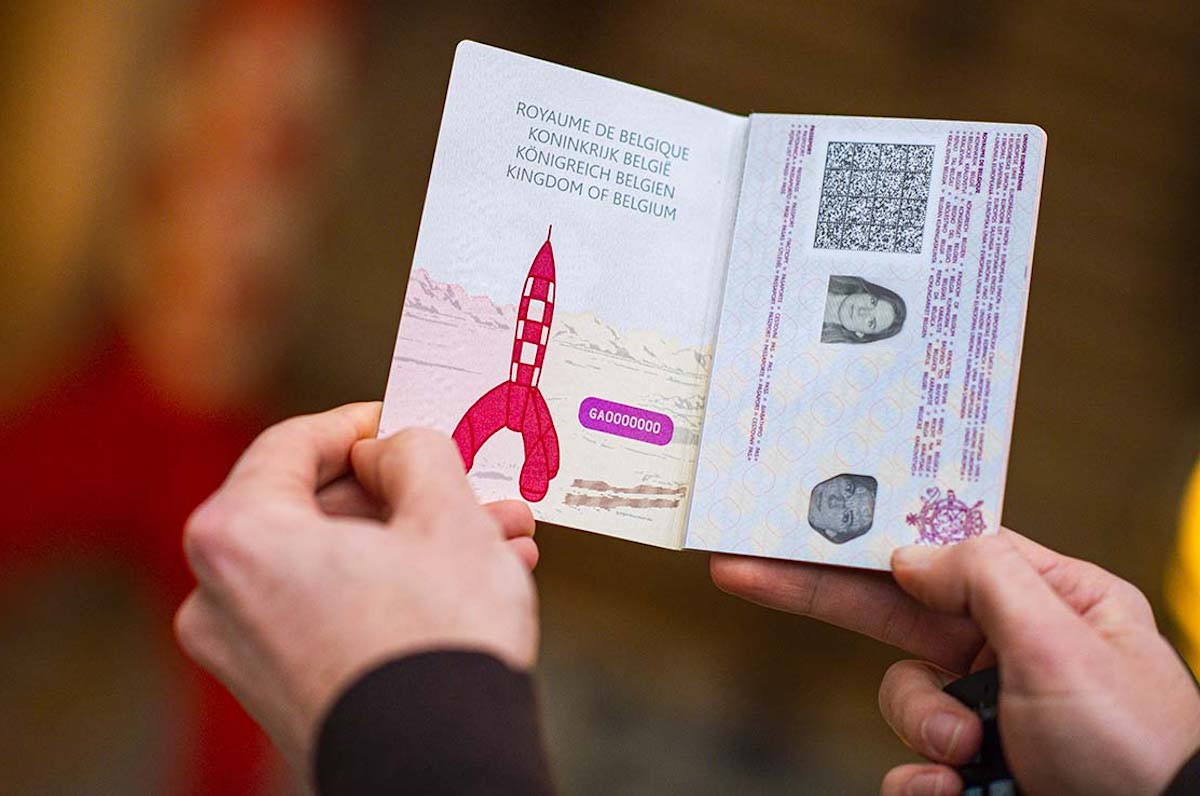
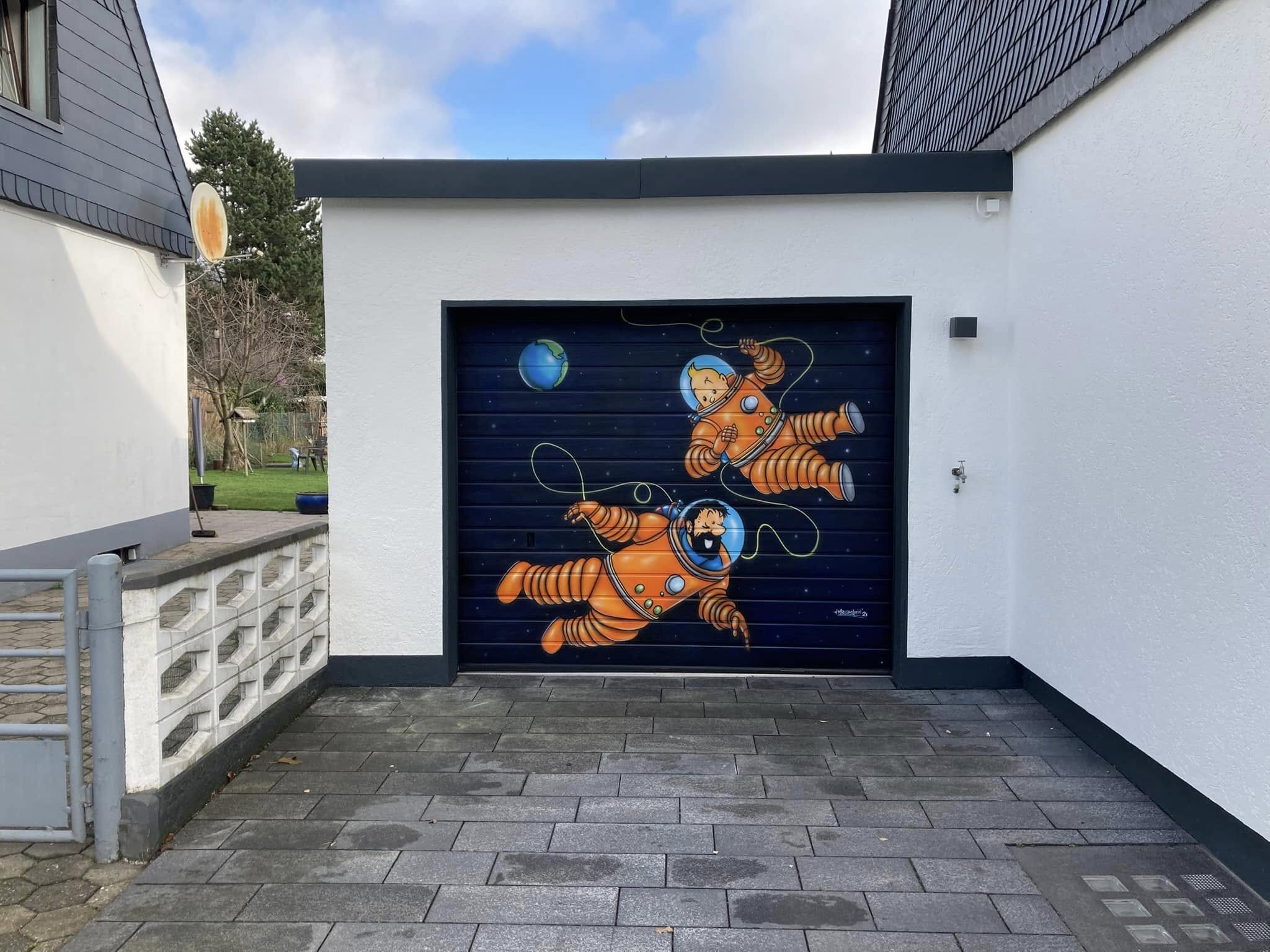
Tributes to the Lunar Triumph
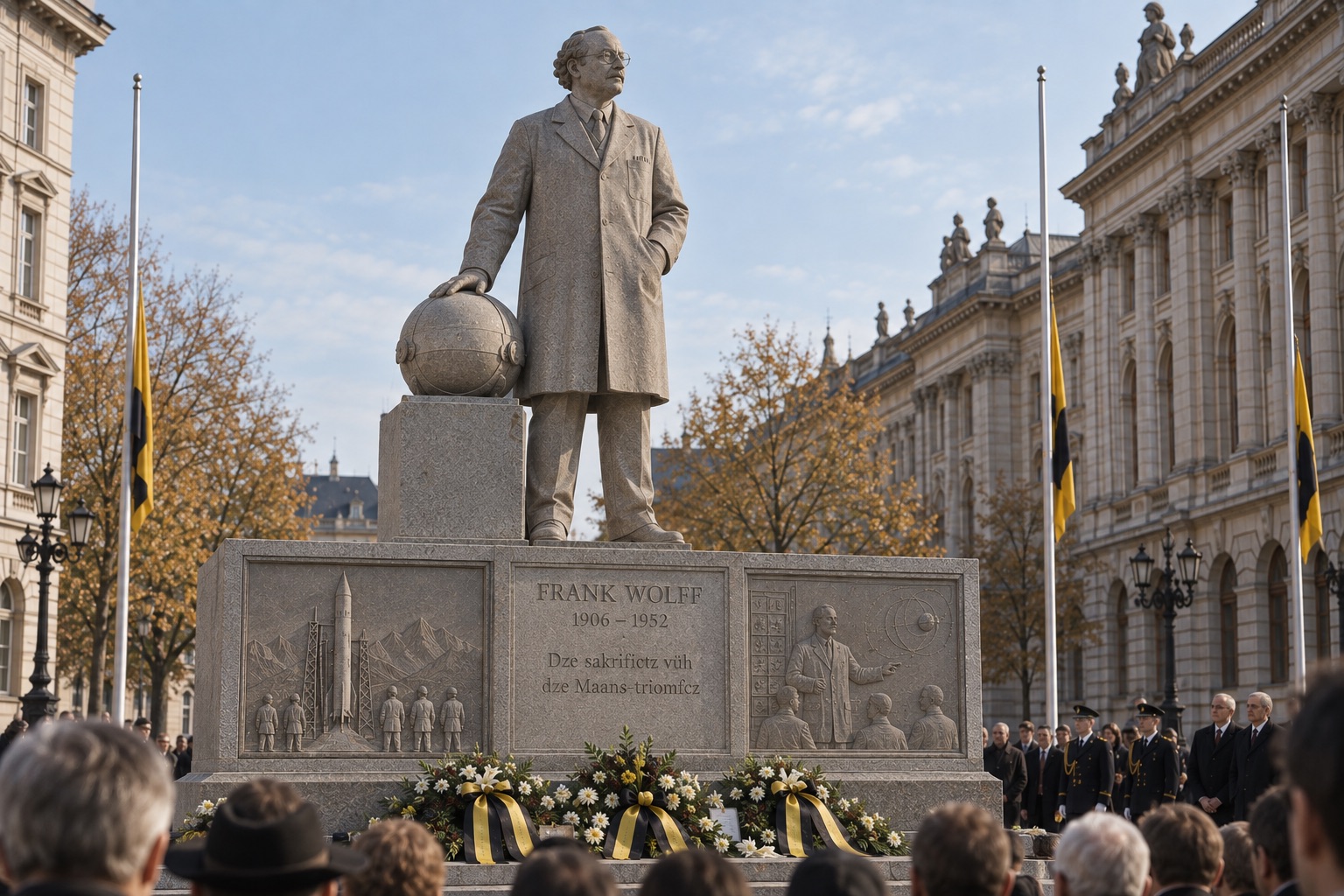
The rocket remains the image of the Lunar Triumph. Wolff has a memorial of his own: it stands on Heroes' Square in Klow. Every 3 June the Kingdom recalls there the name of the man whose sacrifice made the return possible.
 Sprodj Atomic Research Centre
Astronautical Section
Sprodj Atomic Research Centre
Astronautical Section
Concordance · Mission log · 03/06/52 – 09/06/52
Mission log, 3–9 June 1952
The sequence as the Section's registers record it, and, for each moment, the page of Hergé's adaptation where the reader can find it. The Section publishes this concordance for readers of the adaptation, which remains the most widely read account of the mission. Times the registers do not give are marked as not recorded; those the Section has reconstructed are marked as reconstructions.
| Date and time | Event | Where to read it |
|---|---|---|
| 3 June, 01:34 | Lift-off from Sprodj; the Thom(p)sons still aboard | Adaptation, p. 3 |
| 3 June, time not recorded | Captain Haddock leaves through the airlock and becomes a satellite of Adonis | Adaptation, p. 8 |
| 3 June, time not recorded | Landing in the crater Hipparchus; Tintin's first steps | Adaptation, p. 25; crossing time: reconstruction after sciences.amatheurs.fr |
| 3 June, 23:45 | Unloading complete; observatory begun; assembly of the Moon tank started | Logbook, reproduced p. 32 |
| 4 June, 08:30 | Telescope mounted, cameras in position, theodolite in working order; cosmic rays, Record Books I and II | Logbook, reproduced p. 32 |
| 5 June, 19:20 | Moon tank ready for use | Logbook, reproduced p. 32 |
| 6 June, 12:35 | The tank leaves for the caves near Ptolemaeus: Wolff, Haddock, Tintin, Snowy; stalactites, ice | Logbook, reproduced p. 32 |
| 6 June, time not recorded | Jorgen's attempt; the rocket damaged; repairs estimated at 100 hours | Adaptation, pp. 41–43; the estimate p. 48; placed at 16:52 in the Section's oxygen register |
| 6 to 9 June | Repairs: 72 hours; the tank and the optical instruments stay on the Moon | Adaptation, p. 50 |
| 9 June, 16:52 | Lift-off from the Moon, 7 aboard | Logbook, reproduced p. 50 |
| 9 June, return flight | Jorgen killed in the struggle; Wolff leaves the rocket; the last cylinder; automatic pilot | Adaptation, from p. 50; approximate times: the Section's oxygen register |
| 9 June, about 20:28 | Landing at Sprodj; the crew revived | Adaptation, pp. 58–62; the hour: reconstruction by the Astronautical Section, after sciences.amatheurs.fr |
Compilation: Astronautical Section, Sprodj Atomic Research Centre
Key Dates
- 1789: Henrïc Klaproth identifies uranium in a fragment of Syldavian pitchblende
- 1946: Muskar XII has the Sprodj Atomic Research Centre developed
- 1950: test launches at the Sprodj range; on 30 March, Hergé begins covering the preparations in the Journal de Tintin
- 1951: the King tours the Centre, guided by Professor Calculus
- 3 June 1952: lift-off at 1:34 a.m., landing in the crater Hipparchus a few hours later and the first steps on the Moon; the live broadcast breaks off after twelve minutes
- 6 June 1952: tank outing to Ptolemaeus; Jorgen's sabotage attempt, the rocket damaged
- 9 June 1952: lift-off from the Moon at 16:52; Jorgen killed, Wolff's sacrifice; return to Sprodj the same evening
- 1953–1954: Hergé's comic adaptations, Destination Moon and Explorers on the Moon
- 1956: Bordurian agents abduct Professor Calculus in Switzerland
- 21 July 1969: Apollo 11, seventeen years later
- 2018: the lunar water ice Calculus logged in 1952 confirmed at the poles (NASA, Chandrayaan-1)
- 2025: an album signed by Apollo astronauts sets a world auction record
- Every 3 June: Lunar Triumph Day