An Incident Beyond Technical Explanation
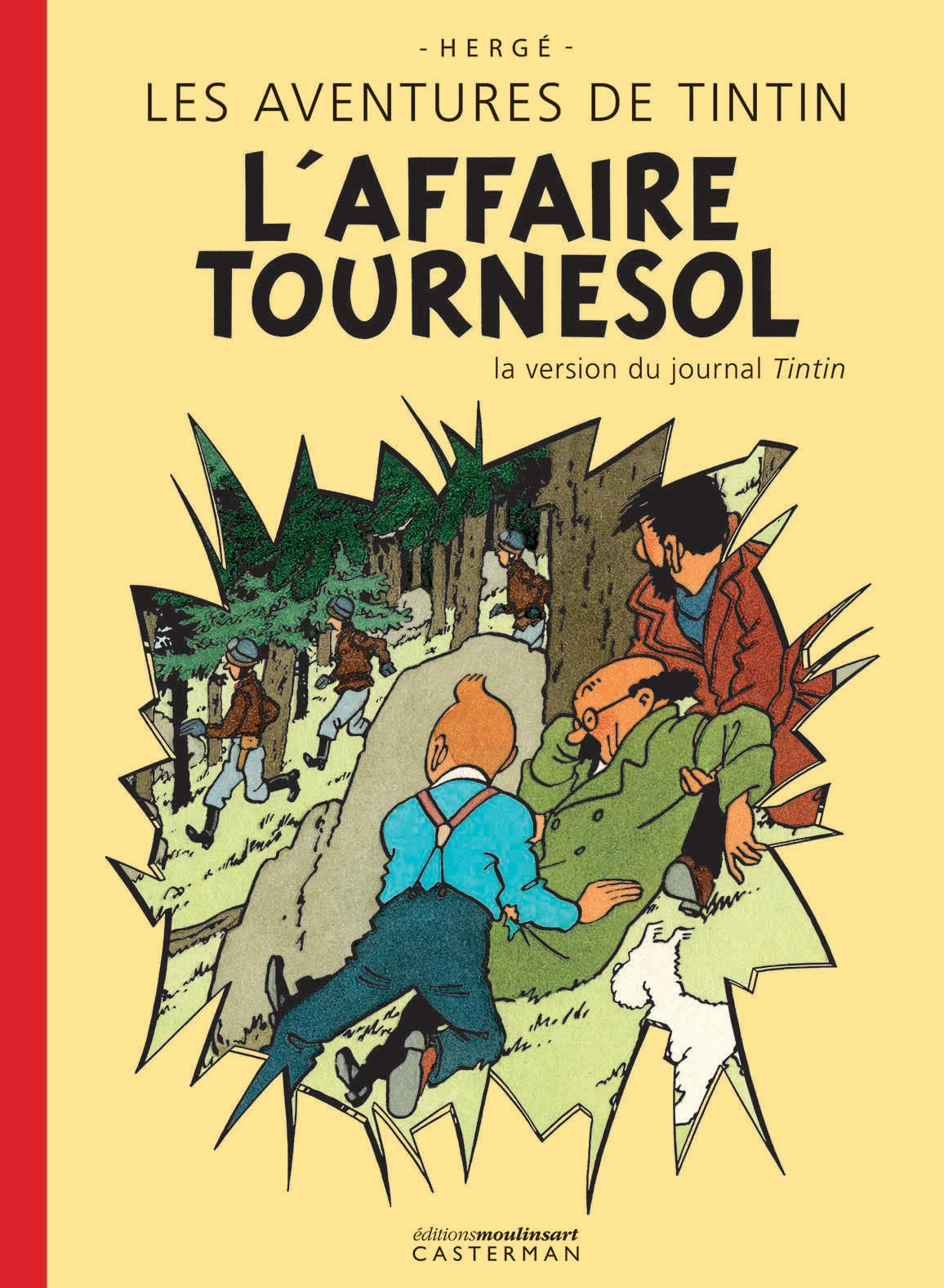
The Consulate of Syldavia in Bangkok has taken note of the suspension of The Calculus Affair – The Tintin Magazine Edition, announced by Tintinimaginatio and Casterman.
The official communiqué cited unacceptable technical problems which led to the immediate withdrawal of the special edition.
This decision follows the discovery of technical difficulties that arose during the production of the album. These difficulties compromise the faithful reproduction of the work and do not meet the quality standards it deserves. Concerned about respecting the integrity of Hergé's work and satisfying readers, Tintinimaginatio and Casterman immediately withdrew the albums from sale.
In the upper circles of the State, and, it is said even within the corridors of the Royal Palace at Klow in Klow, this purely technical explanation convinces few. The Royal Commission of Chromatic Inquiry (CREC), composed of experts from Klow and Kragon, has been tasked with determining the exact causes of the incident.
Its preliminary findings suggest Bordurian interference, likely introduced through a batch of non-compliant inks used during the printing process.
To refine its analysis, the Commission relied on SYLVIA, the national artificial intelligence system specialising in graphic forensics, which reportedly detected alteration patterns “incompatible with an industrial accident.”
The hypothesis of deliberate sabotage has since gained strength.
Mounting Evidence
A report from the CREC lists several anomalies:
- Abnormal fluctuations of the primary yellow (Pantone 115-C);
- Spectral misalignment consistent with the Szohôd-3 printing process;
- Presence of ferromagnetic microparticles similar to those found during the diplomatic passport incident of 1982;
- Unexplained layout irregularities, with certain panels overlapping the binding, a highly unusual defect that could only result from deliberate tampering.
Mr Alexi Kraznovic, Deputy Director-General of the Bureau for Printed and Visual Works, did not mince his words:
This is not a mere industrial mishap. Everything points to a coordinated attempt to distort a landmark episode in Syldavian memory.
Prof Ljubomir Teslarek from the SYLVIA AI team in Velgrad added:
The Bordurians cannot bear history reminding them of their past failures: they prefer to erase memory rather than face it.

Source: Bundesarchiv, Bild 102-13738 / CC-BY-SA 3.0 DE
Professor Calculus: A Reluctant National Hero
Distinguished Belgian scientist Professor Cuthbert Calculus, Head of the Astronautical Section at the Syldavian Atomic Research Centre in Sprodj, was the mastermind behind the conception and construction of the lunar rocket that enabled Syldavia’s lunar triumph in 1952. Under his direction, the Kingdom thwarted several Bordurian sabotage attempts aimed at diverting the rocket or compromising the mission.
A close friend of the young reporter Tintin, who once saved the Royal Sceptre of Ottokar on the eve of St Wladimir’s Day by foiling another Bordurian plot in 1938, Professor Calculus has since embodied the alliance between scientific excellence, loyalty, and devotion to the Syldavian Crown.
Working from his personal laboratory, he pursued studies on high-frequency acoustic waves, exploring peaceful applications of sonic energy, a field in which German wartime research, catalogued after 1945 by Colonel Leslie E. Simon in German Research in World War II (1947, article in French), had already tested sound as a weapon. It was in this context that he developed a revolutionary ultrasonic emitter capable of disintegrating solid materials at a distance. Originally intended for civilian use (mine clearance, geology, engineering) the device soon attracted the attention of Szohôd’s intelligence services, who recognised its strategic potential.
His abduction in Switzerland in 1956, followed by transfer to the fortress of Bakhine, a reputedly impregnable Bordurian military stronghold, triggered an unprecedented diplomatic crisis.
His release, conducted efficiently and discreetly, confirmed his status as a national hero and cemented Syldavia’s vigilance against scientific interference from the East.
A Delayed Revenge?
The 1956 crisis remains a cornerstone of Syldavian foreign policy. It affirmed the primacy of peaceful science over totalitarian coercion and reinforced the Kingdom’s role as guardian of free inquiry. Borduria has never acknowledged its failure, attributing it instead to a “technical coordination error.”
For Syldavian historians, the suspected sabotage of 2025 constitutes a long-delayed act of revenge, an attempt to blur the memory of a moment when reason, loyalty, and truth once again triumphed over propaganda.
By tampering with the ink, they hope to tamper with history. But Syldavian history does not fade.
According to the CREC, this act of sabotage may have sought to prevent the release of an edition recalling Szohôd’s successive humiliations, from the failed royal coup attempt of 1938 to the disrupted lunar programme of 1952, and finally the acoustic debacle of 1956.
The Grey Market Awakens
While diplomats assess political implications, collectors are mobilizing. Some copies of the withdrawn edition circulate in European bookshops, sold discreetly or at inflated prices. Syldavian authorities advise caution, reminding that these may not become highly valuable collectors’ items.
Serialized between 1954 and 1956, The Calculus Affair remains Hergé’s most refined synthesis of humour, suspense, and design. The new edition restores its rare double-page Italian format, a luminous trace of the artist’s hand and of a lost era of meticulous craftsmanship.
For the time being, Moulinsart has not issued any statement regarding the possible release date of a corrected edition of The Calculus Affair – The Tintin Magazine Version.
The Consulate advises keeping any remaining copies safe from humidity, speculation, and Bordurian influence. Readers are reminded that other editions of this historic retelling remain available.
Eih bennek, eih blavek.
— Office of the Consul of Syldavia, Bangkok