Serving Syldavia abroad

History of Syldavia

Kingdom of the Black Pelican

The Kingdom of Syldavia, in the Balkans between Borduria, Croatia, and the Adriatic coast, has sustained from its capital, Klow, a monarchical heritage of close to nine centuries, broken more than once and always restored. Archival paintings, illuminated chronicles, rare photographs and objects from the national collections bear witness to the great stages of that long struggle for sovereignty.

Byzantine mosaic portrait of Emperor Justinian I in the Basilica of San Vitale, Ravenna

Mosaic of Emperor Justinian, Basilica of San Vitale, Ravenna, 6th century
Photograph: Petar Milošević (CC BY-SA 4.0)

Pre-6th Century: Illyrians, Rome and Byzantium

Until the 6th century, Syldavia was inhabited by Illyrian tribes, gathered around 385 BC by King Bardylis, whose capital stood on the shore of Lake Shköder. It is to the Dalmatian pelican of those shores that the royal genealogies would later trace the national emblem, which medieval heraldry rendered in sable, that is in black. Rome subdued the region in 168 BC; when the Empire was divided in 395, the new frontier ran through the country. The Emperor Justinian (527-565) left there the chapel that is today the oldest part of Kropow Castle.
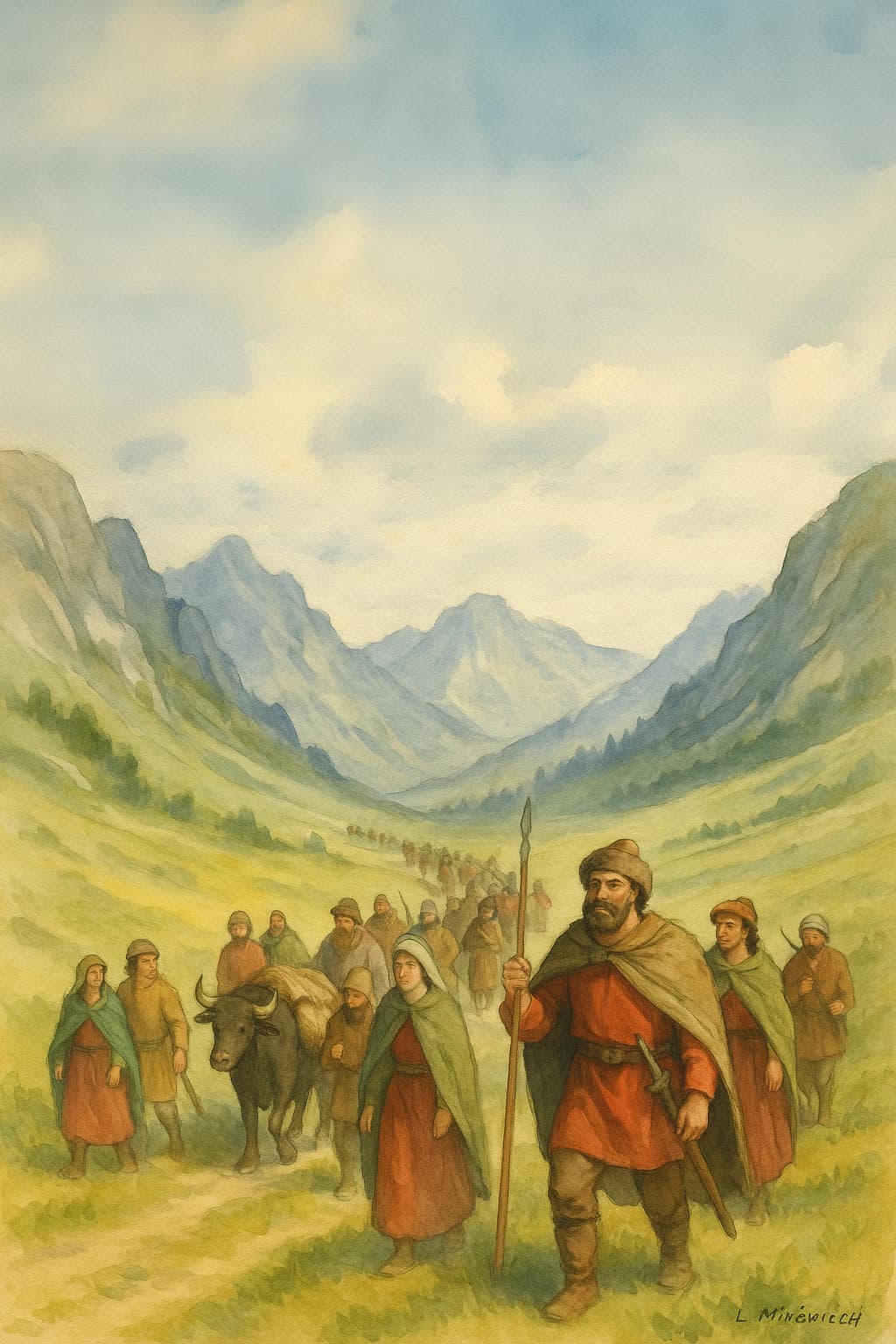
Watercolour of a highland migration: a column of families crossing a green mountain valley, a bearded man in a red tunic and cloak leading with a spear, women in headscarves and a black ox among them, the line trailing back toward distant peaks

Artist's interpretation of early Syldavian tribes migrating across the valleys.
Watercolour by L. Mirovich (1961)

6th to 9th Century: The Syldavian Arrival and the Principality

In the 6th century, Slavic peoples migrated into the region. The Syldaves were among these South Slavs, who came from north of Ukraine. They are thought to have previously spent close to a century in contact with Germanic peoples, whose language they may have partly adopted. They appeared on the Danube under Justinian, paid by Byzantium to guard its frontier alongside the Avars. When Justin II stopped paying them, they turned on their protectors: from 586 the Syldavian armies crossed the river and took the territory that has borne their name ever since. Byzantium extinguished the threat by absorbing them: the Syldaves swore allegiance to the emperor but kept the region, erected into an autonomous principality, and converted to Christianity of the eastern rite during the 9th century.

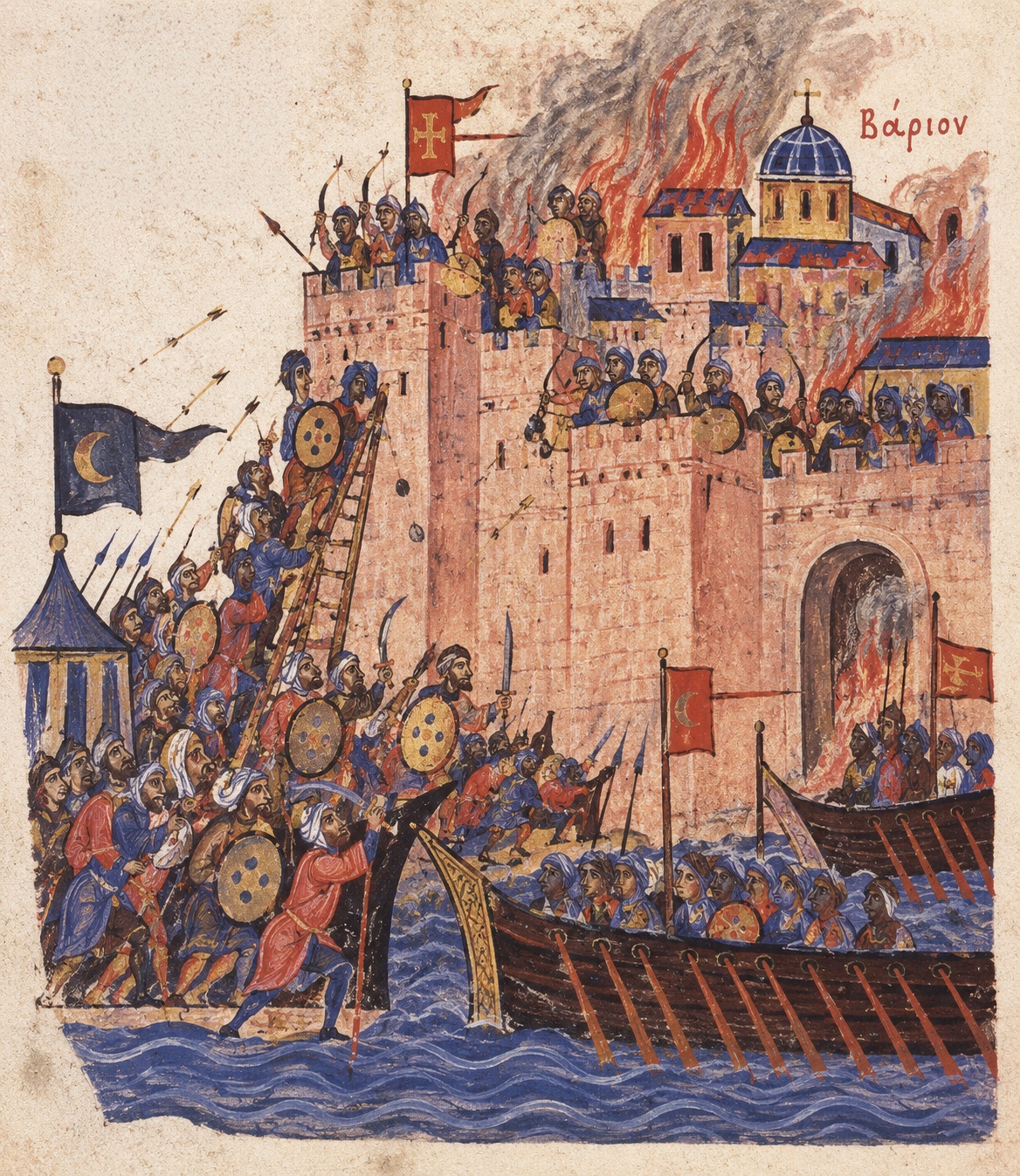
Manuscript miniature: turbaned warriors with round shields and curved swords climb ladders against the burning pink walls of a city, a blue-domed church behind; an oared galley lies at the shore below, a crescent banner over the besiegers

The Saracen fleet storms Bari, 847
Syldavian chronicle miniature, 15th century

9th to 10th Century: The Arab Raids and the Retreat to the Mountains

Arab raids multiplied in the Adriatic from the 9th century, held off for a time after the victory of Louis II and Basil I at Bari in 871. But in the 950s Syldavia, weakened and abandoned by a Byzantium looking elsewhere, saw Arab pirates make themselves masters of the fertile lowlands, driving the Syldaves into the mountains. Tradition calls them Turks, and still does: it was the chroniclers of the 15th century who, under Ottoman threat, renamed the old invader to remind the country that it had beaten him once already. These centuries of conflict set the stage for Syldavia's long struggle for sovereignty.

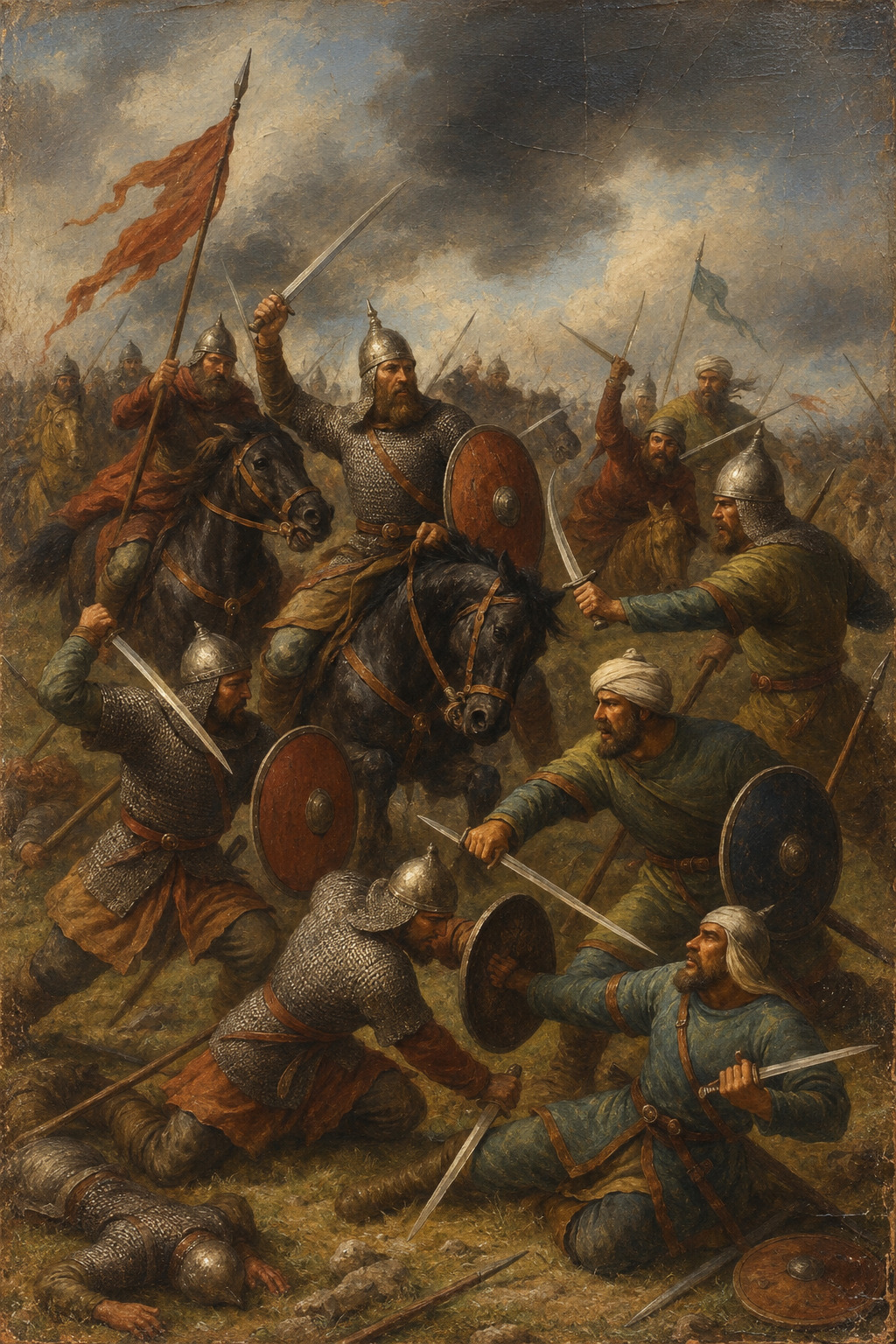
History painting of the Battle of Zileheroum: mailed warriors in pointed helmets and round shields fighting hand to hand with swords and curved sabres, two dark horses in the press, a red pennant raised at left, the fallen in the foreground under a smoke-darkened sky

The Battle of Zileheroum
Oil on canvas by Arkan Dbrant (1876)

1127: Liberation and the Founding of the Kingdom

After decades of exile in the highlands, the displaced Syldavian tribes were united under Hveghi, a leader whose forces included descendants of Flemish Crusader knights settled in the valleys since the late 11th century, among them the ancestors of the House of Douma. Launching a daring campaign from the mountains, he led his forces to a decisive victory over the occupiers at the Battle of Zileheroum. National legend holds that on the eve of the battle Hveghi beheld a great black pelican descending from a starless sky, a golden scroll in its beak; taking the vision as a sign of divine favour, he raised the black pelican upon his banners at dawn, and the bird has crowned the Syldavian standard ever since. He was elected king by his troops and reigned as Muskar I, “the valorous king” (1128-1168), founding the Syldavian monarchy. The former capital, Zileheroum, was renamed Klow, “the reconquered town”.

Orthodox icon on a gold ground: Saint Wladimir crowned and haloed, a cross in one hand and an unrolled scroll of text in the other; Christ enthroned between two angels above, small saints in the side borders, Cyrillic inscriptions throughout

Saint Wladimir of Kiev
Russian icon painted for the nine-hundredth anniversary of the Baptism of Rus', 1888. Public domain

1160: Saint Wladimir, Patron of the Kingdom

Muskar I brought the cult of Saint Wladimir of Kiev to Syldavia. The choice was deliberate. The Syldavians traced their origins to northern Ukraine, and the prince who had baptised the Rus' in 988 gave them both an ancestral link and Christian legitimacy. Elected by his troops rather than born to the throne, Muskar also found in Wladimir a patron who had himself been a sovereign.

Muskar obtained the relic during an embassy to Kiev. Grand Prince Mstislav received him and took him to Wladimir's tomb, where the guardian monks released a fragment for Syldavia. Tradition holds that on the journey home the horse carrying it stopped outside Klow and struck the ground; water sprang from the hoofprint, and the spring has supplied the city ever since. The relic was deposited at Kropow, where it has stayed: it leaves the castle only on the eve of the feast.

In 1160 Muskar raised the cathedral of Saint Wladimir to receive the relic each year. Wladimir became patron of the kingdom, and his feast the chief date of the Syldavian calendar.

Muskar did not follow his patron in everything. Where Wladimir had baptised a nation, he proclaimed no state religion: the Muslim and Jewish communities already established in Syldavia retained their worship.

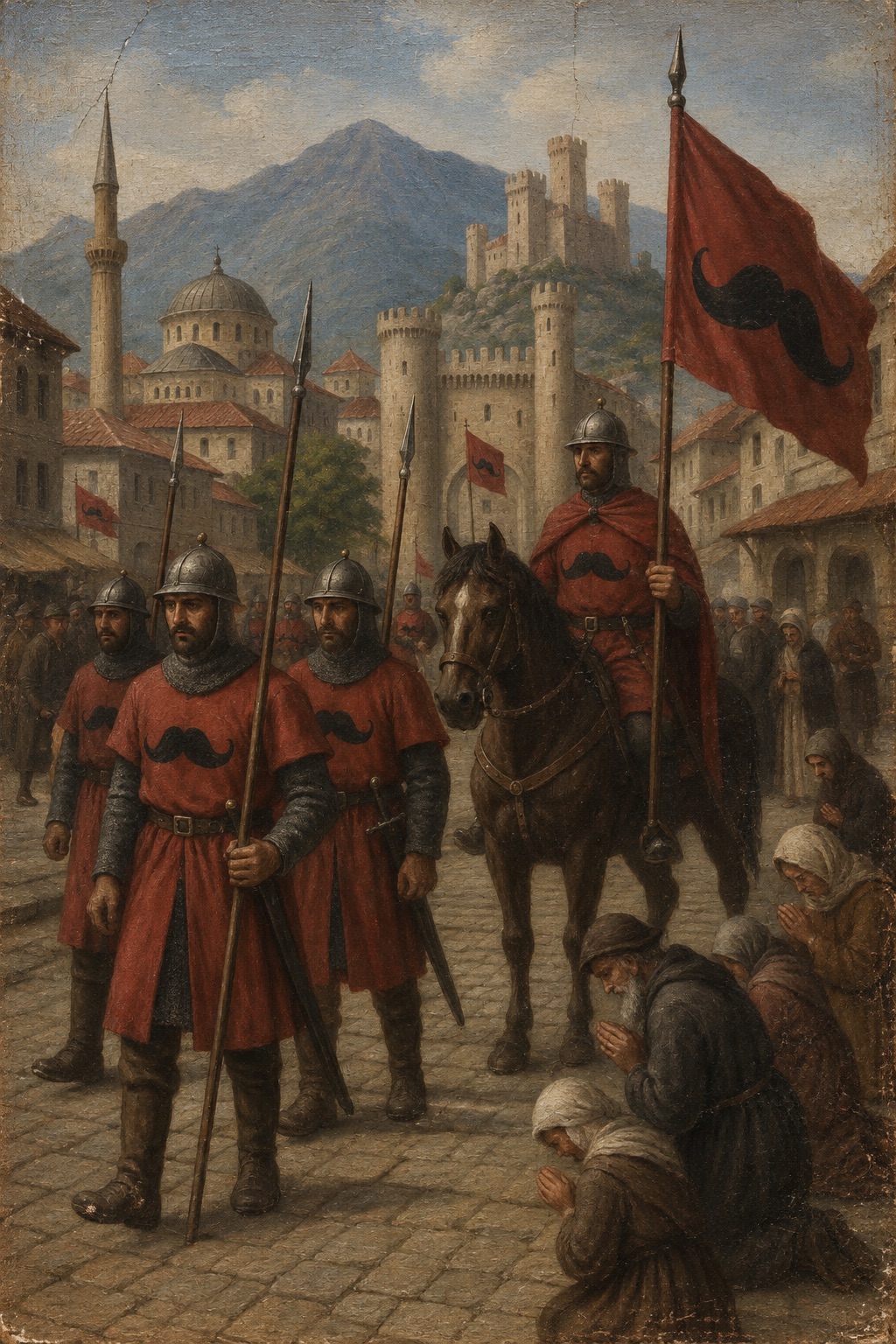
Painting of Klow under Bordurian occupation: soldiers in steel helmets and red surcoats blazoned with the black Bordurian moustache, standing with spears in a cobbled square, a mounted standard-bearer with a red banner bearing the same device, townspeople kneeling at right, a minaret, a domed mosque and a hilltop castle behind

Klow under Bordurian occupation
Oil on canvas by Ferenc Vladoff (1892)

1168-1195: Decline and Annexation

Following the death of Muskar I in 1168, his son Muskar II ascended to the throne. Lacking his father's authority, he struggled to maintain order amid rising noble factions and internal disputes. The resulting instability weakened the young kingdom considerably. In 1195, the neighbouring state of Borduria invaded Syldavia and annexed it: local customs were suppressed and national institutions repurposed to serve Bordurian authority.

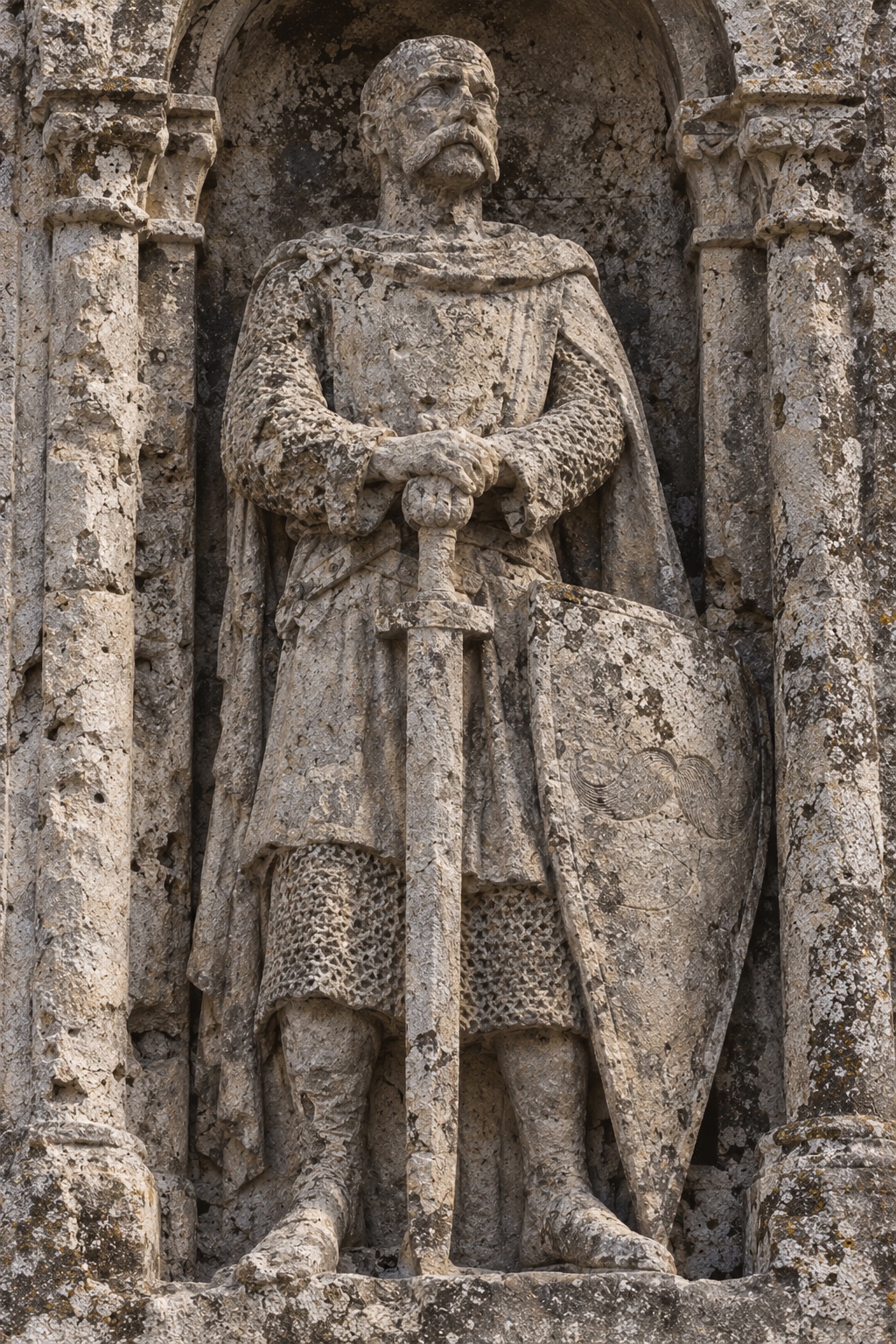
Weathered limestone statue in a columned niche: a bare-headed warrior without a crown, with a thick drooping moustache, in mail hauberk and surcoat, both hands resting on the pommel of a sword held point-down; beside him a kite shield carved with a single stylised moustache device

Figure traditionally identified as Zsnôrr
Limestone, 13th century. Citadel of Zbrenow

1195-1275: The Bordurian Interregnum

The annexation of 1195 opened eighty years in which the Syldavian crown was taken by force and lost the same way. Hôikgang (1195-1198), the Bordurian general who had led the invasion, was killed by his own aide-de-camp Szônett (1198-1199), who was himself shot during a hunt within the year. His nephew Prîtzzy (1199-1200) died on a raid beyond the eastern frontier, and Mânir (1200-1222), another general who had proclaimed himself king, was deposed by his own chief of staff.

That chief of staff reigned as Tôpp I (1222-1223), a convinced pacifist who died of plague within a year. His son Tôpp II continued his work until a war chief of Turkish origin, Zsnôrr, overthrew him and left him to die of hunger and cold in captivity. Zsnôrr never troubled to have himself crowned. He held the country for some sixty years under the dictatorship the chronicles call the reign of Zsnôrr the Bloody, and it was to end it that the tribes of the east gathered behind the Baron Almaszout.

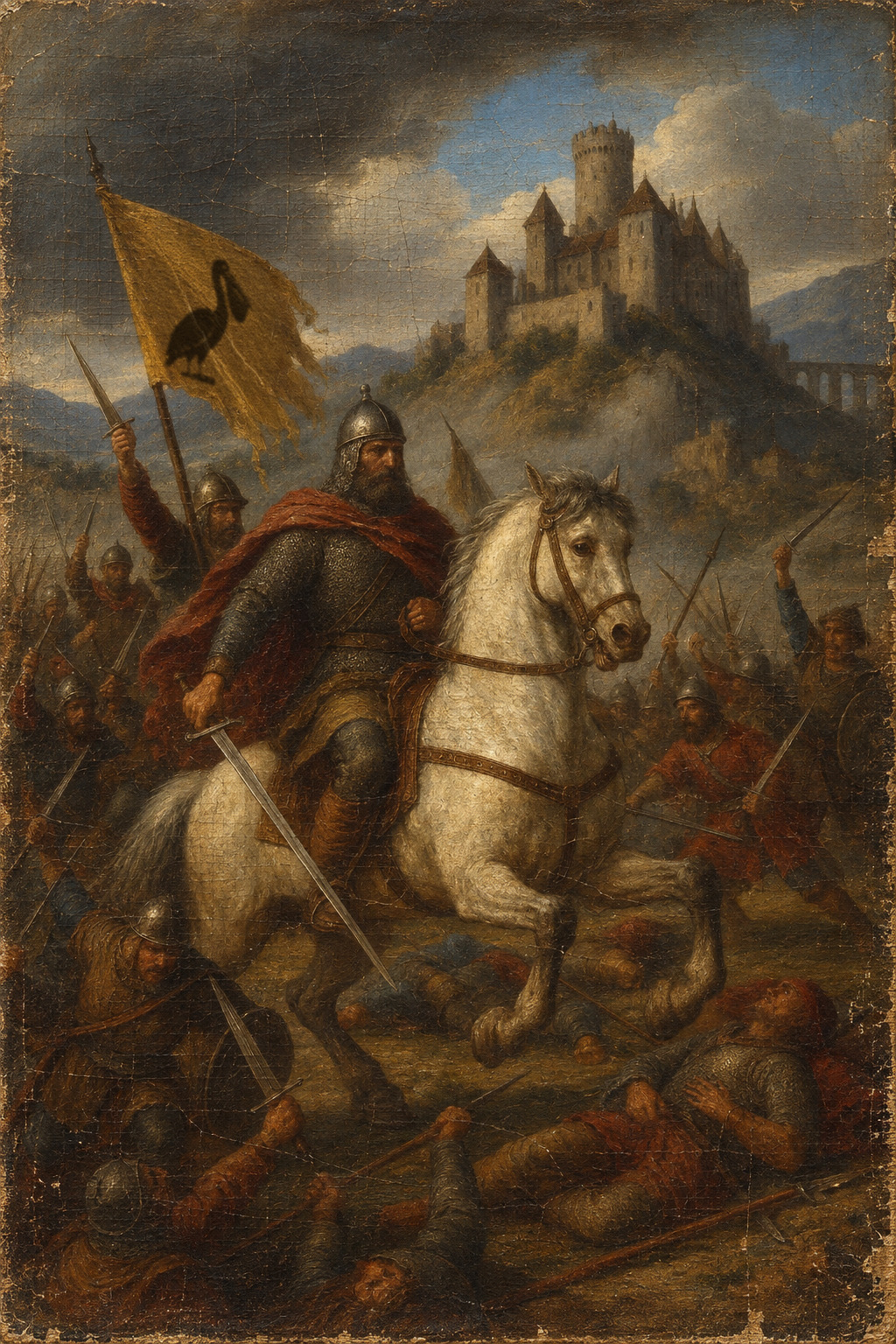
History painting of Baron Almaszout retaking Klow: an armoured knight in a red cloak on a rearing white horse, sword drawn, leading his men past the fallen, a yellow banner bearing the black pelican raised behind him and the castle on its height above

Baron Almaszout's Triumph at Klow
Oil on canvas by Gregor Mieslav (1882)

1275-1277: Independence from Borduria

Eighty years of Bordurian occupation ended when the tribes of the east gave themselves a leader. Baron Almaszout gathered his forces, came down on Klow and put an end to the dictatorship of Zsnôrr.

Victorious, he was crowned King Ottokar I, but the nobles who had carried him made him pay for his crown: a charter, comparable to the English Magna Carta of 1215, set bounds to his powers. The kingdom he had just given back to the Syldavians entered by the same act into its long feudal period.

The house he founded bears his name and reigns still: seven and a half centuries later, the sovereign of Syldavia is an Almaszout yet.

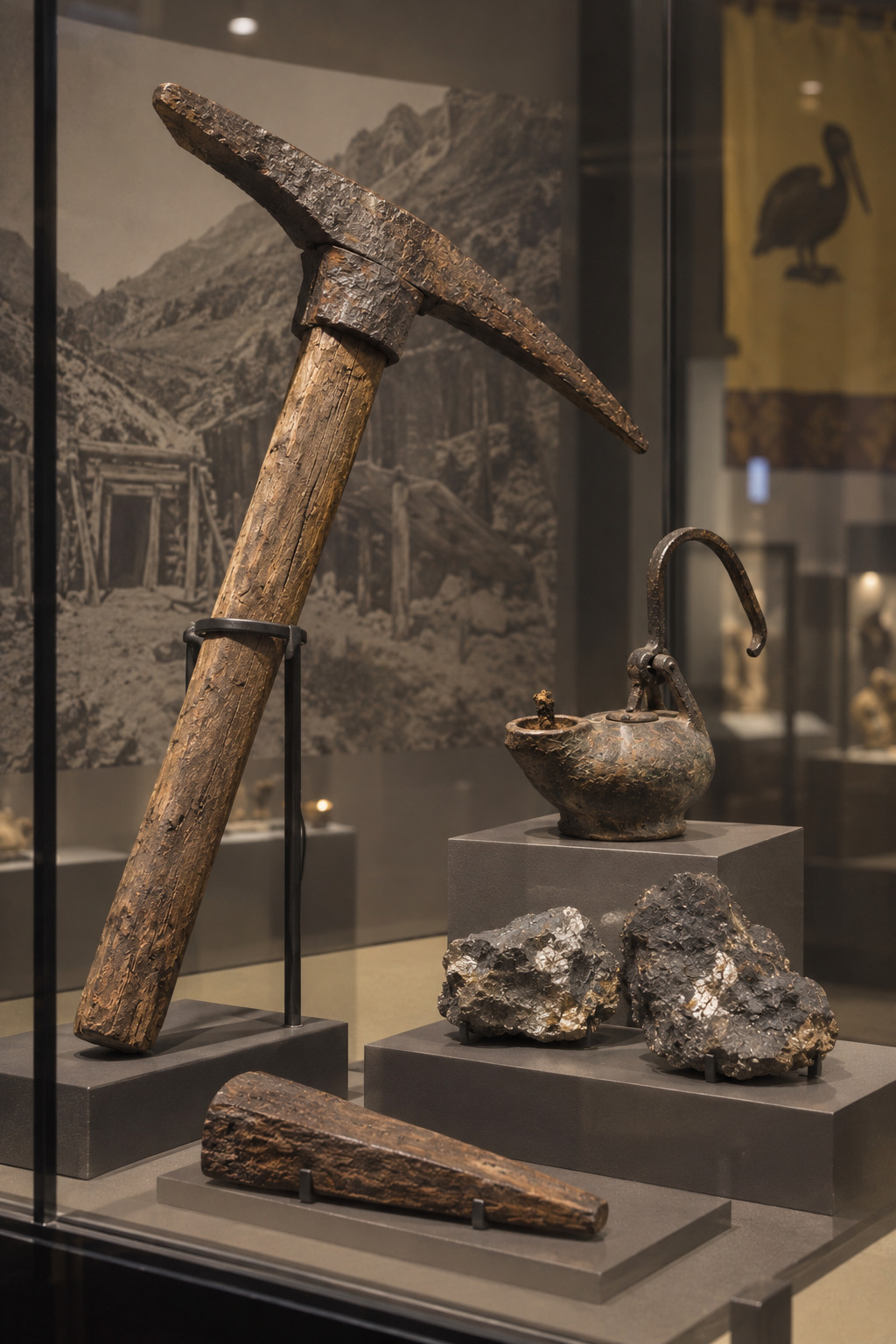
Museum display case holding medieval mining equipment: a pick with a heavy wooden haft and iron head mounted upright, an iron wedge below it, a hooked oil lamp on a plinth, and two lumps of glittering lead-silver ore; behind the glass a photographic backdrop shows a mine adit in the mountains, beside a yellow banner bearing a black pelican

Miners' tools from the Zymylpathians: pick, wedge, oil lamp and blocks of galena
Wood, iron and argentiferous lead, 13th-14th century. Display case of the Mining Museum, Sprodj

1277-1298: Feudal Fragmentation

Following the coronation of Ottokar I, Syldavia entered a long period of feudal decentralisation.

This era saw the rise of fortified castles, local militias, and ongoing power struggles between noble factions, weakening the monarchy and fragmenting national authority. It was also during this period that Syldavian rulers invited Flemish and Walloon mining guilds to develop the silver and iron mines of the Zymylpathians, bringing a second wave of settlers from the Low Countries whose Brabantian dialects further shaped the national language. The fragmentation would outlast three reigns.

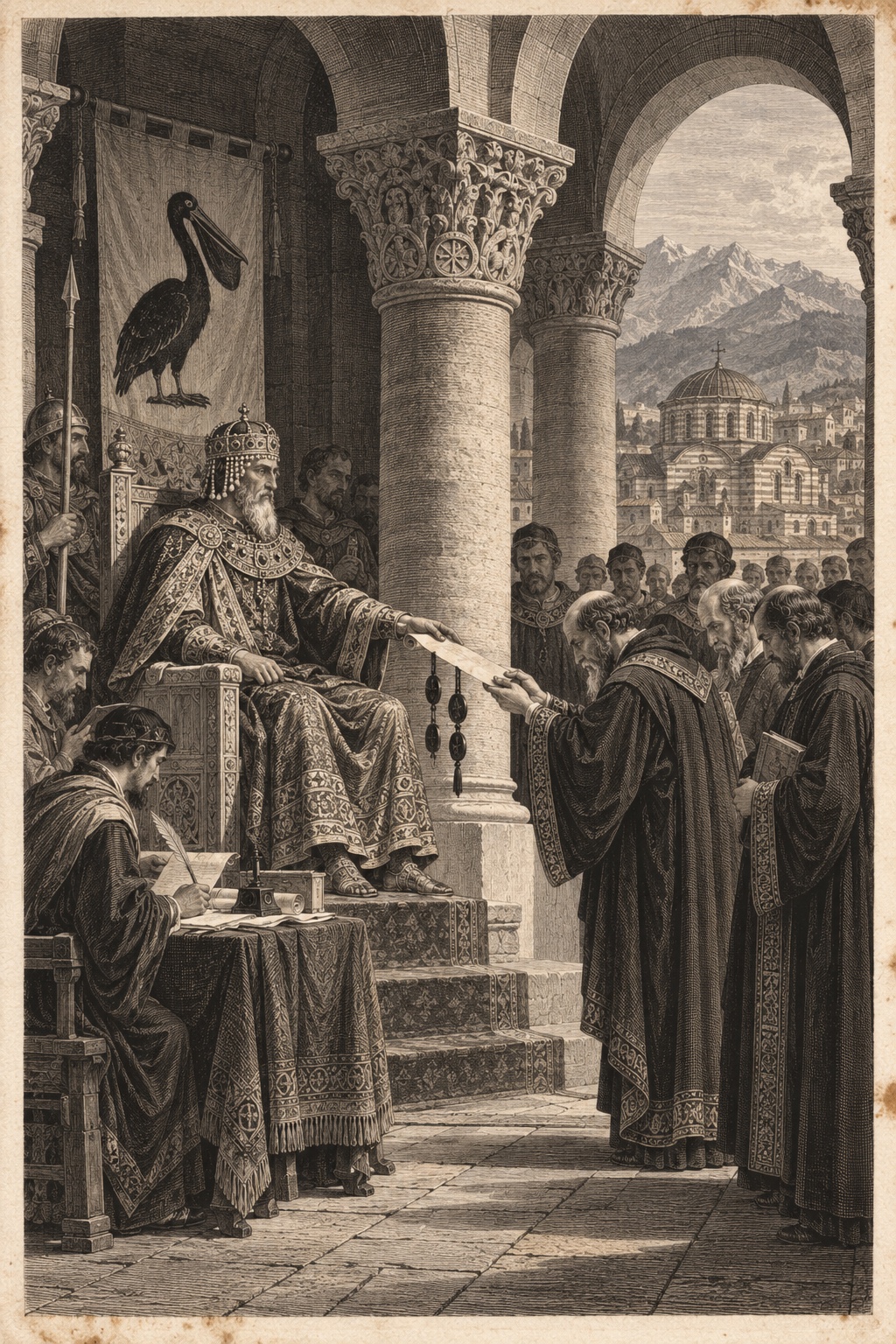
Engraving: an enthroned king in a Byzantine crown and jewelled vestments hands a charter to a bowing scholar; clerks write at a table on the left, robed scholars wait on the right, a banner bearing a black pelican hangs behind the throne, and through the arch stand a domed church and snow-capped mountains

The foundation of the University of Klow
Wood engraving, 19th century

1298-1303: Ottokar II and the University of Klow

Ottokar I, by then very old, abdicated and withdrew to a monastery, where he died at ninety-four. The crown passed to his son Ottokar II, whose reign lasted barely five years and left more behind it than many of forty years.

He founded the University of Klow and a network of charity hospices in the towns of the interior. He died peacefully in 1303, and the crown went to his brother.

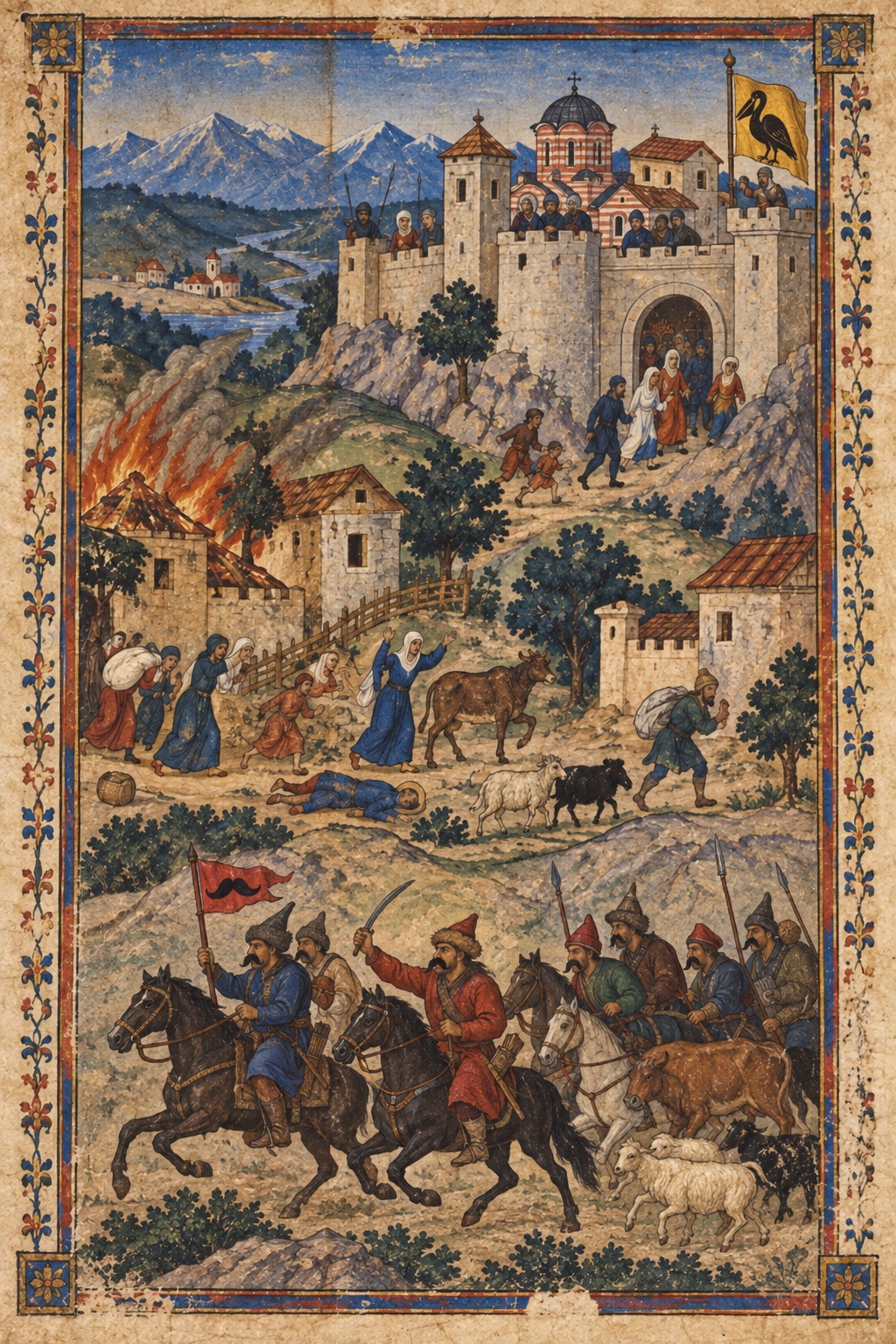
Illuminated manuscript page with a floral border: below, mounted raiders with thick moustaches drive off cattle, sheep and goats under a red pennon bearing a black moustache device; in the middle a village burns and peasants flee with bundles past a fallen man; above, a walled hilltop town with a banded Orthodox dome flies a gold banner with a black pelican, mountains behind

Bordurian raiders drive off Syldavian herds
Illuminated chronicle, 15th century

1303-1360: Ottokar III and the Bordurian Raids

Ottokar III, brother of the preceding king, reigned fifty-seven years without ever imposing his authority on the barons his father and his brother had failed to subdue. Border disputes with Borduria multiplied, and raiding parties crossed at will into a countryside they ravaged season after season.

It was a reign of attrition rather than of events, and it is remembered chiefly for what it made necessary: the work of unification his successor would take up in 1360.

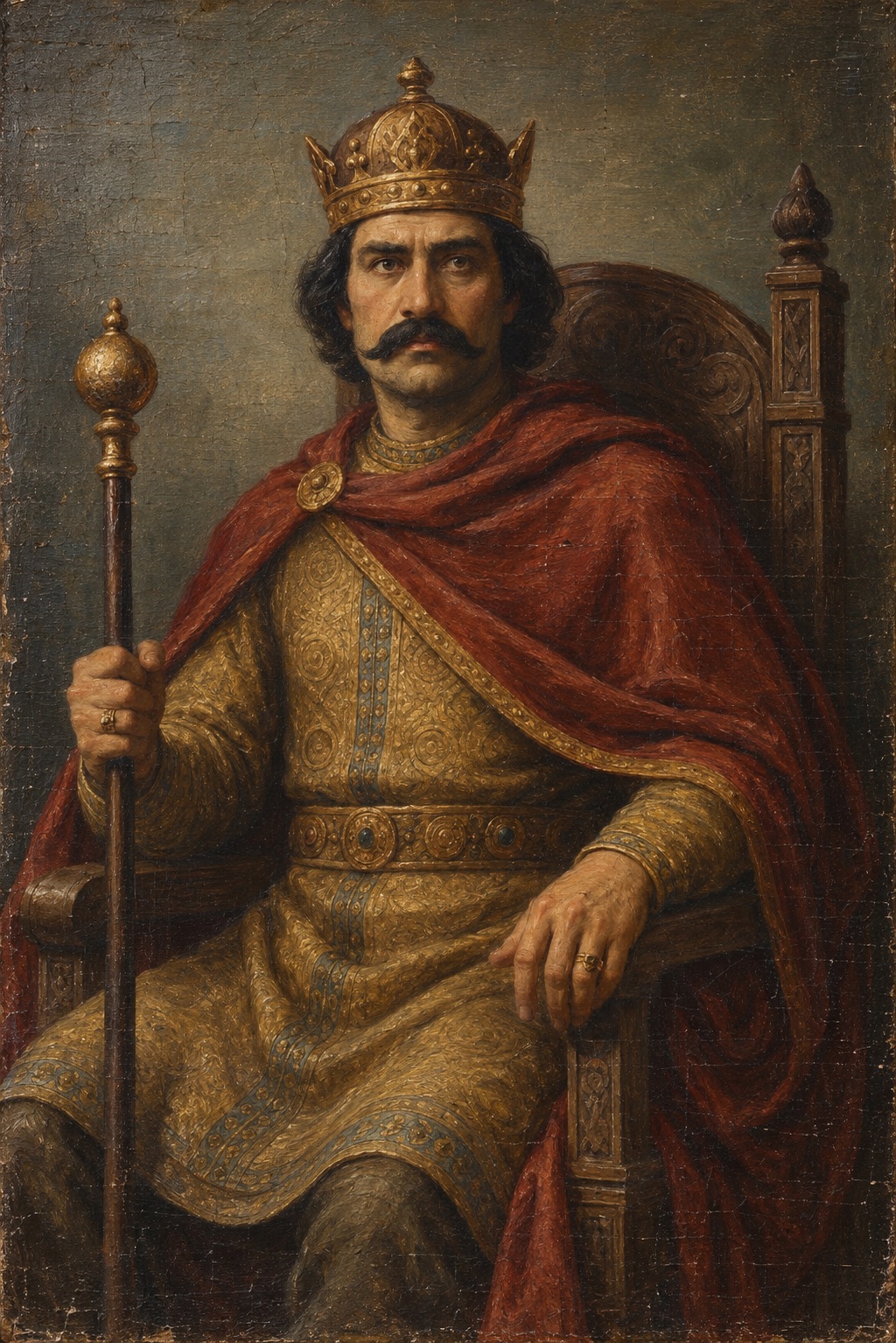
Painted portrait of King Ottokar IV of Syldavia seated on a carved throne, wearing a gold crown and a red cloak over a gold brocade robe with a jewelled belt, a gold sceptre in his right hand

Ottokar IV on the Throne
Traditional oil on canvas by Pavel Tarnas (1936)

1360-1389: Reign of Ottokar IV and National Unification

King Ottokar IV (1360-1389) subdued feuding nobles, reformed the kingdom, and elevated Syldavia to a unified state. The national motto “Eih bennek, eih blavek” (“If you gather thistles, expect prickles”) was born after a dramatic confrontation with a rival baron, Staszrvitch, who went so far as to attempt to seize the Sceptre. From that episode dates the ostension of the Sceptre on Saint Wladimir's Day: the King shows it every year to remind the country that his authority comes from holding it. Ottokar IV also raised the Istow Gate at the northern entrance to Klow. His reign ended against the Turks: in 1381 he joined the coalition of the Christian princes of the Balkans, crushed at the Battle of Kosovo Polje in 1389, where he was taken prisoner and beheaded on the order of Sultan Bayazid.

The Sceptre of Ottokar →

Indian court painting: pale bearded foreigners in tall black hats and long coats come ashore from a high-sided ship flying a gold banner with a black pelican, one bowing to present a casket; an Indian ruler sits enthroned under a canopy with courtiers, a parasol-bearer and a caparisoned elephant, while merchants weigh goods on scales among bales, chests and carpets

Syldavian factors received at an Indian court
Mughal painting, opaque watercolour and gold on paper, about 1600

1390-1463: The Ports and the Indian Comptoir

Muskar III (1390-1400) turned the kingdom towards the sea. In ten years he opened the maritime routes and built the ports of Douma and Dbrnouk, which would carry Syldavian trade for the next five centuries.

His son Muskar IV (1400-1463) continued the work and carried it a good deal further, establishing a Syldavian trading post in India.

Woodcut: peasants set vine cuttings on a terraced hillside, one digging with a spade while others bed the stakes; pack mules bring bundles of cuttings up the slope behind a cloaked nobleman, and beyond lie a river with a bridge, a walled hill town with a domed church, and mountains

Planting the vine stock brought from France
Hand-coloured woodcut, 16th century

1463-1520: Muskar V and the Vines of Szprädj

The long reign of Muskar V (1463-1520) opened ten years after the fall of Constantinople, and its most lasting act was begun before he came to the throne. As a prince of twenty he travelled to France incognito and under an assumed name, looking for vine stock that would take to Syldavian ground. He came back with Marsanne and Syrah, and the wines they gave are the Szprädj appellation.

As king he had the road network rebuilt on the Roman lines it had followed since antiquity. It was in the middle of his reign, in 1479, that Syldavia passed under Ottoman tutelage, and the royal house began the long century in which it reigned under the name of Milan.

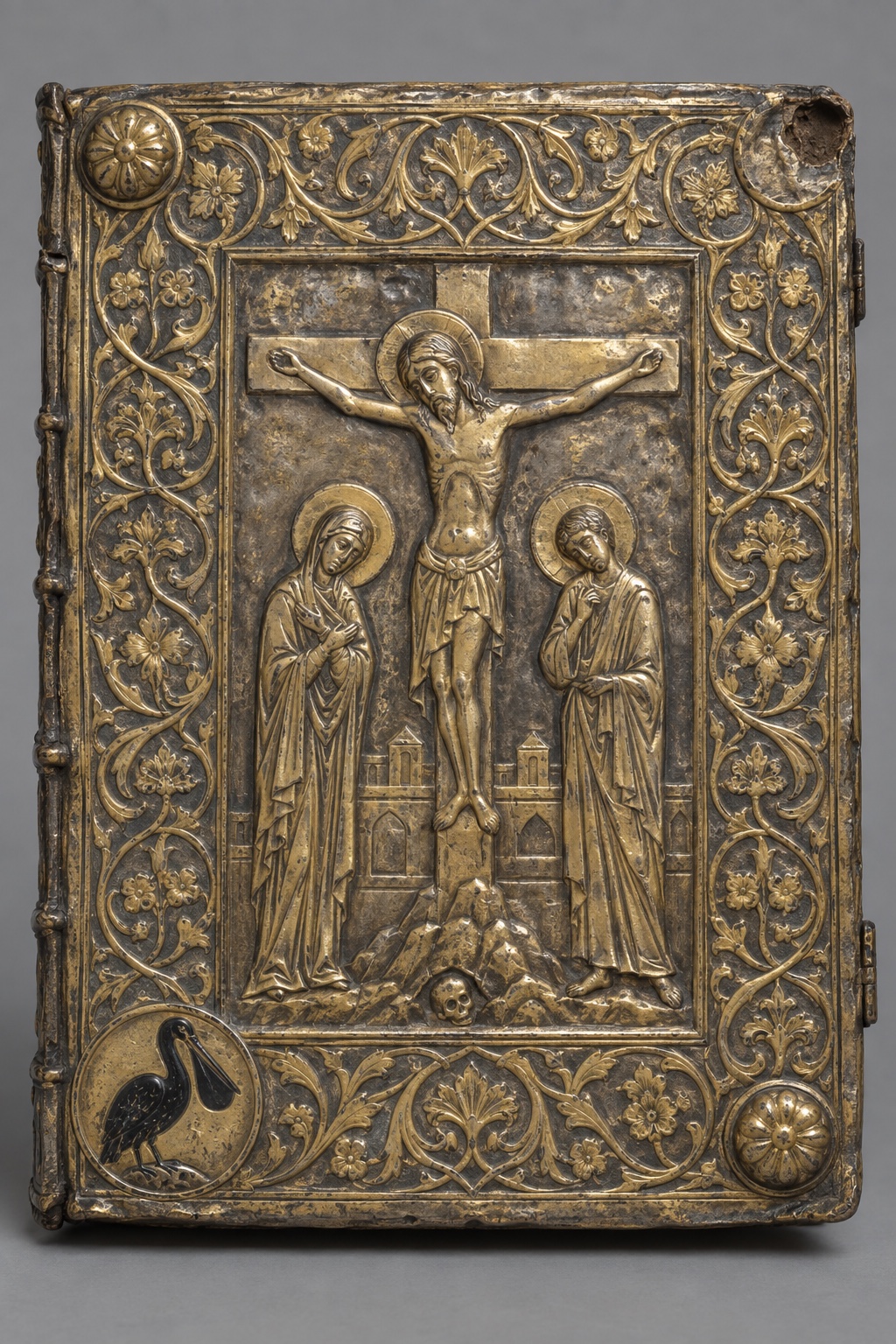
Silver-gilt book cover in repoussé relief: the Crucifixion with the Virgin and Saint John standing before city walls, a skull at the foot of the cross, framed by a broad border of scrolling vine and flowers; rosette bosses at the corners with one missing, and a medallion at the lower left bearing a black pelican

Silver-gilt Gospel cover, a royal donation
Late 16th century

1479-1640: Ottoman Tutelage and the Milan Kings

After a long resistance, the tutelage of 1479 was formalised in 1496, when the country was integrated into the Empire alongside neighbouring Montenegro. It became a sandjak, though the religion of the occupier was never imposed: conversions came mostly from the poor, who escaped by them the double taxation on non-Muslims and above all the devchirmé, the levy of one child in forty for the janissary corps. It is from this period that the Syldavian religious landscape dates, where orthodox churches stand beside mosques. The royal house survived without ever renouncing Christianity, its representatives reigning under the name Milan: Milan I (1520-1550), under whom the economic recovery begun by Muskar V was completed, Milan II (1550-1597), who made a considerable export trade of the Syldavian draught horse, and Milan III (1597-1640), whose reign closed on Bordurian provocation and a grain shortage brought on by too hard a winter.

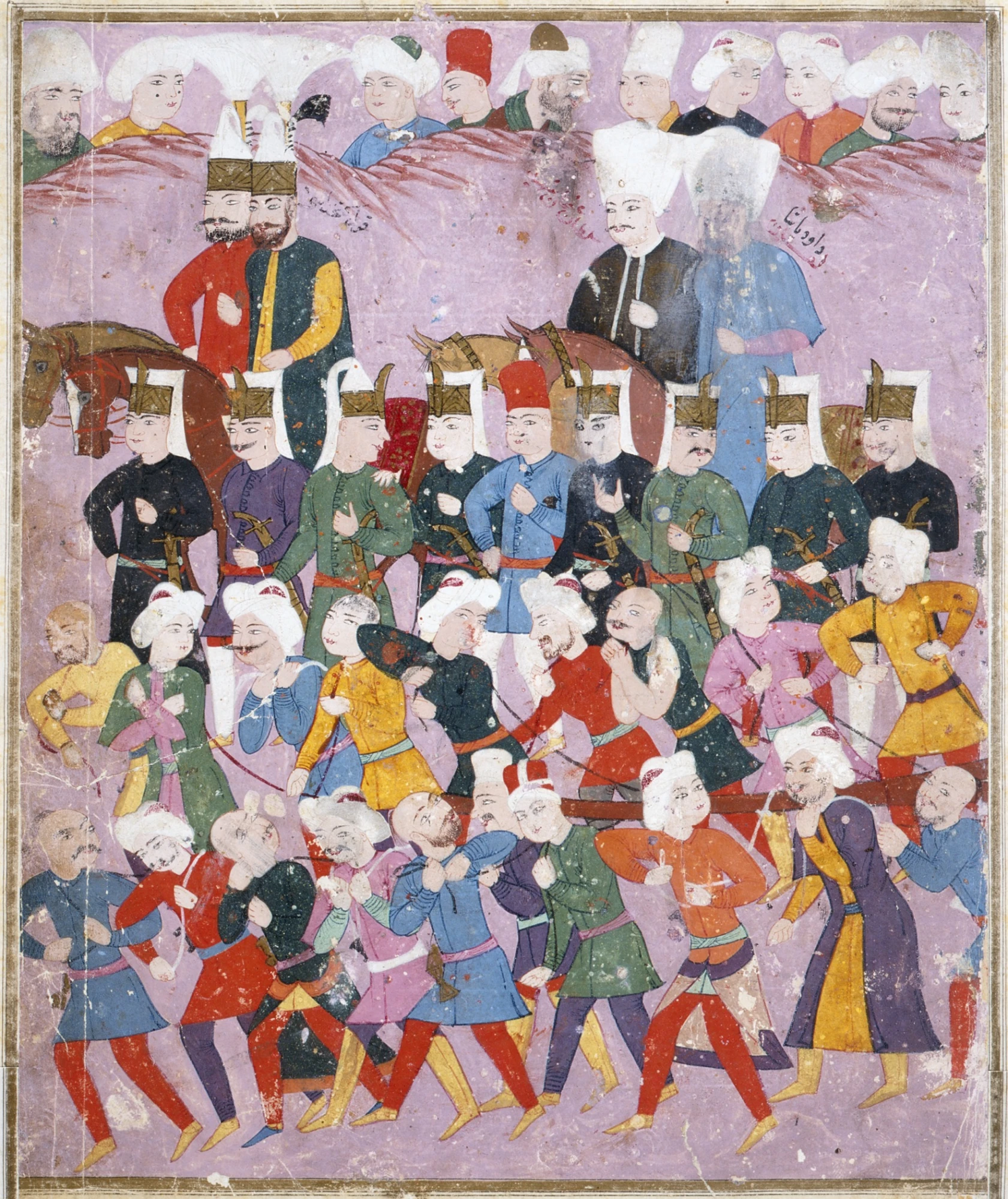
Ottoman miniature: ranks of janissaries in tall white sleeve-cap headdress, the sultan and his vizier mounted behind them, a crowd of attendants below

Ottoman janissaries and guards, circa 1620
Ottoman miniature, artist unknown. Los Angeles County Museum of Art, public domain, via Wikimedia Commons

1640-1699: The Janissary Restoration and Muskar VI

The janissaries in turn grew unruly. In 1648, King Milan, heir of Milan III (1597-1640), turned a janissary revolt to his own cause and ended with them the by then wholly theoretical sovereignty of the Sublime Porte. He then took the name Muskar VI (1640-1699), in homage to Hveghi, the national hero who had first driven out the invader. The dynastic lists do not count him among the Milan: he had borne the name only for the duration of the tutelage, and the number Milan IV would fall to the king of 1770. The janissaries have been heroes of Syldavian independence ever since.

Museum object photograph of a dark brown fur kalpak with a red velvet crown, carrying on its front a large gilt brass plate of a standing pelican with a long pouched bill on a scrolled cartouche; a bullion tassel hangs at the left, and the cap is mounted on a black plinth against a plain grey ground

Royal Guard kalpak with its pelican plate
Fur, velvet and gilt brass, 18th century. Kropow Castle

1699-1741: Muskar VII, Kropow and the Royal Guard

Turco-Bordurian troops made a brief return in the 1700s, and an ephemeral republic was proclaimed, before Muskar VII (1699-1741) retook control of the country with the support of the former janissaries. His rapprochement with the Empire of Austria secured protection enough to end Turkish designs on the country for good.

It is Muskar VII who made Kropow Castle the place where the royal insignia are kept, first among them the Sceptre of Ottokar. Because the former janissaries had twice contributed to the independence of the country, they were granted the honour, which they hold to this day, of guarding the symbols of the Crown. They abandoned the ak börk, too closely associated with the Ottoman corps, for a Syldavian kalpak struck with the national pelican; their uniform took its final form in the following century, under the influence of hussar dress.

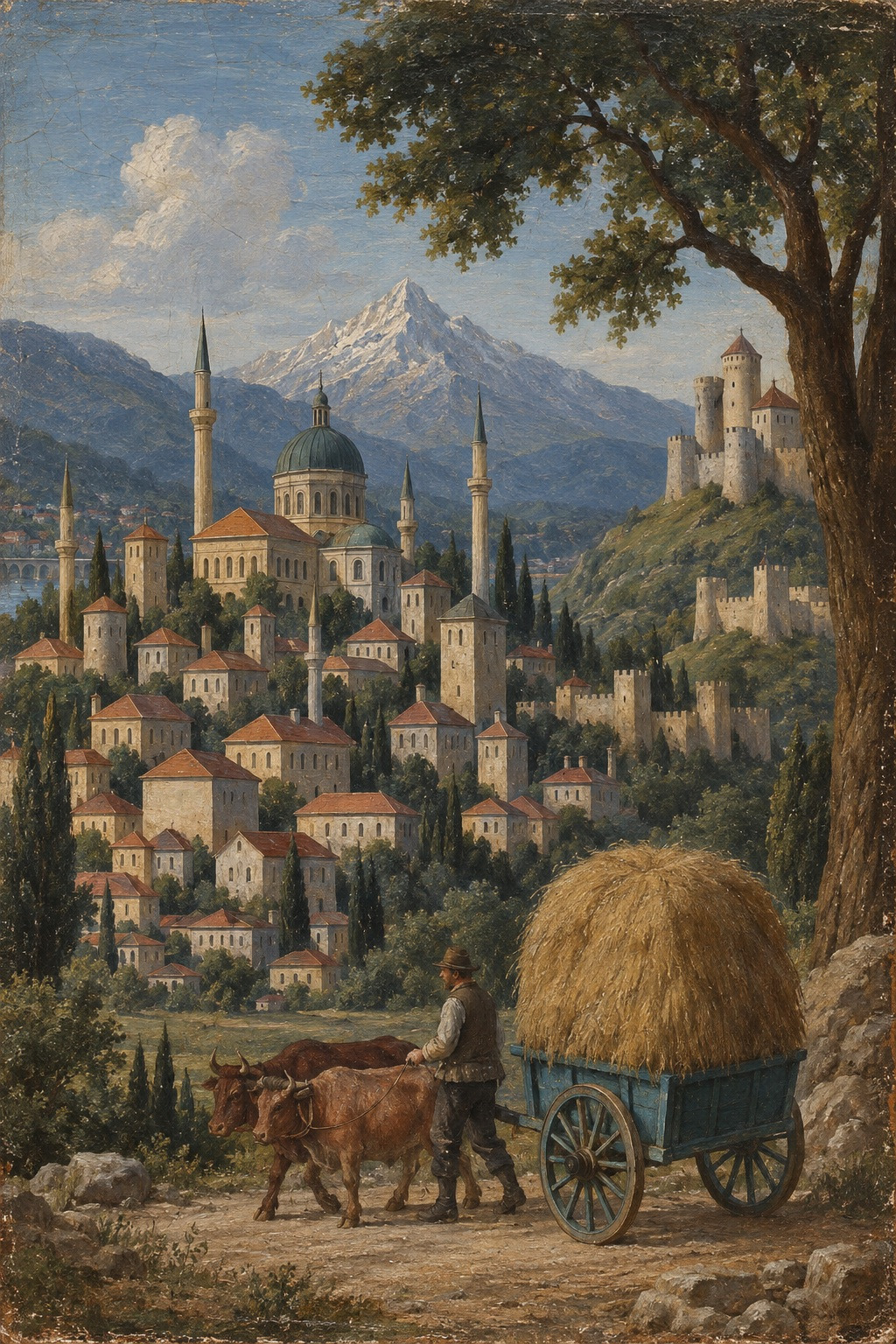
Painting of Klow in 1760: a countryman leading two oxen and a blue hay cart along a track, the town rising on wooded slopes behind with red-roofed towers, a domed mosque and minarets, a walled fortress on the crag at right and a snow-capped peak beyond

View of Klow about 1760, the lower town and the citadel
Oil on canvas by Vladan Petrovic (1955)

1741-1809: The Syldavian Enlightenment and the Grand Council

Although Klow had long been the symbolic capital since the reign of Muskar I, it was only in the mid-18th century that it became the administrative heart of the kingdom. A palace, ministries, and the Royal Archive were established, reinforcing Klow's status as Syldavia's cultural and political centre.

The kingdom then enjoyed a long prosperity. On the model of Frederick II of Prussia and Joseph II of Austria, Muskar VIII, called “the Wise” (1741-1770), set out to be an enlightened despot and developed Syldavian agriculture. His son Milan IV, called “the Good” (1770-1809), went further: he tempered absolutism by keeping philosophers at court and by creating the Grand Council. His prudent neutrality through the Napoleonic wars preserved the kingdom's independence.

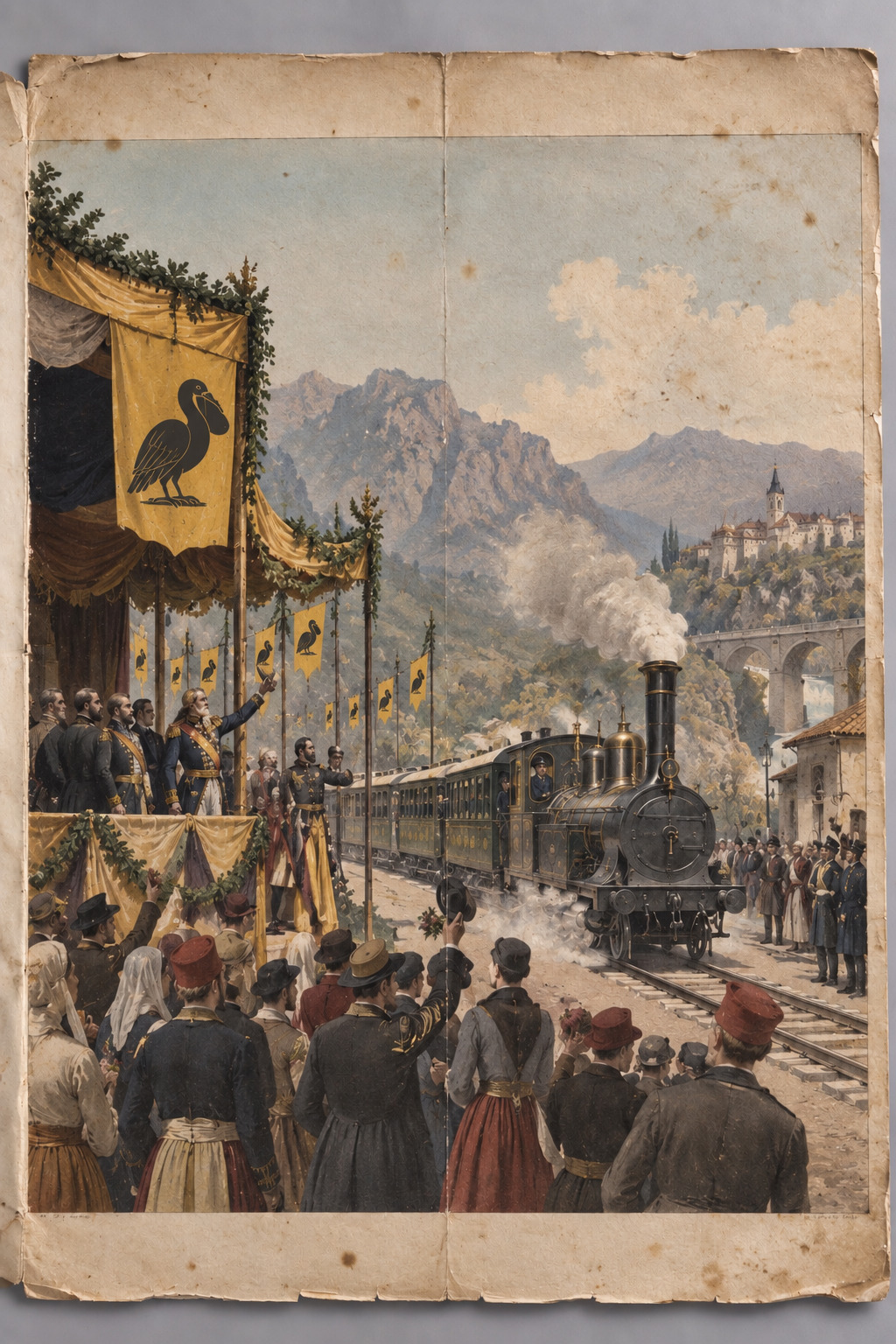
Tinted lithograph: an early locomotive with a tall funnel draws wooden carriages into a mountain station; on a draped tribune hung with gold banners bearing the black pelican, a plumed officer raises his hand to a crowd in uniforms, folk dress and red fezzes; a viaduct and a hill town lie beyond

The opening of the first Syldavian railway, 1849
Tinted lithograph, about 1850

1809-1850: Muskar IX, Austria and the First Railway

But from the fall of the French eagle in 1815, the Syldavia of Muskar IX (1809-1850) drew close to the Austrian empire once more, whose cultural influence lastingly marked the royal family and the court. He opened the kingdom's first railway line in 1849. He also created the golf course that is still the largest in Europe, on which he instituted the Coupe Milan in his father's memory.

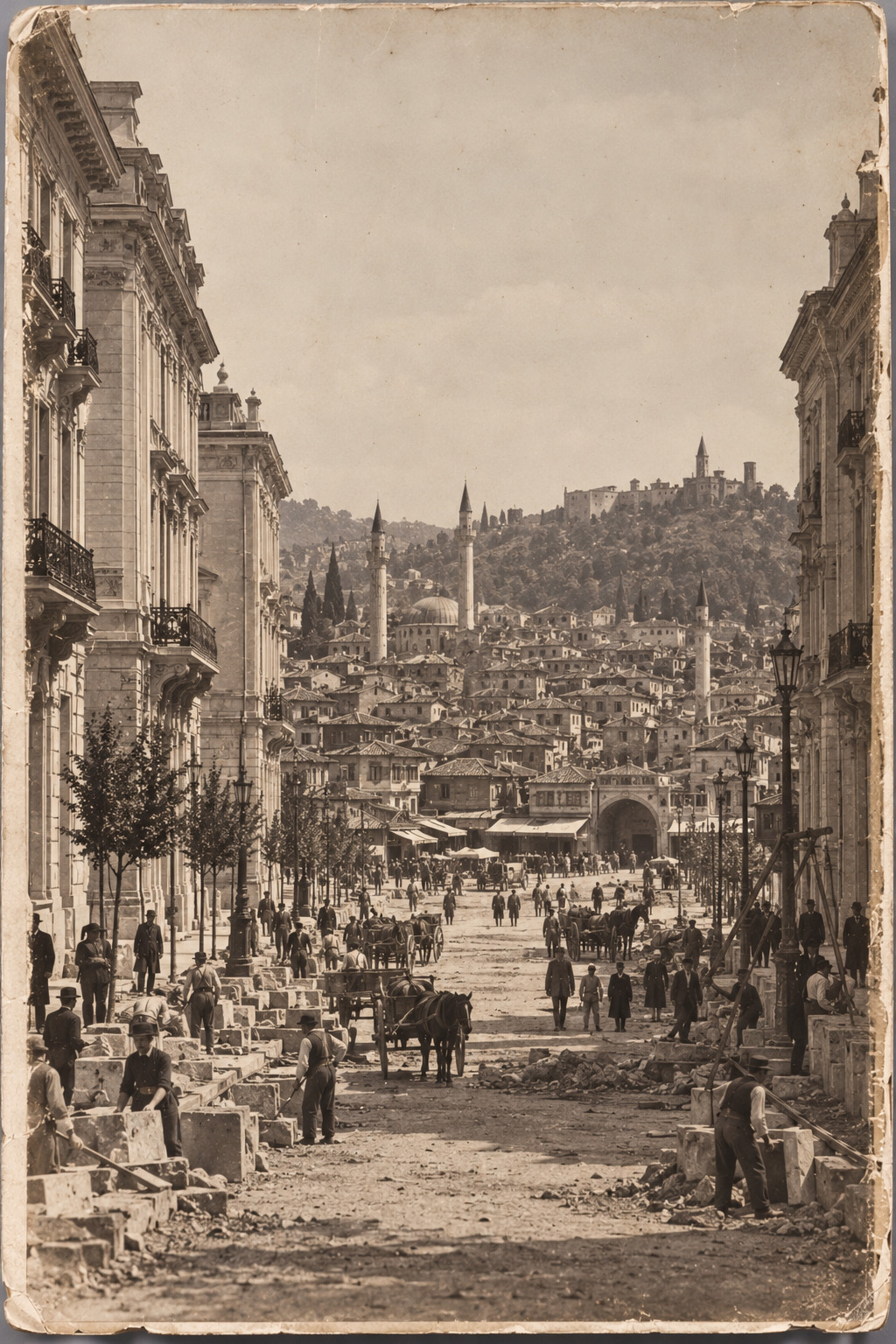
Albumen photograph of a boulevard being cut through Klow: tall neoclassical facades with iron balconies rising on both sides, dressed stone blocks, rubble and workmen with horse carts along the open excavation, and beyond it the old town with its covered bazaar, minarets and a citadel on the wooded hill

The cutting of the great avenues of Klow, the new boulevard and the old bazaar
Albumen print on card, circa 1865

1850-1867: The Royal Archives and the Klow Boulevards

Under the reign of King Milan V, the Royal Archives Codification Act established a national standard for classifying and preserving state documents. The act introduced permanent indexing systems, stamped routing slips, and the threefold duplication rule still honoured today. It also laid the foundation for the University Archives of Sprodj, securing Syldavia's reputation for meticulous recordkeeping and archival integrity.

The same reign drove the great avenues through Klow, on the model of Baron Haussmann's works in Paris. The undertaking stayed partial: a few quarters received straight boulevards and aligned frontages, while the old bazaar and the Ottoman lanes were left as they stood. Klow keeps from that period its characteristic contrast, where a 19th-century avenue gives without transition onto a covered market and its minarets.

Albumen photograph on a foxed card mount: a gaunt young king sits in a cane chair on a terrace, wrapped from chest to feet in a heavy patterned travelling rug, a dog lying at his feet; an attendant in a frock coat stands behind him, and beyond the stone balustrade lie a valley town and snow-capped mountains

King Ottokar V at Pau, 1869
Albumen print on card

1867-1870: The Short Reign of Ottokar V

Ottokar V, son of Milan V, came to the throne in 1867 and was almost at once prevented from exercising it. His health failed within months, and from the winter of that first year he entrusted the government to his son as regent.

He died of tuberculosis at Pau in 1870, after three years in which he had reigned without governing. The regent who had held the country in his name succeeded him as Muskar X, and would carry it into its modern age.

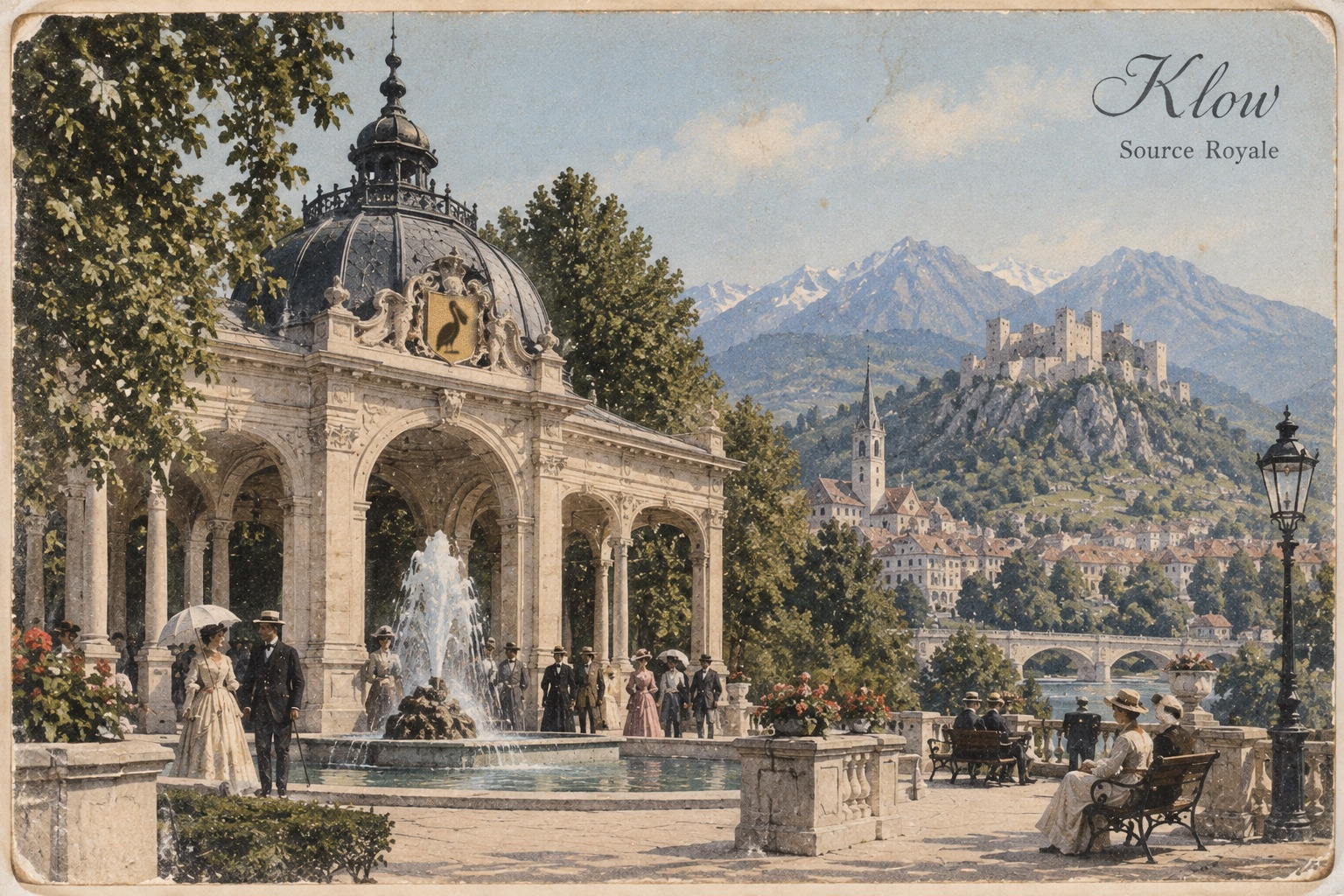
Chromolithograph: a domed neo-baroque pavilion sheltering the Klow spring, its pediment bearing the black pelican on a yellow shield, belle-epoque visitors with parasols around the basin, the town and a hilltop castle beyond, lettered Klow Source Royale

The Royal Spring of Klow
Chromolithograph by the Royal Klow Water Company, circa 1895

1870-1909: Tongo, the Klow Spring and the Cyrillic Reform

Two events under Muskar X (1870-1909) opened the way to the kingdom's economic take-off: the commercial launch of Klow mineral water by Wladimir Hônthon, and Prince Slava's expedition of 1871, which brought Syldavia to Tongo. The territory was held from 1885 as the king's own possession rather than the kingdom's, and became a Syldavian colony only in 1909, when his successor ceded his personal rights to the State. It was Muskar X, too, who instituted the Order of the Golden Pelican in its three grades of knight, commander and grand cross, which remains the highest distinction the Kingdom can confer.

The same reign saw a policy of cultural affirmation. In the spirit of the panslavism then in vogue, sharpened by the influence Russia sought in the Balkans, the Syldavian language was reslavicised by an orthographic reform, and the Cyrillic alphabet was adopted.

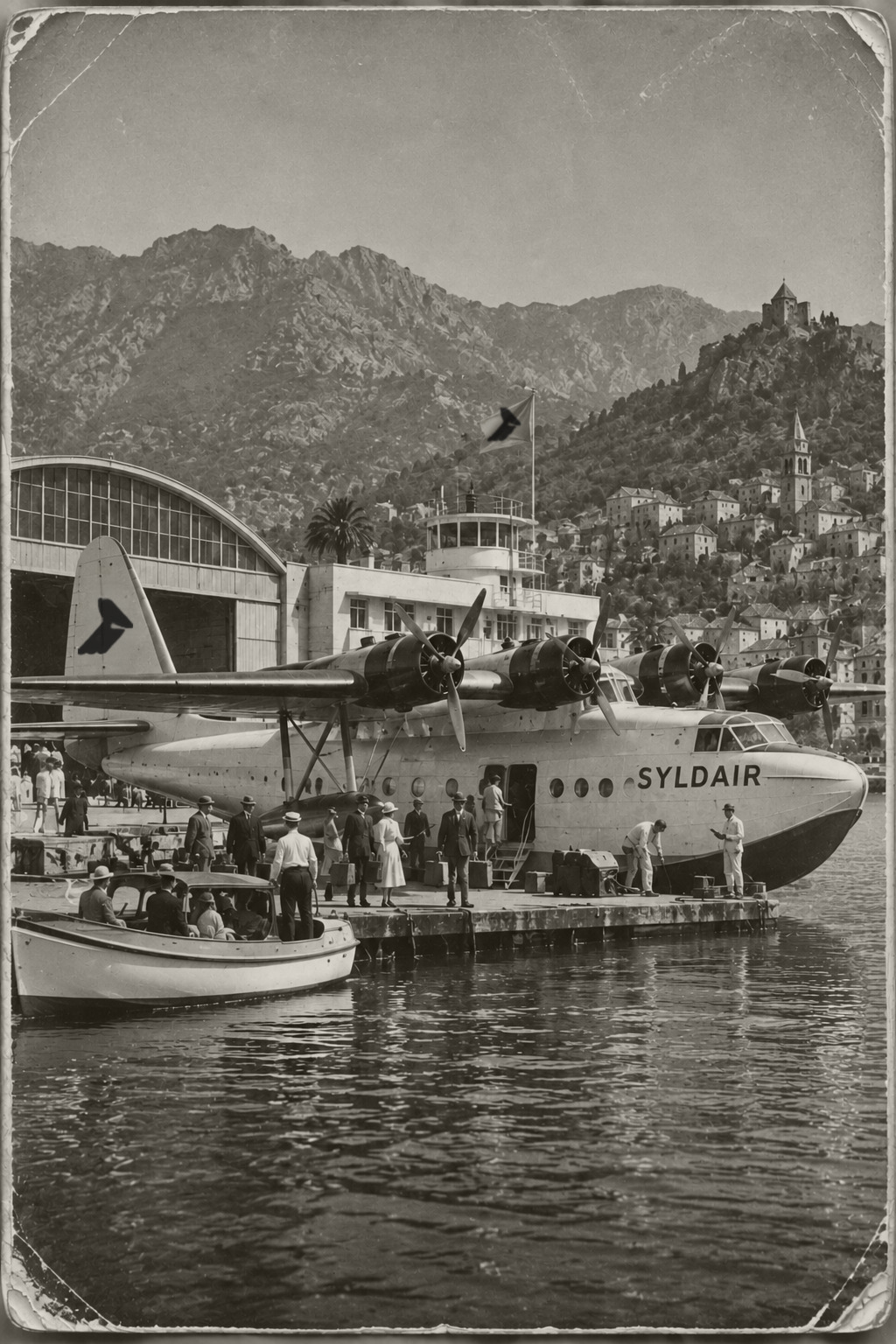
Photograph: a four-engined flying boat moored at a jetty, a black pelican on its tail fin and SYLDAIR on the hull; passengers in 1930s dress and ground crew stand among baggage on the pontoon, a launch waits alongside, and behind rise a curved-roof hangar, a moderne terminal flying the pelican flag, a hillside town and mountains

The Syldair flying-boat base at Douma
Photograph, about 1935

1909-1937: Muskar XI, the Kursaal and Klow Airport

Muskar XI (1909-1937) was a musician before he was anything else. He encouraged the practice of the violin and the accordion, founded an academy, and built the Kursaal, the opera house that gave Syldavia a name in the lyric art well beyond its own borders.

The reign closed on a different kind of ambition. The building of Klow airport, today the country's international gateway, was the work of his eldest son the Prince Viktor, who founded the national airline Syldair and the seaplane base at Douma, from which a regular service ran to Marseille. He also built an airport at Tongolala to serve operations in the Tongo.

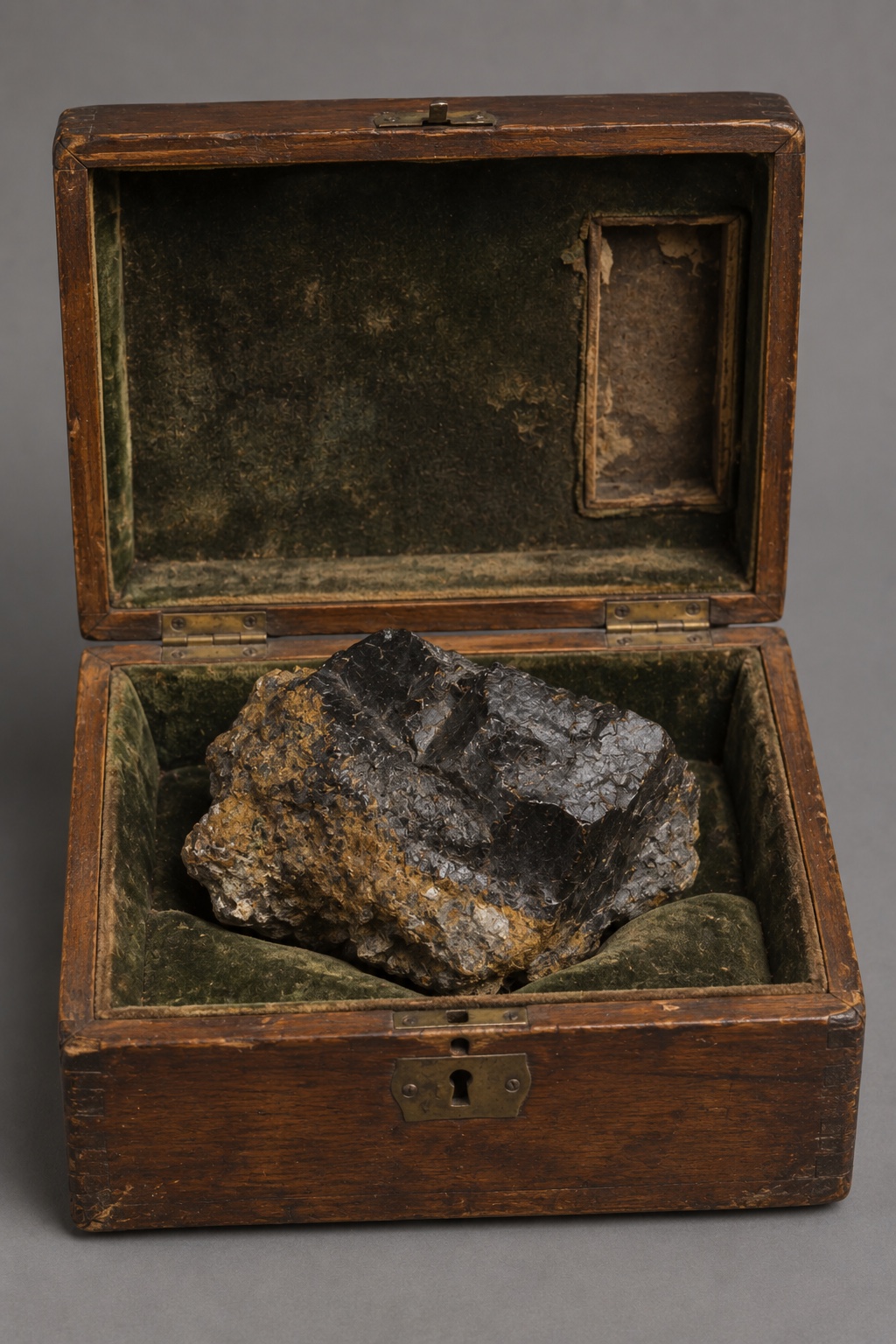
An old oak specimen case with brass hinges and a lock, lined in worn olive velvet, its lid holding an empty torn label pocket; inside lies a lump of dark grey-black ore with a lumpy crystalline surface and patches of yellow-ochre alteration, photographed against plain grey

The Klaproth specimen
Pitchblende in an oak case, late 18th century. University Archives of Sprodj

1789-1937: The Origins of Sprodj

In 1789 a Syldavian chemist who had entered the service of Prussia, Henrïc Klaproth, analysed a fragment of pitchblende brought back from a walk at home and identified in it an element nobody had yet named: uranium. The stone then waited a century and a half for anyone to ask where it had come from.

His great-grandson obtained the King's authorisation to look. The mine lay in the massif of the Zymylpathians, close to the Bordurian frontier, and the expedition was a success. A line of fortification was thrown up along the border at once, and further inland, at Sprodj, the Kingdom built the centre that would work the ore. Everything Syldavia would later be known for in the sciences begins with that walk.

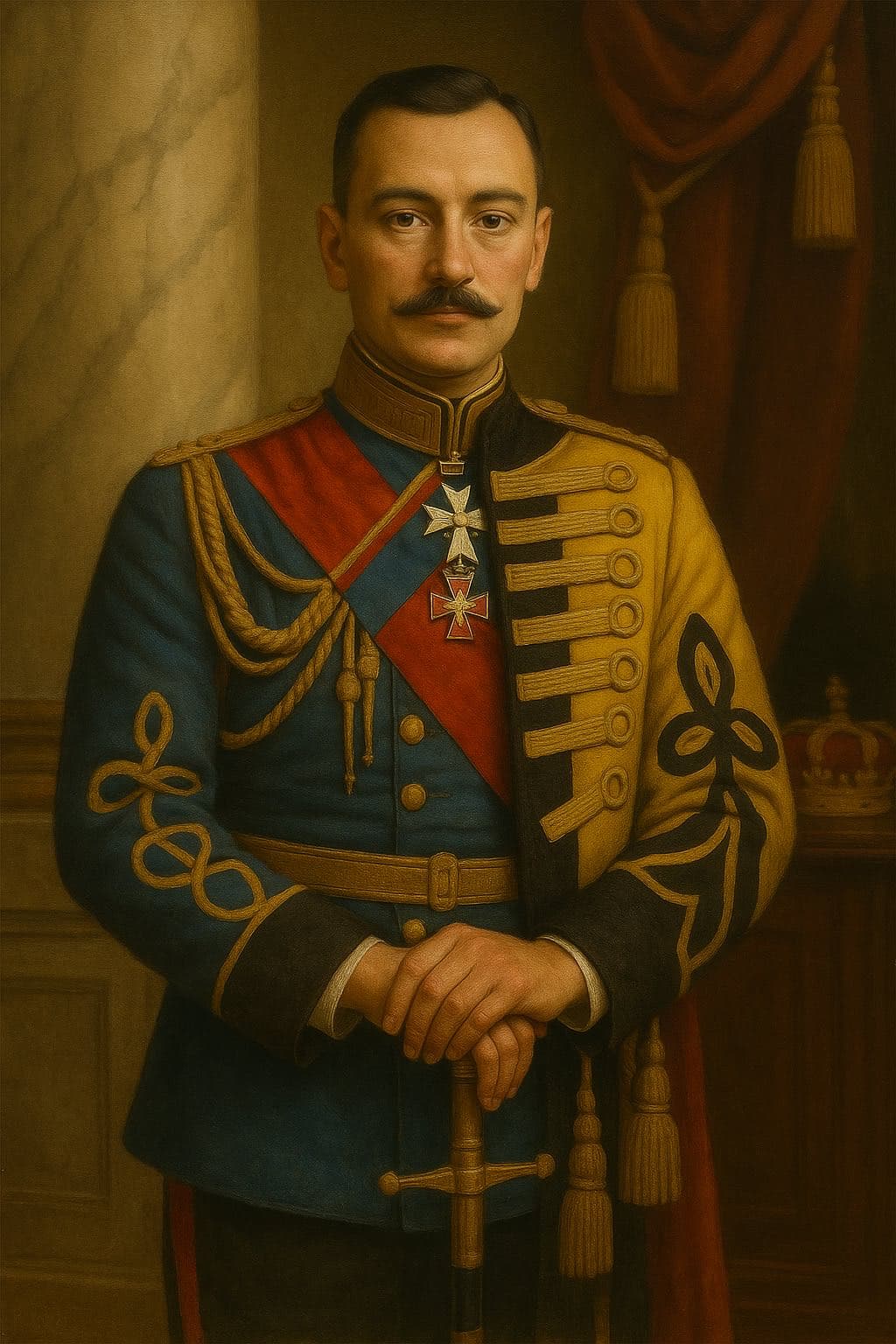
Painted portrait of King Muskar XII of Syldavia in a braided hussar uniform of blue and gold, a red sash across his chest and two crosses at his breast, both hands resting on his sword hilt, a crown on a table beside him under a draped curtain

Official portrait of His Majesty King Muskar XII
Oil on canvas by Jozef Nieszka (1937)

1937: Accession of Muskar XII

King Muskar XI died shortly after his own crown prince. Prince Viktor had been killed at the motor Grand Prix of Angoulême, and the Crown fell instead to his younger brother Muskar XII, who was forty-three, whom nothing had destined for the throne.

The succession was confused, and it was tested at once: Prince Karamellovitch, a distant cousin of the kings of Syldavia living in exile in Borduria, attempted to seize King Ottokar's Sceptre in order to claim the throne. The attempt failed. The reign then beginning would last thirty-eight years and carry the Kingdom through the Sceptre Crisis, the occupation, Sprodj and the Moon.

The life of Muskar XII →

Sepia photograph of a court ceremony in a palace hall: King Muskar XII, in uniform with sash and orders, and Queen Milena, in a pale gown and tiara, seated on two thrones beneath a tall banner embroidered with a black pelican, wings displayed, under a crown; Royal Guardsmen in plumed kalpaks stand at either side and courtiers in uniform and evening dress fill the foreground with their backs to the camera

King Muskar XII and Queen Milena at the Royal Palace of Klow
Period gelatin silver print, 1938

1938: King Ottokar's Sceptre and the Bordurian Plot

In a covert operation orchestrated with the complicity of Müsstler, leader of the Iron Guard, Bordurian agents took King Ottokar's Sceptre from Kropow Castle on 11 July 1938, to destabilise the monarchy on the eve of Saint Wladimir's Day. The plot was foiled thanks to the decisive intervention of Belgian journalist Tintin, which preserved the Crown. In recognition of his service, Tintin became the first foreigner to be awarded the Order of the Golden Pelican. This dramatic episode is now commemorated annually as Sceptre Day. The events are of July 1938: the adaptation Hergé drew from them began appearing in Le Petit Vingtième on 4 August 1938 and was not collected as an album until 1939, which is the source of the common confusion over the year.

The Sceptre of Ottokar →

Black and white photograph of an occupied market square: two soldiers in field caps and tunics, belted and booted, stand facing an elderly local man in baggy trousers, waistcoat and cap who holds a large copper vessel in both hands; more soldiers wait behind him beside empty wooden trestles under canvas awnings, with stone-roofed Ottoman houses, a minaret and bare hills beyond

The market at Niedzdrow under occupation
Bordurian propaganda company, 1941. Seized holdings, University Archives of Sprodj

1941-1945: Occupation and Liberation

On 8 March 1941, Borduria, an Axis ally, invaded the Kingdom alongside the German army. Klow fell, and the country endured four years of occupation. Muskar XII did not abdicate: he entered the resistance and remained in his own country in hiding.

Syldavia was liberated on 4 March 1945, four years almost to the day after the invasion. The monarchy was restored, the King came out of hiding with the sceptre he had kept safe. The date has been kept ever since as the Liberation Day.

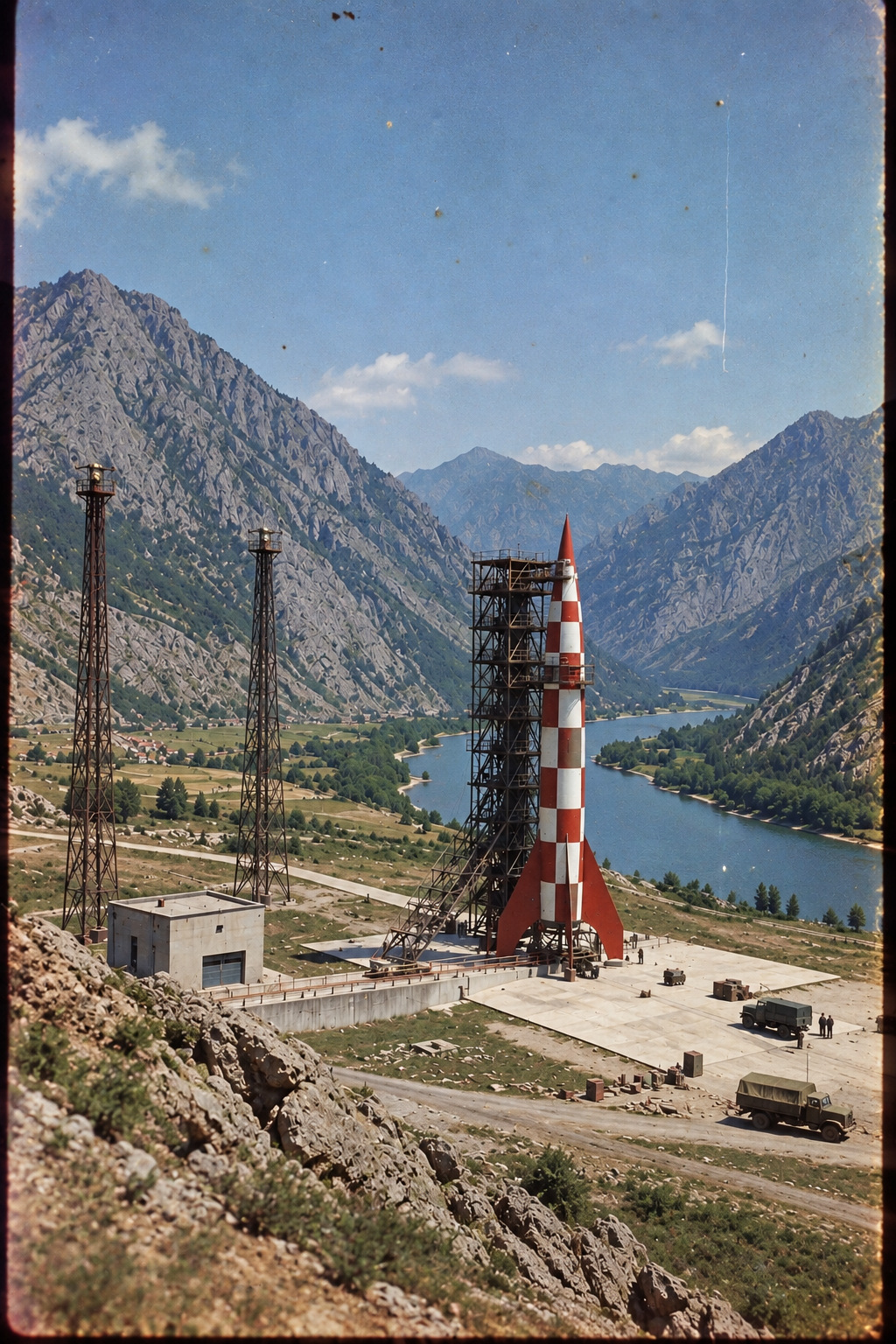
Colour photograph of an early test rocket, a prototype predating the XFLR programme, standing on its steel gantry at the head of a mountain valley: a red and white chequered hull with straight fins and none of the lunar rocket's landing legs, a concrete apron, two lattice pylons, a low blockhouse, khaki trucks and figures at the foot of the gantry, a turquoise lake and wooded rock faces behind under a clear sky

A prototype of the series that preceded XFLR, on its gantry at the Sprodj test range, 1951
Original colour transparency, photographic service of the Sprodj Atomic Research Centre

1950s: The Sprodj Programme and Lunar Triumph

Sprodj Atomic Research Centre, hidden deep within the Zymylpathian Mountains, marked Syldavia's entry into peaceful atomic science. It also became the launch site of the first human expedition to the Moon, the Syldavian lunar mission of 3 June 1952. Under the scientific direction of Professor Cuthbert Calculus, a crew including Belgian reporter Tintin and Captain Archibald Haddock set foot on the lunar surface, seventeen years before Apollo 11. The triumph was shadowed by sacrifice: the engineer Frank Wolff gave his life on the return journey, stepping out into the void so that his companions might reach home. It was shadowed, too, by misfortune. The live broadcast broke off after twelve minutes, and the film exposed on the Moon was destroyed during re-entry: of the first photographs ever taken there, only a handful of fogged negatives survive. The world would come to know the Lunar Triumph through Hergé's comic adaptations rather than through photographs.

The Lunar Triumph →

Black and white portrait photograph of Auguste Piccard physicist and explorer

Professor Calculus, photographed under the alias “Auguste Piccard”
Switzerland, 1932. Source: Bundesarchiv

1956: The Calculus Affair

Four years after the Lunar Triumph, Professor Cuthbert Calculus, Head of the Astronautical Section at Sprodj, was abducted in Switzerland by Bordurian agents seeking to exploit his revolutionary ultrasonic research for military purposes. The crisis was resolved through the intervention of Tintin and Captain Archibald Haddock, who secured the professor's release from the fortress of Bakhine. The affair heightened tensions with Borduria and strengthened the protection given to the facilities and scientists of Sprodj. Professor Calculus's steadfast refusal to cooperate with his captors cemented his status as a national hero.

Photograph of Queen Mother Valeska in mourning black and lace veil, her hand on the shoulder of the young King Ottokar VI, who wears the yellow sash and star of a Syldavian order, plumed guards and funeral flowers behind them

Her Majesty Queen Mother Valeska and the young Ottokar VI at the obsequies of Muskar XII
Marko Vlednik, Syldavian Royal Press Agency (APRS), September 1975

1975: Succession of Muskar XII

Upon the death of Muskar XII in 1975, his eldest son Milan had long since renounced his dynastic rights to devote himself to religious life. Archbishop of Klow, Abbot of the Cloister of Saint Wladimir and Apostolic Nuncio for Syldavia, he remained outside the succession. The Crown therefore passed to his younger brother, the young Prince Velimir of Almaszout, still a child, who was proclaimed king under the name Ottokar VI. The Queen Mother Valeska, assisted by the Royal Council, assumed the regency and ensured the stability of the institutions and the continuity of the monarchy.

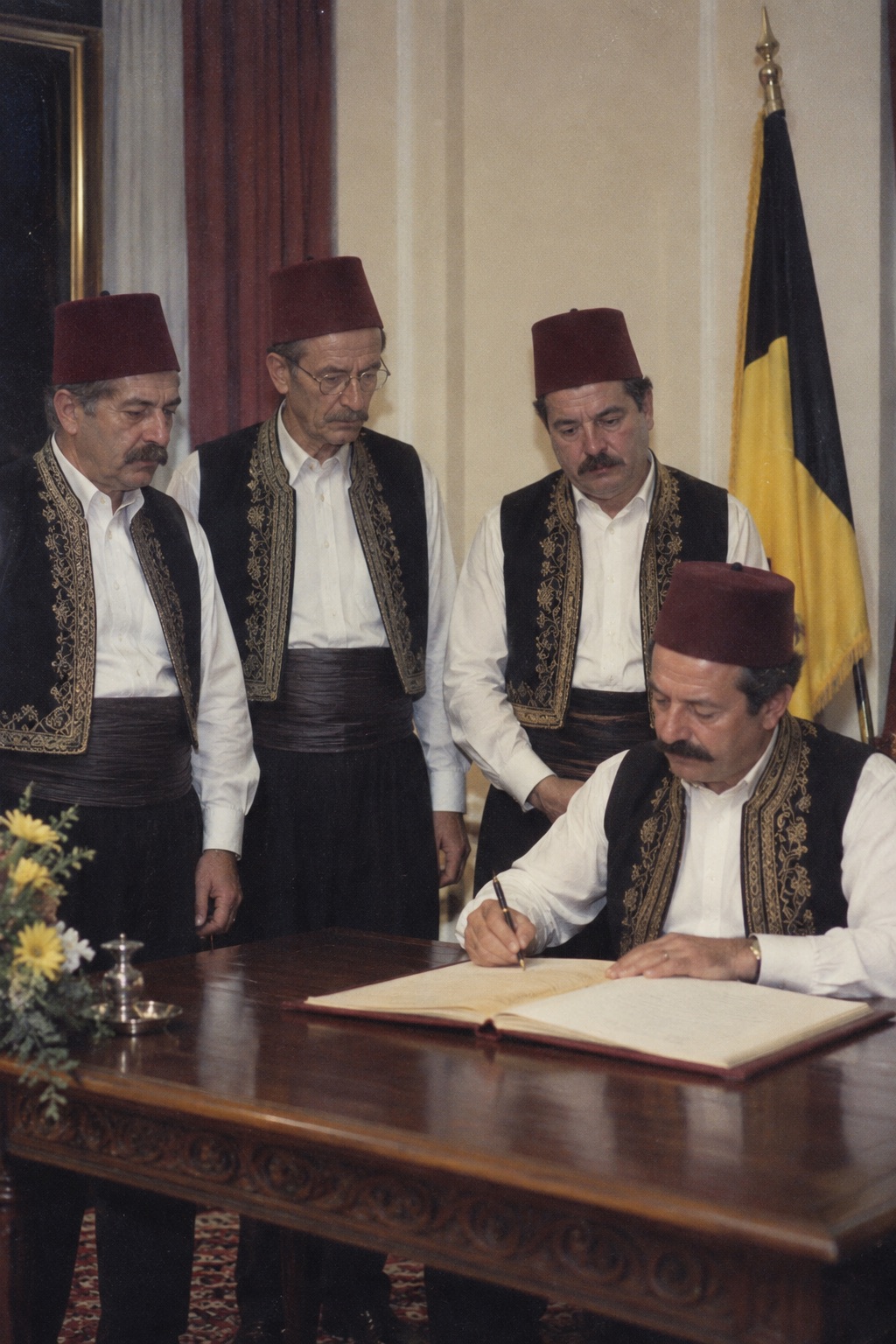
Photograph of the ratification of the Syldavian Constitution: four men in fezzes and embroidered waistcoats around a table, one of them signing a large register, the black and yellow national flag beside them

Signing of the Constitution
Photograph by S. Jakubov (1987)

1987: New Constitution, Strengthened Douma

Following the great demonstration of 12 January 1987, known as the “Syldavian Spring”, a new Constitution came into force, reaffirming civil rights and the separation of powers, strengthening the Douma and establishing a ceremonial monarchy. It was Ottokar VI, who came of age that year, who decided to adopt it: the regency of Queen Mother Valeska came to an end and the King entered on his personal reign.

It remains the foundation of the present system: the Douma governs and legislates, while the Crown retains its constitutional and ceremonial functions. The Constitution is symbolically reaffirmed each year on Saint Wladimir's Day, prior to the royal procession through Klow.

Official photograph of King Ottokar VI in dark uniform, wearing the yellow sash and the collar of a Syldavian order, the black pelican standard on a yellow field behind him

His Majesty Ottokar VI, official portrait
Katarinak Blenkantow, Klow, 2000

2000: The Turn to Modernisation

At the turn of the century, the reign of Ottokar VI opened an era of modernisation and closer ties with the West, particularly in the fields of science and higher education.

Thirteen years had passed by then since the King came of age. The Syldavia the new century discovered was the Syldavia of its laboratories and its universities, faithful to a scholarly tradition running from the foundation of the University of Klow, seven centuries earlier, to the work at Sprodj.

The year also saw, in the utmost discretion, the opening of a sensitive affair concerning a figure connected with the late King Muskar XII. The Consulate in Bangkok investigated it; its dossier remained under seal until 2025.

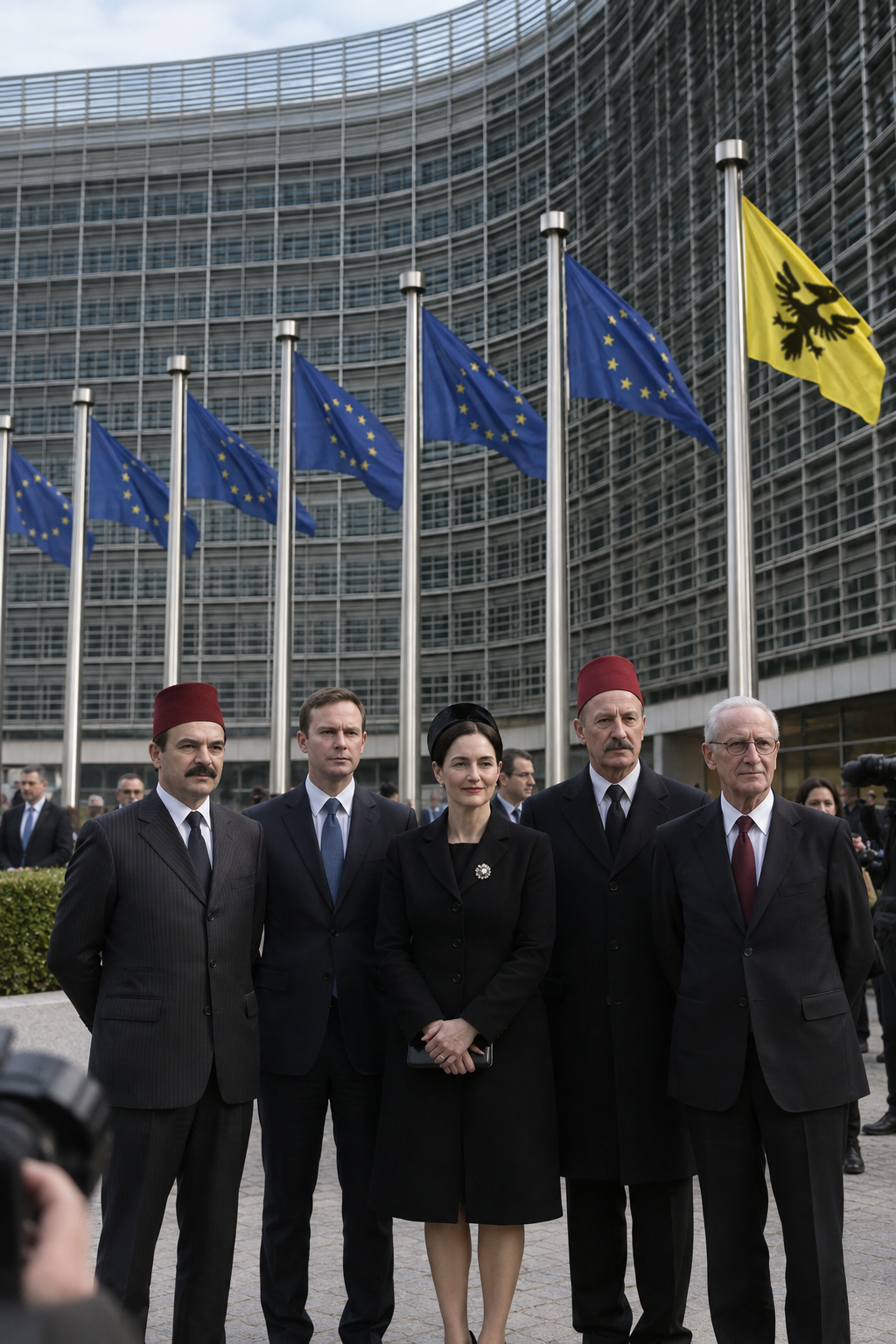
Five members of the Syldavian delegation posed outside the curved glass facade of the Berlaymont, two of them in red fezzes, a row of European Union flags and the Syldavian flag on poles behind them, Brussels, 2010

Syldavian delegation in front of the Berlaymont, Brussels, 2010
Photograph: Ministry of Foreign Affairs of Syldavia

2010 - European Integration in Abeyance

Having joined the Council of Europe and the European Convention on Human Rights in 1992, Syldavia once considered a closer alignment with the European Union. Between 2007 and 2010, a policy of détente with Borduria, including a joint civil nuclear project, even allowed both states to participate, on an experimental basis, in certain activities of the European Commission. This brief episode came to an end in 2010, following a military incident at the border and Syldavia's ongoing failure to meet budgetary criteria. Since then, the Syldavian process of rapprochement has remained dormant, while the kingdom continues to cooperate with its European partners through other channels.

The hemicycle of the French National Assembly in the Palais Bourbon, Paris

The hemicycle of the French National Assembly, Paris
Photograph, public domain

2011: The Sceptre Stolen Again

In July 2011, around Saint Wladimir's Day, Bordurian troops were massed on the Syldavian frontier, under the authority of General Boris Stefanovitch Plekszy-Gladz, head of the Bordurian State since 2003, and the spectre of war returned once more. The escalation did not stop there. On 25 October 2011 the Sceptre of Ottokar was stolen, as it had been in 1938. Without the sceptre, the king loses the right to reign: it was the Crown itself that was at stake.

The crisis, at the eastern gates of the European Union, made heads of state and government fear the appearance of “a new Bosnia”. It was raised in Brussels on 23 October, and the French National Assembly gave a whole session to it two days later, during which the theft of the sceptre was announced. The Twenty-Seven did not agree on a common approach. The decisive response came not from the speeches but from Belgium: the work of the SGRS, in cooperation with the Syldavian ZEPO, defused the situation, against their Bordurian counterparts of the ZEP. The sceptre came back through the same services; the details have never been disclosed. The episode is reconstructed by Gérald Arboit, of the Centre français de recherche sur le renseignement, in La guerre secrète belgo-borduro-syldave.

The Sceptre of Ottokar →

Klow today, a modern avenue with a tram, civic banners, cafe terraces, and the minarets and hilltop fortress of the old town behind

Klow today: the avenue, the tram, and the old town above
Syldavian Royal Press Agency (APRS), 2026

Present Day: Continuity and International Presence

Proclaimed king at five years old in 1975, Ottokar VI has reigned for more than half a century: no sovereign had worn the crown so long since Muskar VI, whose reign ended in 1699. The monarchy is ceremonial, the Douma legislates, and it is by its embassies and its consulates, not by its arms, that the Kingdom makes itself known abroad today.

Tensions with Borduria have not disappeared, but they are closely watched. And the country goes on searching: from the pitchblende of the Zymylpathians to the Moon, and from the Moon to artificial intelligence, which it has taken up with SYLVIA.

The Sceptre of Ottokar has been stolen twice, in 1938 and in 2011; twice it has come back. Every year, on Saint Wladimir's Day, the King shows it again. For nine centuries Syldavian sovereignty was taken and retaken with weapons in hand; today it renews itself to the rhythm of a ceremony, and the Kingdom fully intends that it should go on doing so for a long time yet.

Credits

Compiled by the Consulate from:

  • The Royal Archives of Syldavia, Kropow Castle.
  • Arboit, Gérald, CF2R, La longue guerre secrète belgo-bordure, 2011: the secret war of 2011.
  • Elphara, Kcets, Institut des Hautes Études Religieuses, Université Ottokar II, Klow, Saint Wladimir, Saint Patron de la Syldavie, sa vie et son culte: Saint Wladimir and the spring of Klow.
  • Fabry, Jonathan, La colonisation du Tongo par la Syldavie (1871–1956): the colony of Tongo.
  • Fabry, Jonathan, Presses Universitaires de Klow, 2021: Histoire de la Syldavie, de l'Antiquité à nos jours and his study of King Ottokar's Sceptre.
  • Goddin, Philippe, Chronologie d'une œuvre, vol. 3, and vol. 6: Hergé's albums.
  • Assouline, Pierre, Le Monde, 27 October 2011: the session of the French National Assembly.

Except where the caption states otherwise, the paintings, prints, manuscripts and metalwork come from the permanent collection of the Royal Museum of National Memory, and the photographs from the University Archives of Sprodj.

These pages remain a work in progress; corrections and further information are welcome.

About the images. Images from The Adventures of Tintin and from other works are reproduced on this page for non-commercial documentation, commentary and research, each credited to its source, in keeping with the right of quotation and fair use. They remain the property of their rights holders. If you hold the rights to an image and would like it credited differently or removed, please write to us through the contact form.

Updated