Kropow Castle
Treasure Guard
Kropow Castle
Treasure Guard
The 3D model could not be loaded.
Description The Sceptre of Ottokar
A rod of gold set with stones and surmounted by the crowned pelican, the supreme sign of Syldavian kingship since Ottokar IV: without it, no king may reign.
- Length
- 69.6 cm
- Wingspan
- 16.8 cm
- Shaft diameter
- 2.6 cm
- Weight
- 1,023 g
- Finial
- A crowned pelican with raised wings
- Upper collars
- Two, one above the other, beneath the finial, each set with six stones
- Shaft
- Gold, in sections joined beneath the collars, on the Bohemian model
- Middle collar
- Halfway down the shaft, set with six stones
- Foot collar
- At the foot, set with six stones
- Stones
- Twenty-four, six to each collar: rubies, sapphires, emeralds and hyacinths, polished en cabochon, in closed settings
- Sign of kingship
- Since Ottokar IV (1360–1389)
- Kept
- The Treasure Chamber, in the keep of Kropow Castle
- Digital model
- GuanaBananas, MakerWorld · CC BY-SA, adapted
The Sceptre of Ottokar at a glance
- In Syldavian: Szepter fan Ottokâr
- What it is: the supreme sign of Syldavian kingship since Ottokar IV (1360–1389).
- Kept: in the Treasure Chamber, in the keep of Kropow Castle, under the Treasure Guard, since the reign of Muskar VII (1699–1741)
- Shown: every 15 July, Saint Wladimir's Day, when the King carries it through Klow
- Stolen twice: on 11 July 1938 and on 25 October 2011
The Sceptre
In Syldavia it is not the crown that makes the king. The crown stays in its case at Kropow; it is the Sceptre of Ottokar that the King presents to his people every 15 July. On the Kingdom's arms, the black pelican is often shown bearing the sceptre in its claw.
For so much authority it is a light thing: about a kilogram of gold, made in sections joined beneath its jewelled collars. Light enough to be carried through the streets of Klow for a whole morning; heavy enough to lay a man low, as a baron learned to his cost.
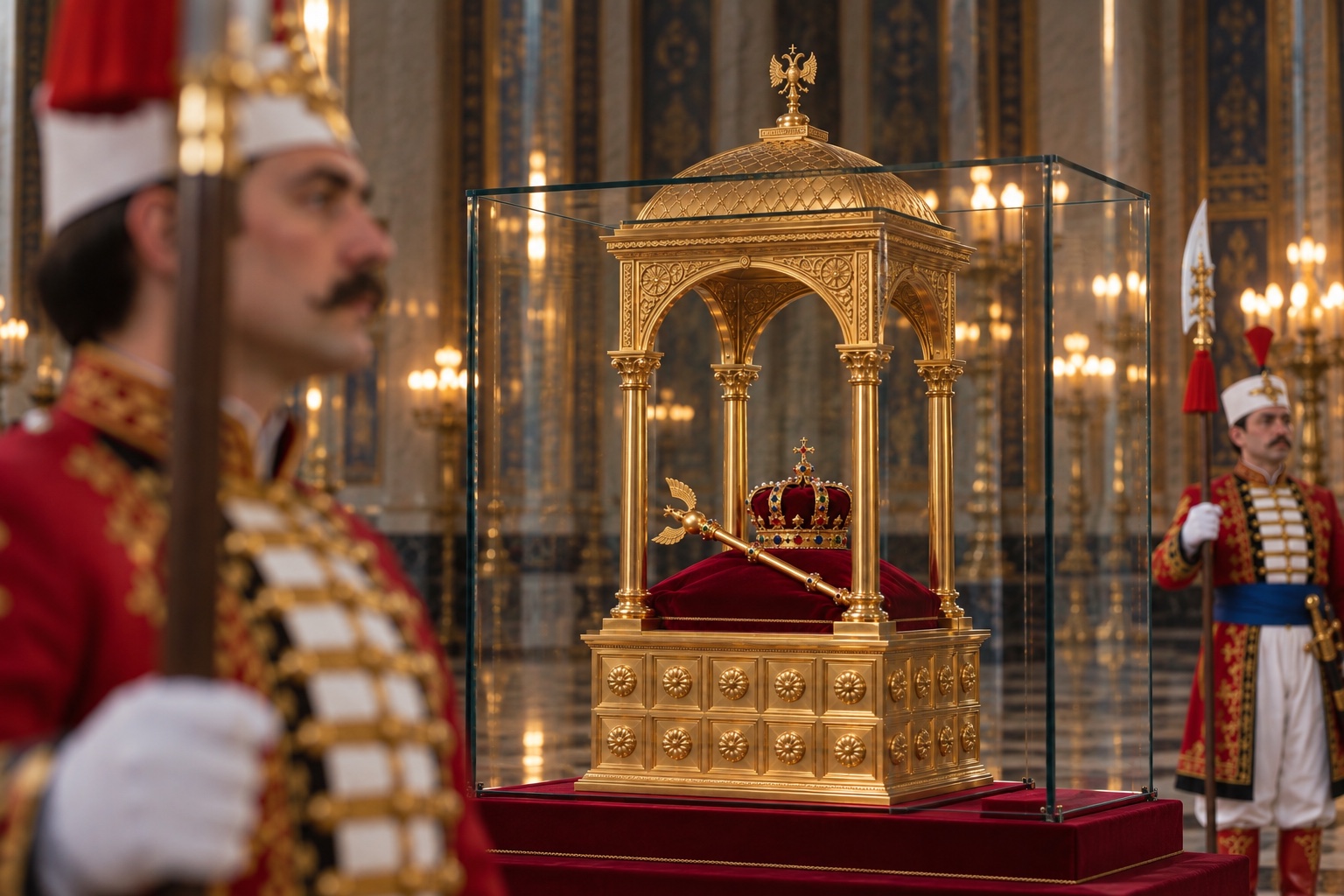
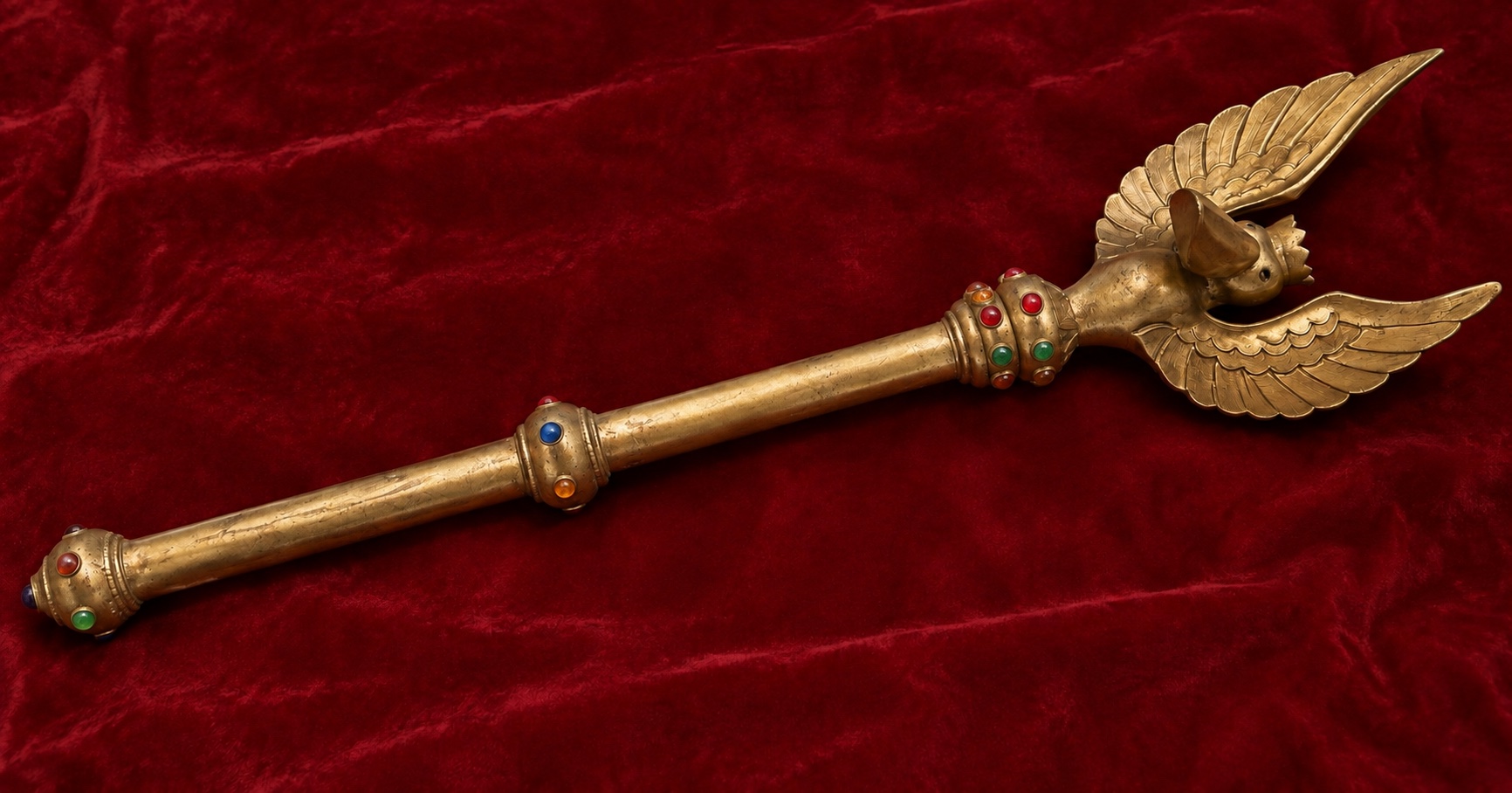
The Sceptre of Ottokar, in the Treasure Chamber at Kropow and out of its case
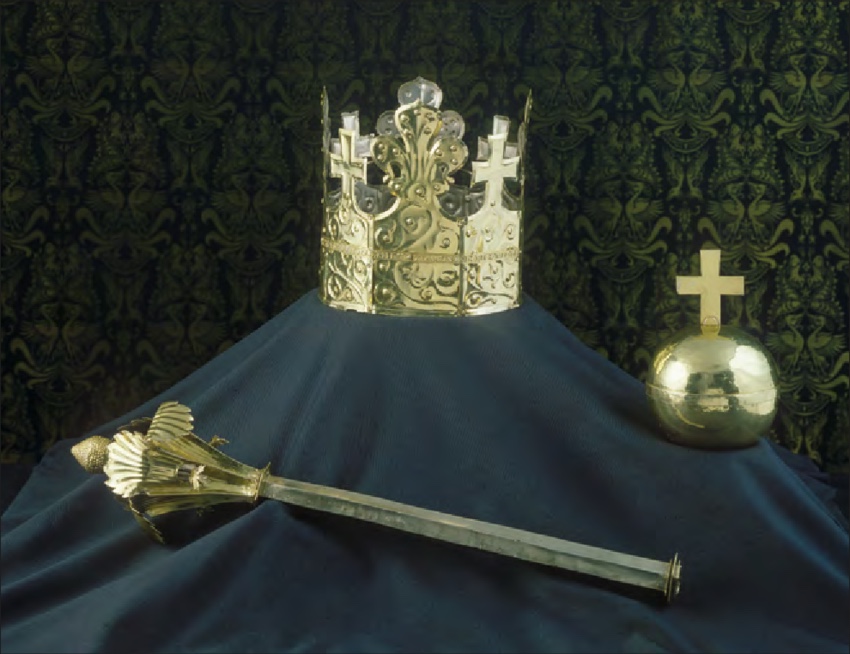
Not the sceptre of Bohemia
Its construction, in sections joined beneath the collars, is also that of the Bohemian coronation sceptre, made in Augsburg in 1533, and there the resemblance ends. The Ottokars of Syldavia are not those of Bohemia. Nor is this sceptre the one found in 1976 at St Vitus Cathedral in Prague, among the funerary regalia of Ottokar II of Bohemia.
Ottokar II of Bohemia also had a literary afterlife: Grillparzer devoted a tragedy to his fall before Rudolf of Habsburg, König Ottokars Glück und Ende (1825).
The Blow of the Sceptre 1360–1389
Syldavian tradition regards Ottokar IV, who came to the throne in 1360, as the true founder of the Kingdom. The royal chronicles credit him with building a powerful army, breaking the power of the barons and creating the security in which the country's arts, letters, trade and agriculture flourished.
The Memorable Deeds of Ottokar IV, an illuminated manuscript of the fourteenth century, tell how one day Baron Staszrvitch, the son of a dispossessed noble, came before the King, claimed the throne and demanded the sceptre. Ottokar rose and answered him in Syldavian:
Kzommetz pakkeh!
The baron drew his sword and charged. The King stepped aside, and as the baron rushed past him, carried forward by his own momentum, Ottokar struck him on the head with the sceptre and laid him low. Then he spoke the words that became the motto of Syldavia: “Eih bennek, eih blavek”, “If you gather thistles, expect prickles”.
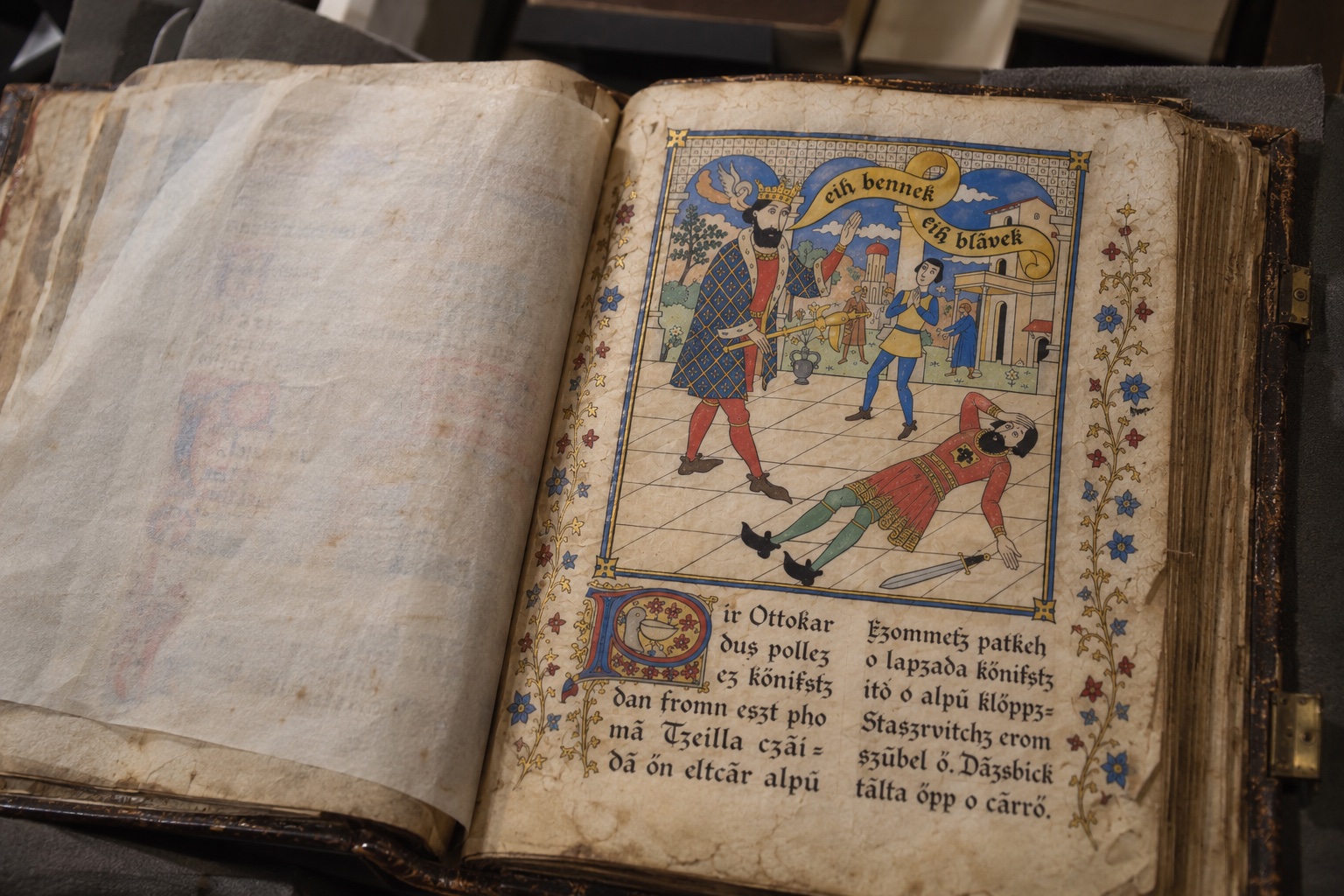
Turning to his astonished court, he added: “Honi soit qui mal y pense.”
The sceptre had saved the King's life, and Ottokar addressed it before the court:
O Sceptre, thou hast saved my life. Be henceforward the true symbol of Syldavian Kingship. Woe to the king who loses thee, for I declare that such a man shall be unworthy to rule thereafter.
From that day every successor of Ottokar IV has carried it through the capital on Saint Wladimir's Day, and as he passes the people sing:
Syldavians unite!
Praise our King's might:
The Sceptre his right!
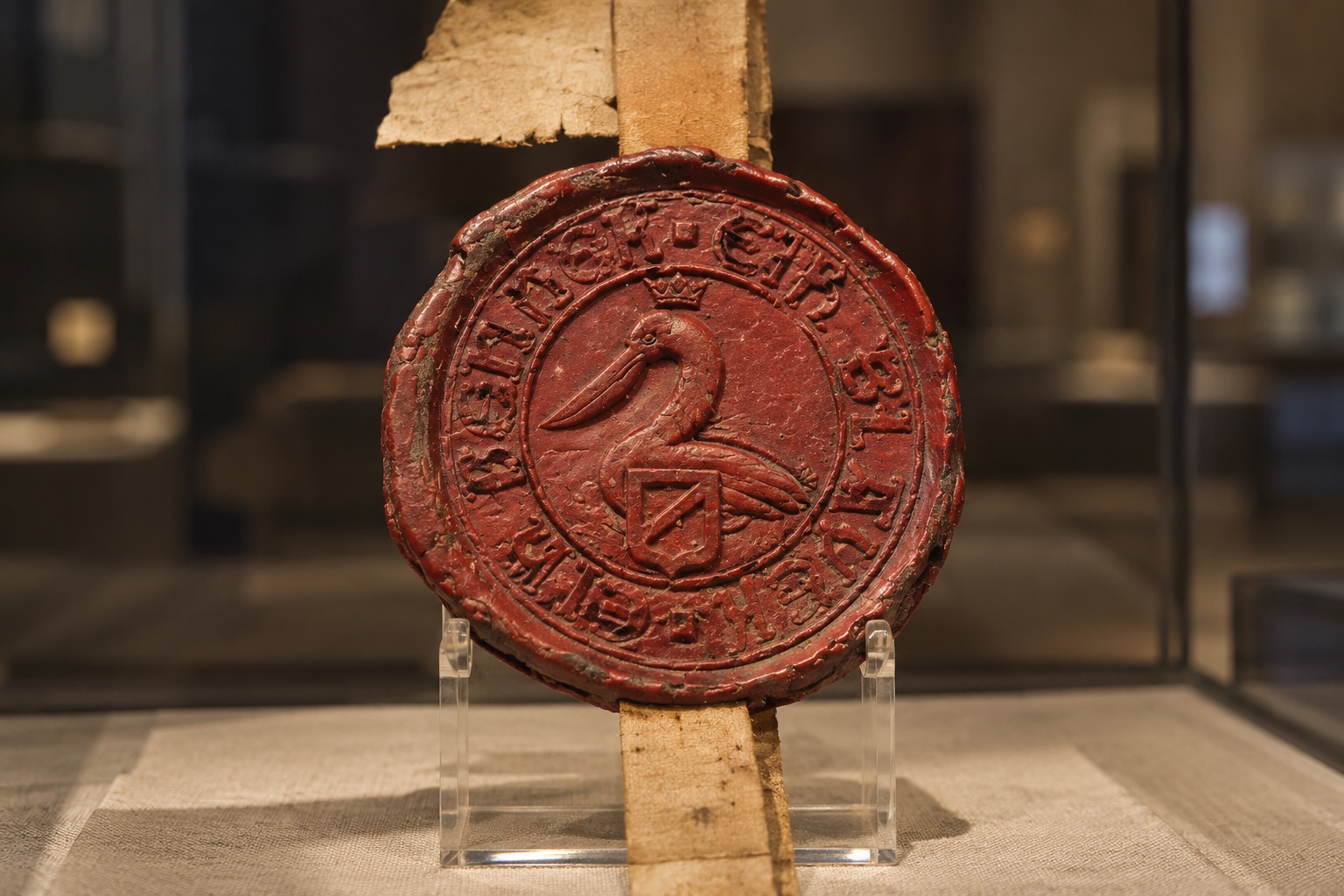
The motto also runs round the King's seal, one of the few seals of Syldavia's medieval kings to survive.
The chronicles record that Ottokar IV fell in 1389 at Kosovo Polje, taken prisoner and beheaded on the order of Sultan Bayazid. The sceptre outlived him.
Kropow and the Treasure Guard from 1699
It was Muskar VII (1699–1741) who established Kropow Castle as the repository of the regalia. The castle was already the Kingdom's oldest sanctuary: its first stones are the chapel the Emperor Justinian built there in the sixth century, and since Muskar I it has kept the relic of Saint Wladimir, which leaves the castle only on the eve of his feast.
Muskar VII entrusted the regalia to the former janissaries, who had twice helped the country win its independence. They exchanged the ak börk for a Syldavian kalpak bearing the pelican, and their uniform took its final form in the nineteenth century, under the influence of hussar dress.
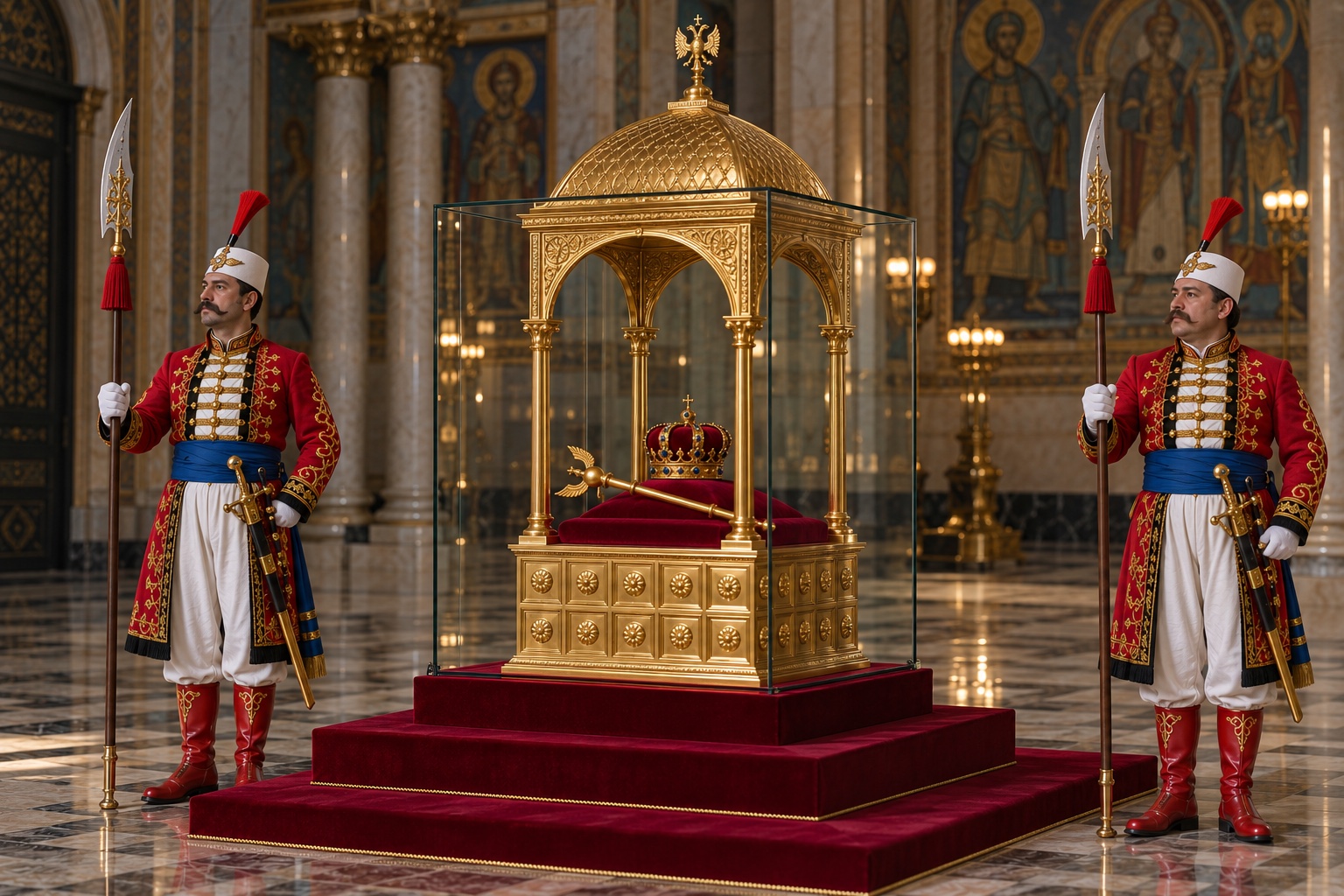
The regalia lie in the keep, the square tower at the centre of the castle, in the Treasure Chamber. The Royal Archives are consulted in the adjoining Muniments Room. Access to either is a privilege rarely granted to a foreigner and requires a document bearing the royal signature; visitors are locked in with two guards, and no one may photograph the documents except the official Court Photographer.
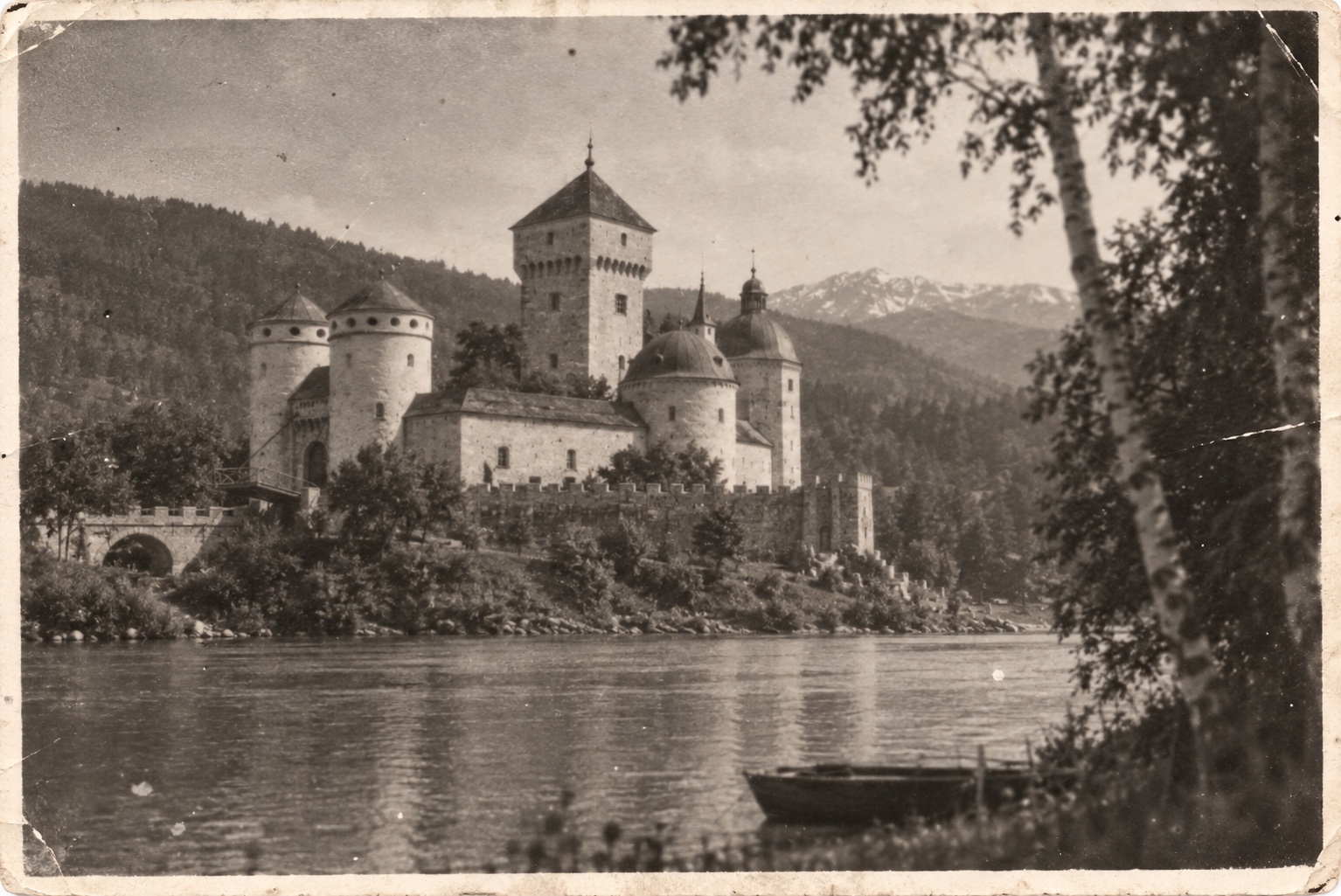
The chamber, painted with frescoes, has a single door, watched by two sentries, and a single barred window that looks out over the guarded courtyard and the ramparts to the river and a wood of birch trees beyond.
The Succession Crisis 1937–1938
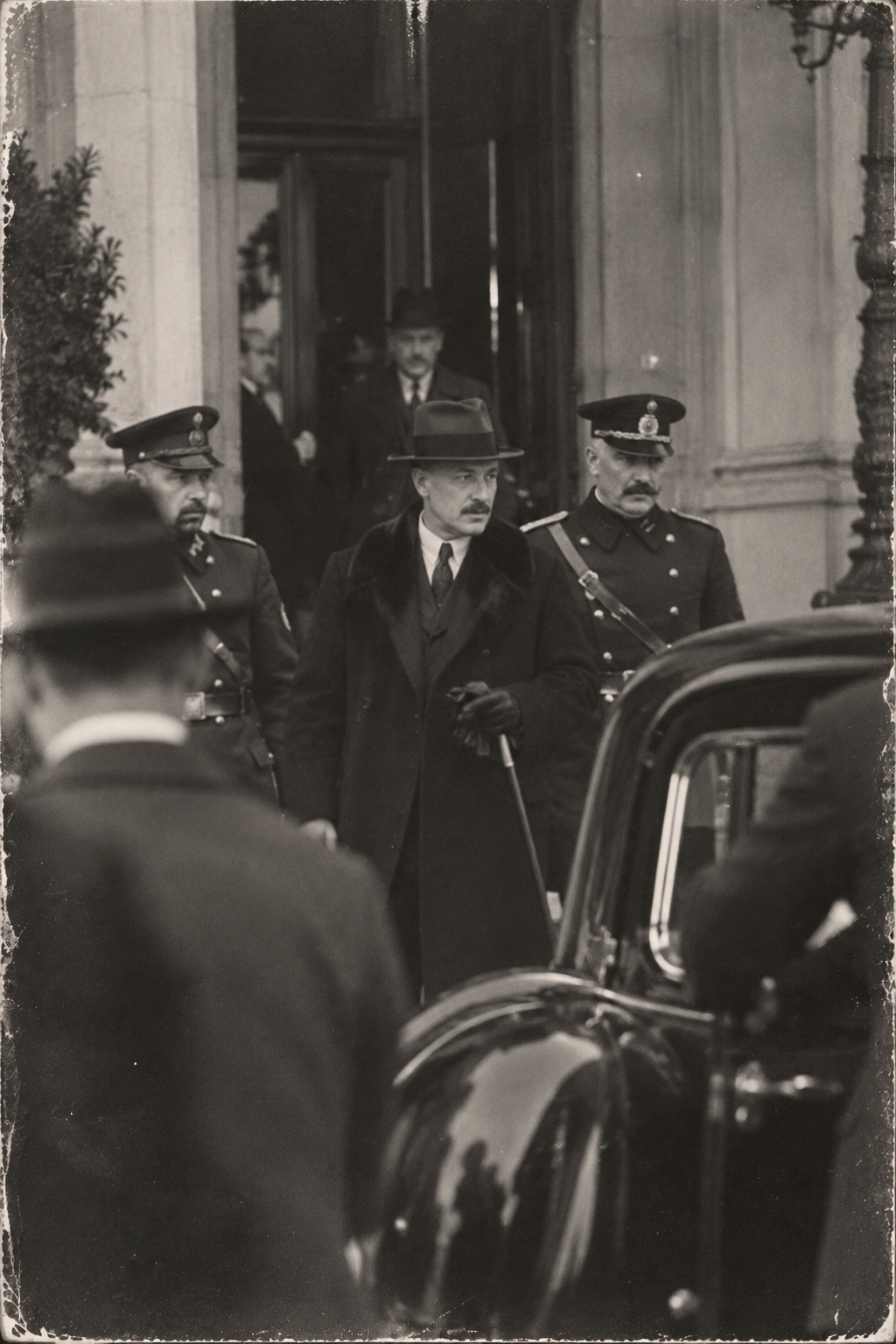
Muskar XI died in 1937, shortly after his heir. Crown Prince Viktor had been killed racing in the Angoulême Grand Prix, and the Crown passed to his younger brother, Muskar XII, forty-three years old, whom nothing had prepared for the throne (the life of Muskar XII).
Borduria, aligned by then with the authoritarian regimes gaining ground in Europe, meant to profit from the uncertain succession. The first candidate Borduria backed was a distant cousin of the kings of Syldavia, Prince Karamellovitch, who lived in exile on its soil. He tried to seize the Sceptre of Ottokar in order to claim the throne, with an eye, as later emerged, on the Kingdom's mineral deposits. The attempt failed.
The new reign and the pretender, 1937
The second attempt came the following year and was prepared on a much larger scale. Its author was a Syldavian, Müsstler, leader of the Iron Guard, under whose cover its members formed the Z.Z.R.K., the Zyldav Zentral Revolutzionär Komitzät. Its aims were the deposition of the King and the annexation of Syldavia by Borduria.
Their plan hung entirely on the sceptre. If it were stolen a few days before the feast, the King would have only two choices: abdicate, or face his people without it. Either would open the way for the coup. The plot had friends close to the throne, among them the King's own aide-de-camp, Colonel Boris Jorgen, and officers of the gendarmerie. It also had agents in Belgium. In Brussels, the sigillographer Hector Alembick, who had found the seal of Ottokar IV by chance in Prague, was preparing to leave for Klow to study the Royal Archives.
Towards Syldavia 7–9 July 1938
Tintin, a young Belgian reporter who had met the Professor when he returned a briefcase left on a park bench, was already on the conspirators' trail. On 7 July, back at the Professor's building to fetch a book, he heard a man with a foreign accent say through a door that they knew his name and needed his photograph. He followed him to the Klow, a Syldavian restaurant in Brussels, and overheard them: they were waiting for the Professor to receive his papers from the Embassy before acting. A warning to mind his own business only sharpened his curiosity. He agreed to act as the Professor's secretary and go with him to Syldavia. On the eve of the departure he heard the Professor cry out on the telephone, and found him minutes later calmly packing.
On 9 July Tintin and his dog Snowy flew out with the Professor. On the plane the clues piled up: the short-sighted scholar, without his glasses, could pick out a flock of sheep from the air, and he had not smoked a single cigarette since packing. It could not be the Professor. At Prague, pretending to trip, Tintin pulled his beard to unmask him: it was real. Tintin was baffled.
A special plane was waiting there to take them to Klow. Soon after the Syldavian frontier, the pilot opened a trapdoor under Tintin's seat and dropped him, seat and all. Tintin grabbed the parachute fixed under the seat but had no time to strap it on: as it opened, the jolt tore it from his hands, and it was Snowy who floated down beneath the canopy. Tintin crashed into a hay cart drawn by oxen and survived. That was how he entered Syldavia.
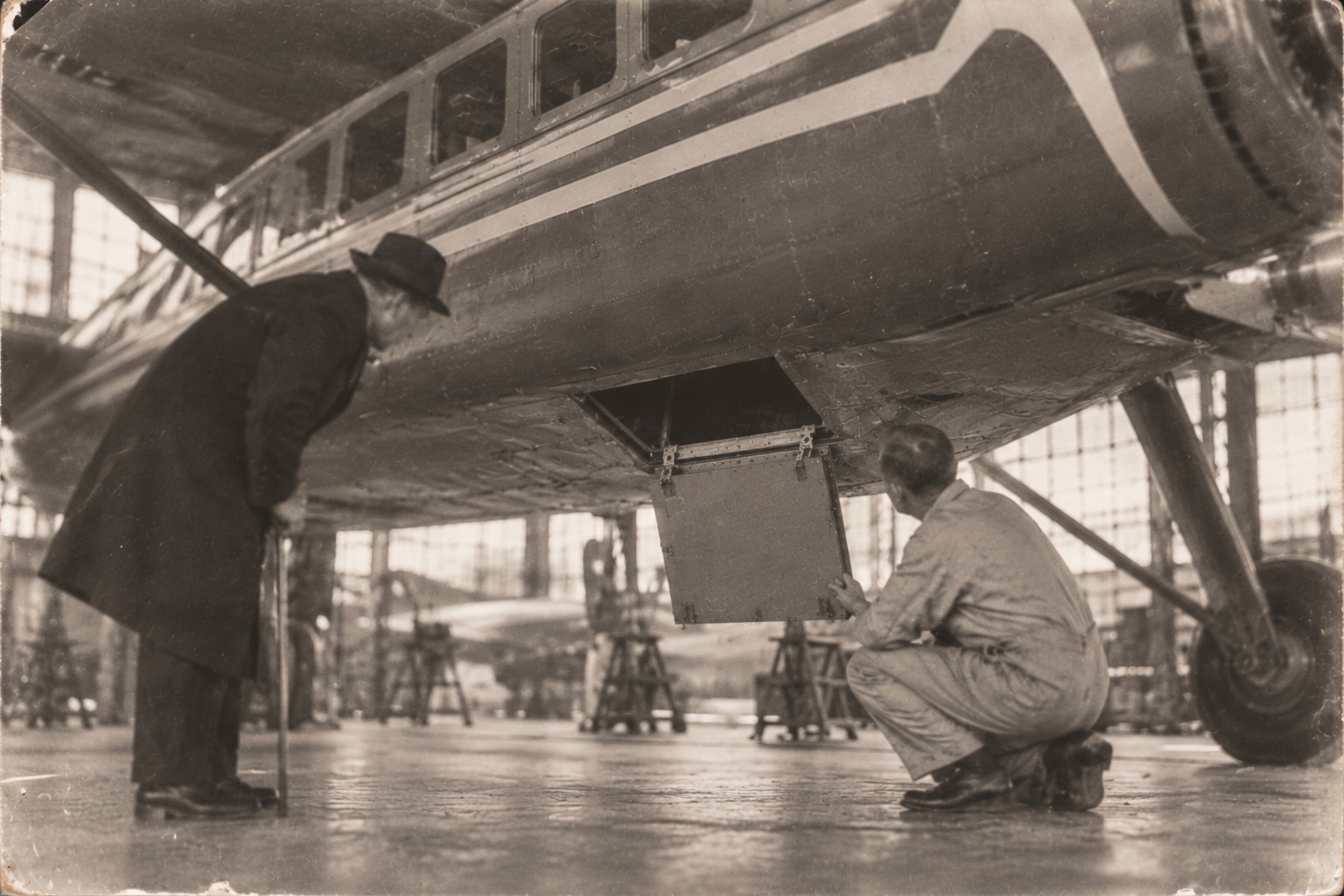
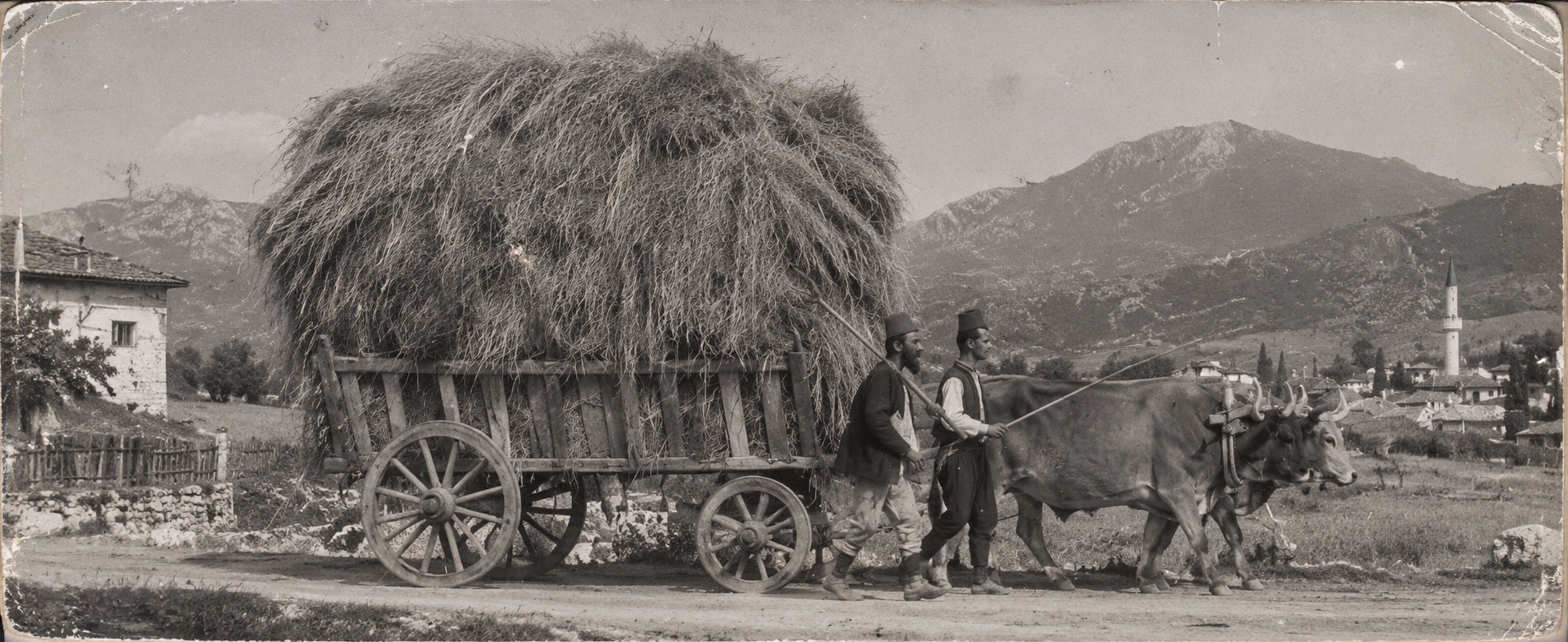
The special plane from Prague and a hay cart
Towards Kropow 9–10 July 1938
The false Professor presented himself in Klow, with a letter of introduction from the Syldavian Ambassador, and obtained leave to study the Royal Archives at Kropow. On his first visit, a guard showing him into the Treasure Chamber assured him that the man capable of stealing the sceptre had not yet been born. The Professor also asked to photograph documents. Only one man had that right, the official Court Photographer, Czarlitz, and he was ordered to accompany the Professor into the castle.
Tintin, for his part, had worked out what the conspirators were after: the sceptre, stolen to force the King to abdicate. He spent the following days trying to reach the King to warn him. On the road to Klow the soprano Bianca Castafiore, of La Scala, Milan, gave him a lift; he left her car rather than hear a second aria, and was arrested by the gendarmes of Zlip, where that night he heard her again on the radio from his cell. He escaped them. On the evening of 10 July he even got into the Royal Palace in Klow, crashing through the glass of the conservatory during a reception while Castafiore was singing, but Colonel Boris dismissed him as “only a young anarchist”, and he was arrested a second time.
11 July 1938, Between Nine and Ten
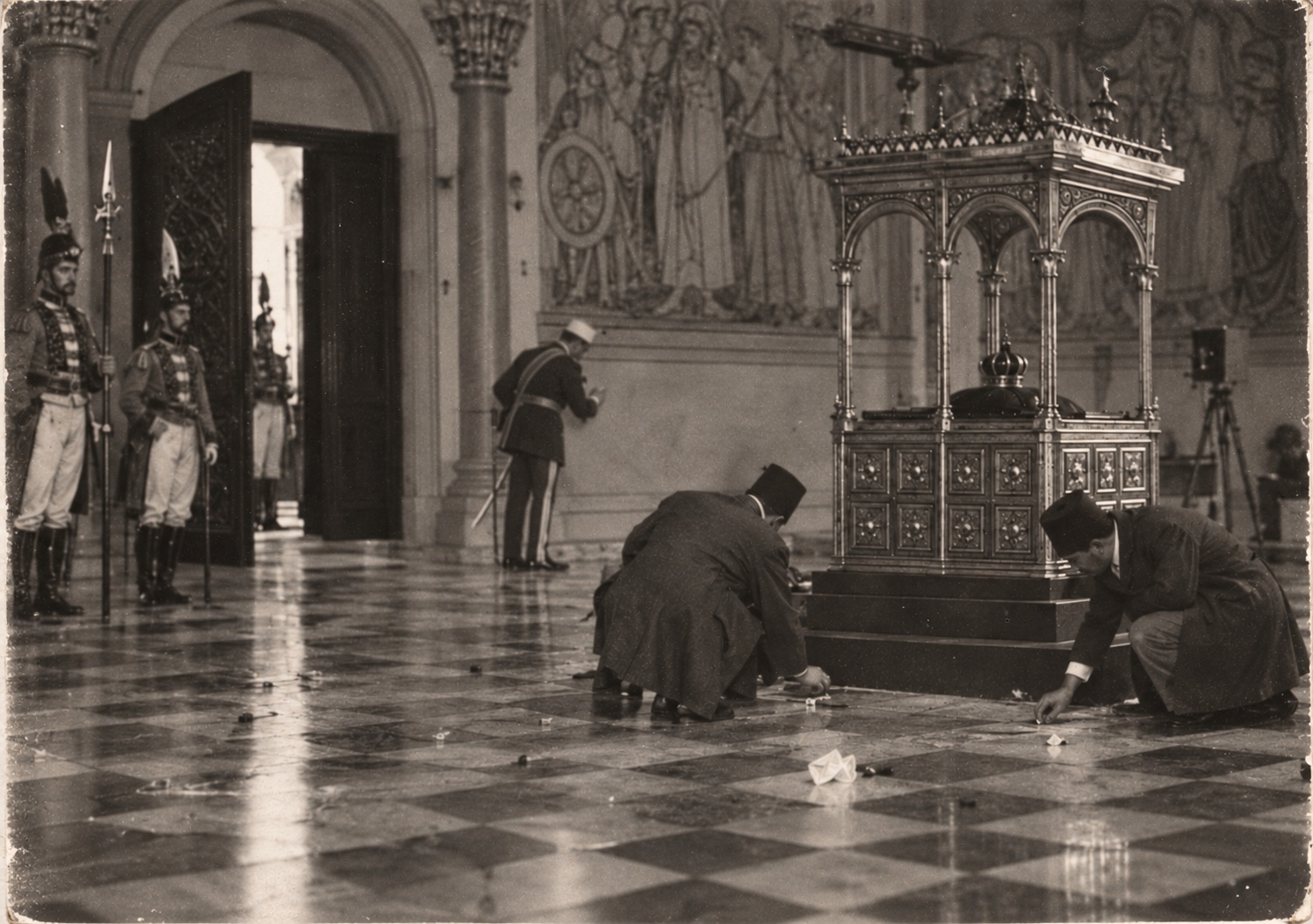
At about nine in the morning, the false Professor and Czarlitz entered the Treasure Chamber with the Governor of the Castle and two of his men. They asked to photograph the crown and the sceptre. The light was poor; Czarlitz announced that he would have to work with magnesium flash powder. The flash filled the room with thick smoke. The five men began to choke.
At the same moment, Tintin had just escaped from his guards for the second time. He threw himself in front of the royal car. Colonel Boris identified him as “the young anarchist”. The King drew his pistol.
Don't shoot, Sir!… Please listen!… I am not an anarchist. I wanted to warn you… Even at this moment those scoundrels may be trying to steal your sceptre!
Muskar XII sent Boris back to the Palace with orders to wait there for instructions, and set off for Kropow himself with Tintin. They arrived a few minutes too late. The door of the Treasure Chamber was locked and no one answered. When other keys had been brought, the five men lay senseless on the floor. None of them came round before the next morning.
The crown was still in its case. The sceptre was gone.
The search was thorough. The guards' halberds were taken to pieces, the tripod examined and the walls sounded for a secret passage. The sentries posted at the only door had seen no one leave.
Four Days 12–15 July 1938
As soon as they came round, on the morning of the 12th, the false Professor and Czarlitz were taken to the State Prison. They escaped the same day, with the help of four warders. Saint Wladimir's Day fell on the 15th.
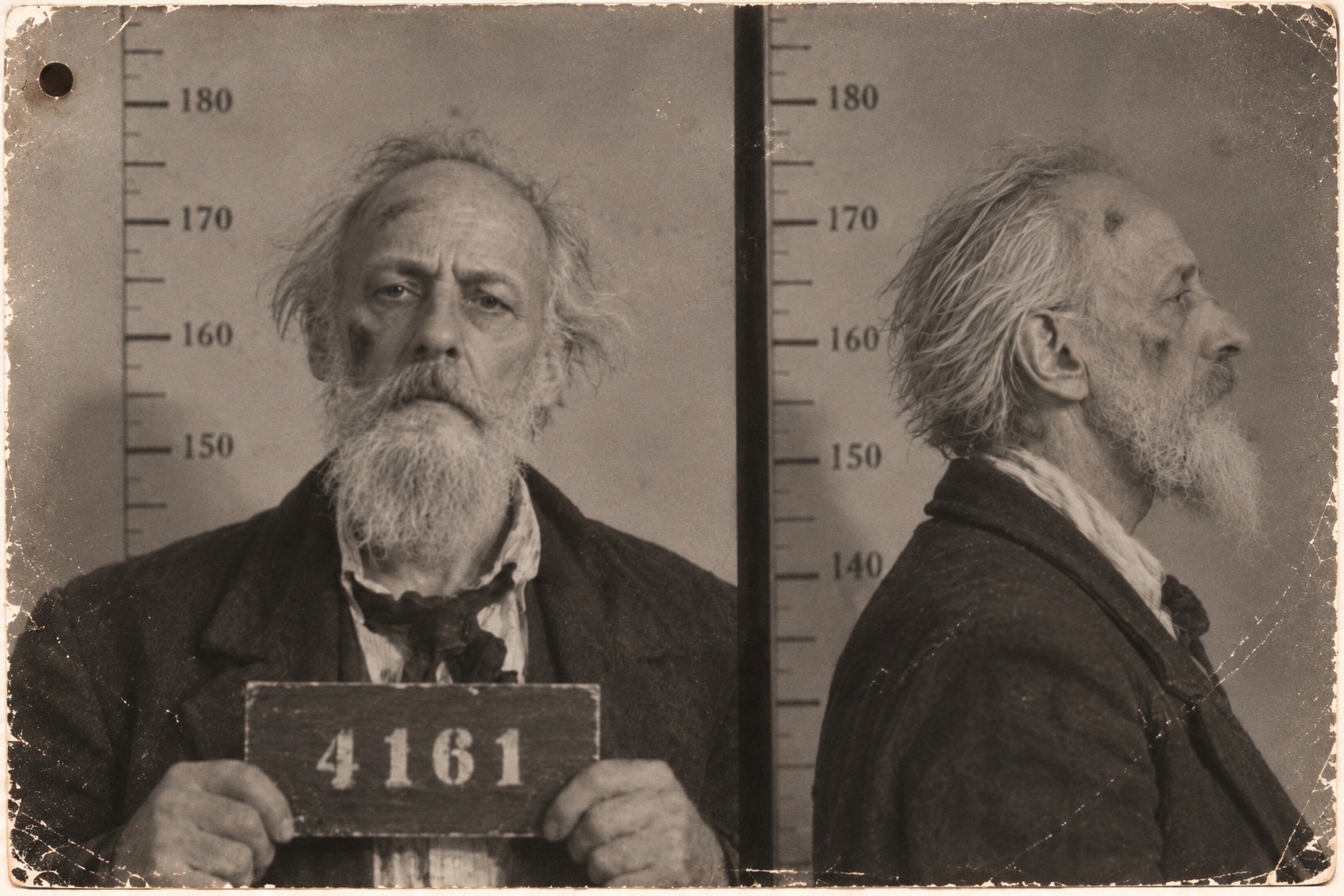
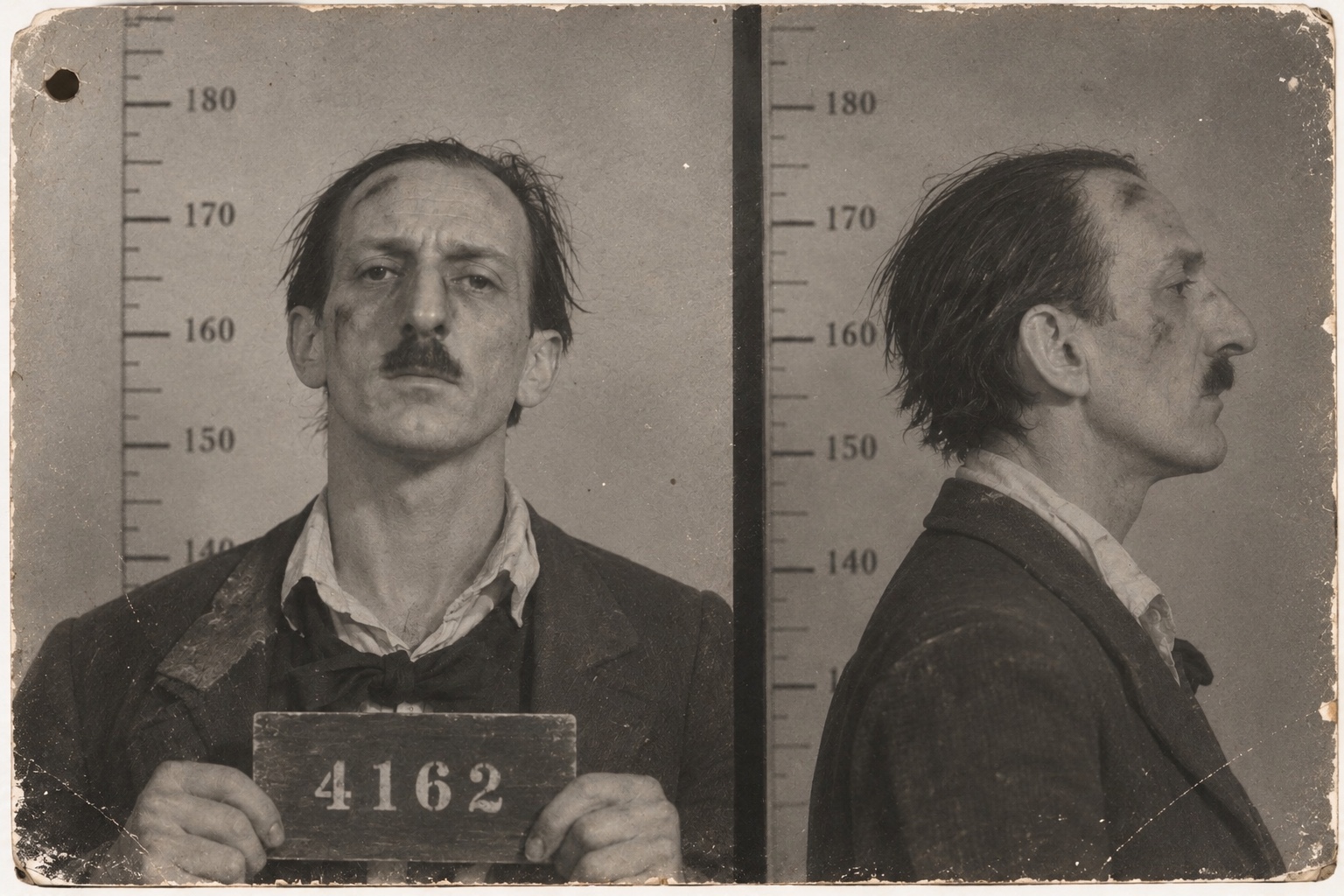
The false Professor and Czarlitz, before their escape
The Lord Chamberlain had sent for two Belgian detectives, Thomson and Thompson, whom Tintin knew from Brussels. Their first theory was simple: one of those present in the room could have dropped the sceptre from the window to an accomplice waiting in the courtyard, or thrown it over the ramparts. It did not survive the facts. The courtyard was guarded, the ramparts stood at least a hundred yards from the window, and the window had bars. The two detectives tried it all the same with a walking stick. It bounced off the bars.
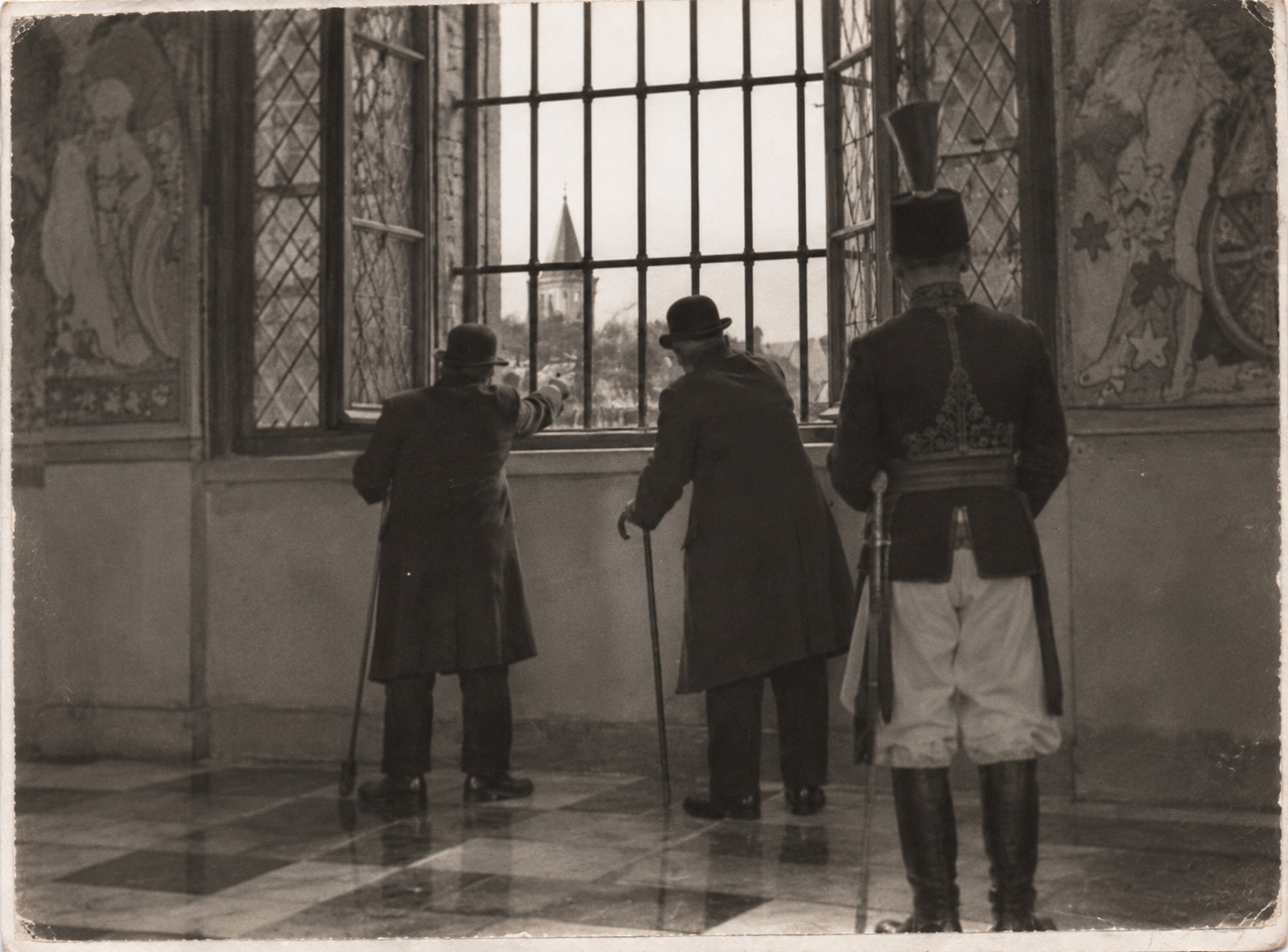
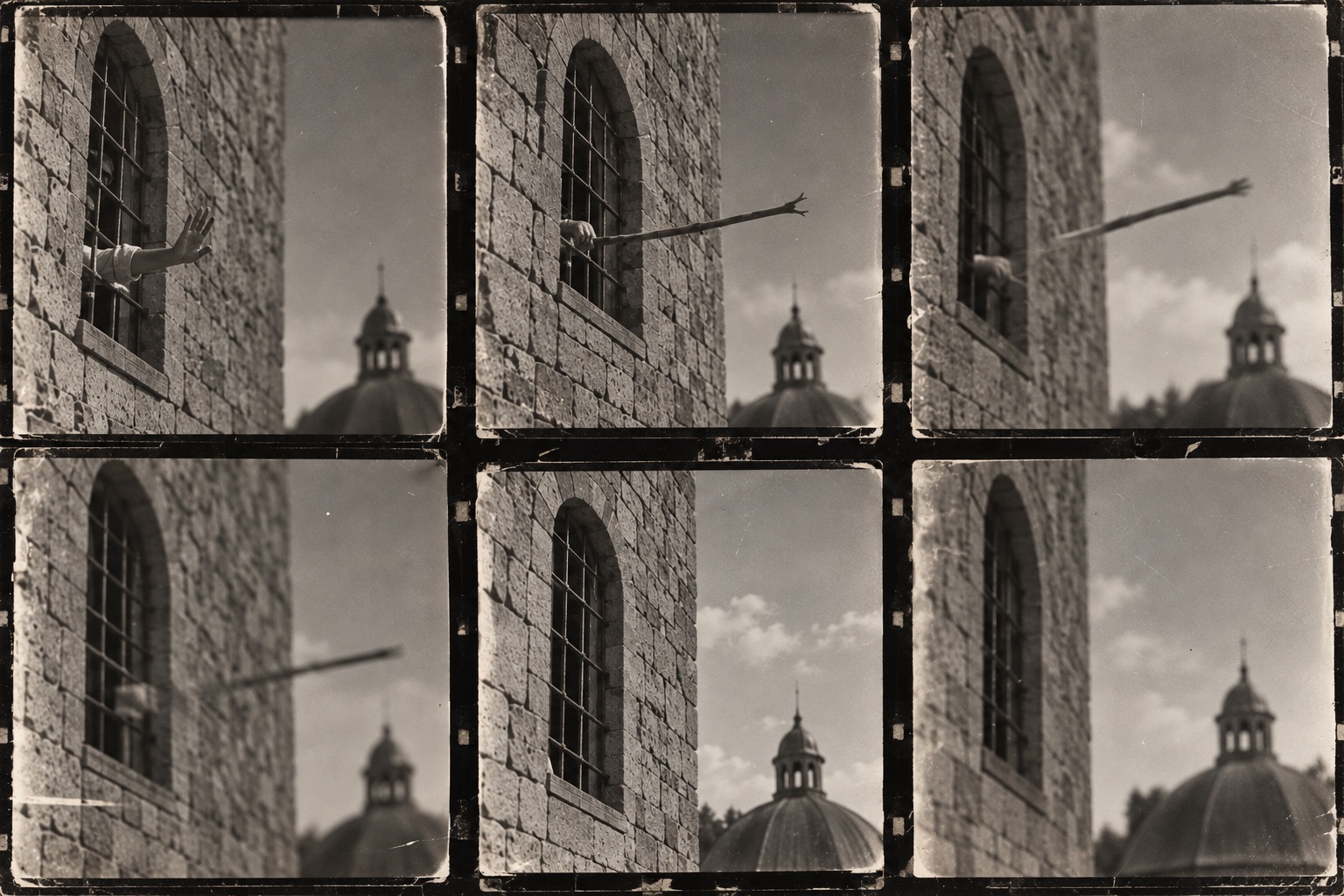
It was Tintin who found the answer, in a toy shop, where a little spring gun was on show. He ran back to Kropow and was the first into the Treasure Chamber. He was found there unconscious: a spring concealed in Czarlitz's camera had struck him in the face. When he came round, he demonstrated it before an officer of the guard. He set the spring back, loaded the detectives' walking stick, placed the camera at the window and pressed the shutter release. The stick flew between the bars, over the ramparts and the river, and fell in the wood beyond.
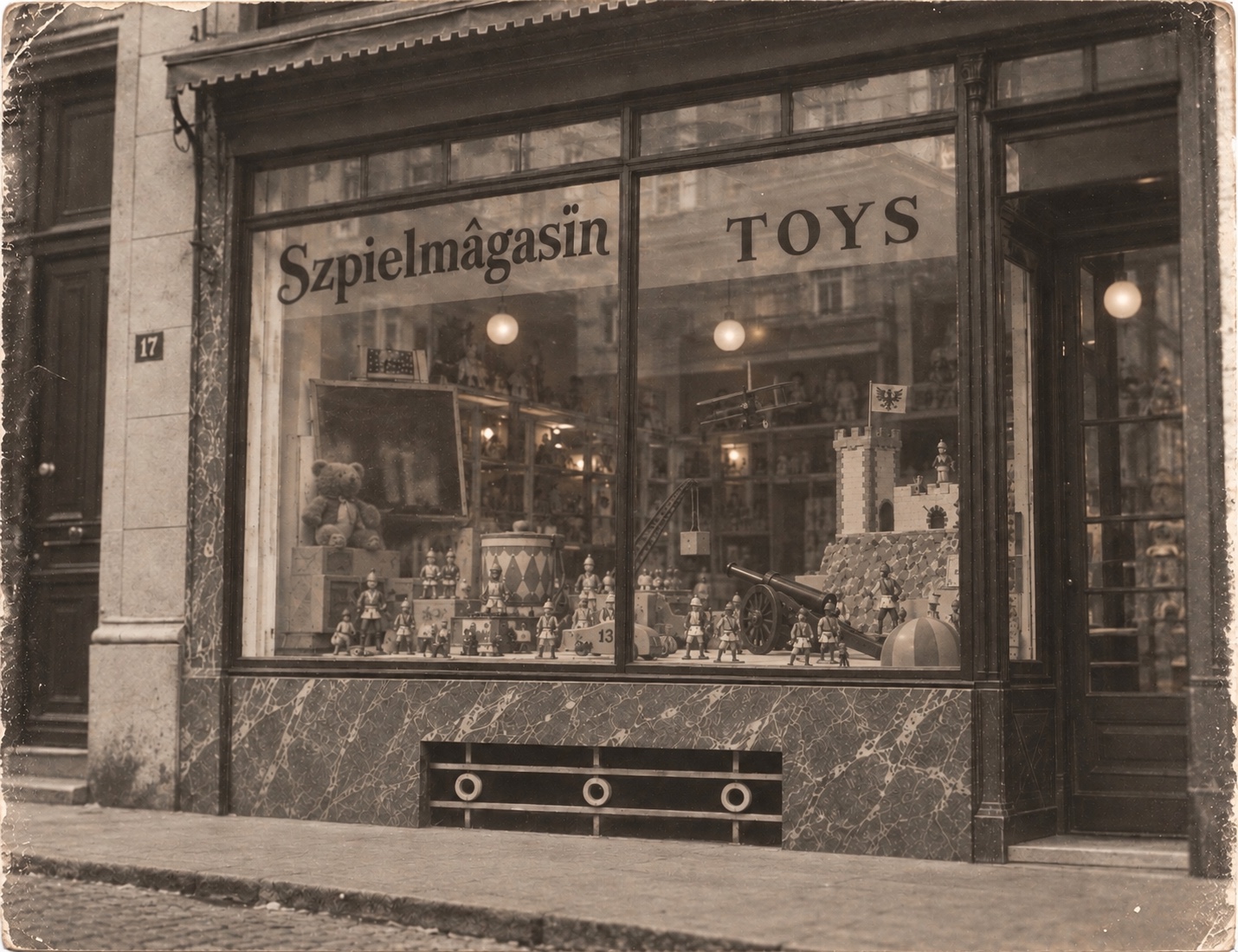
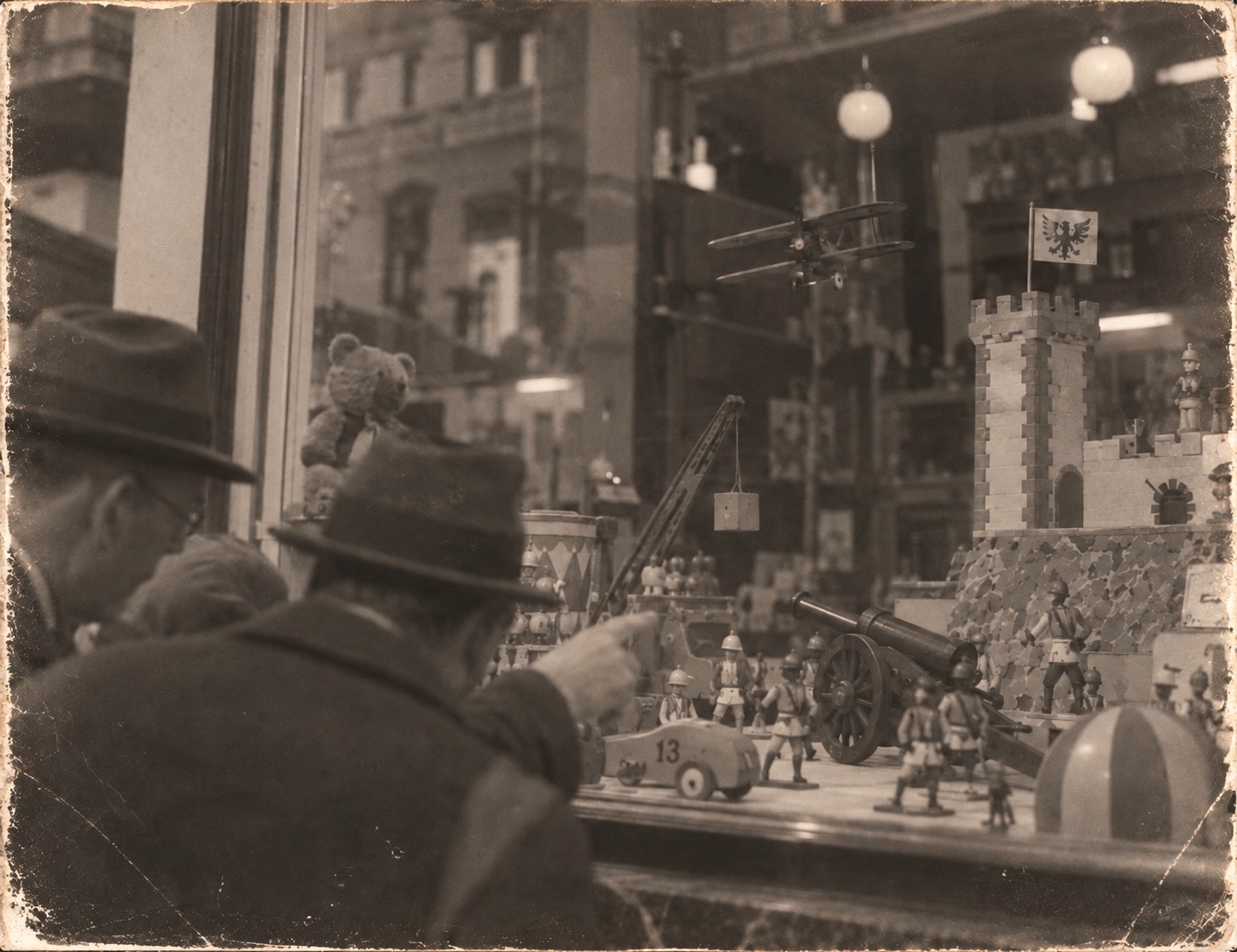
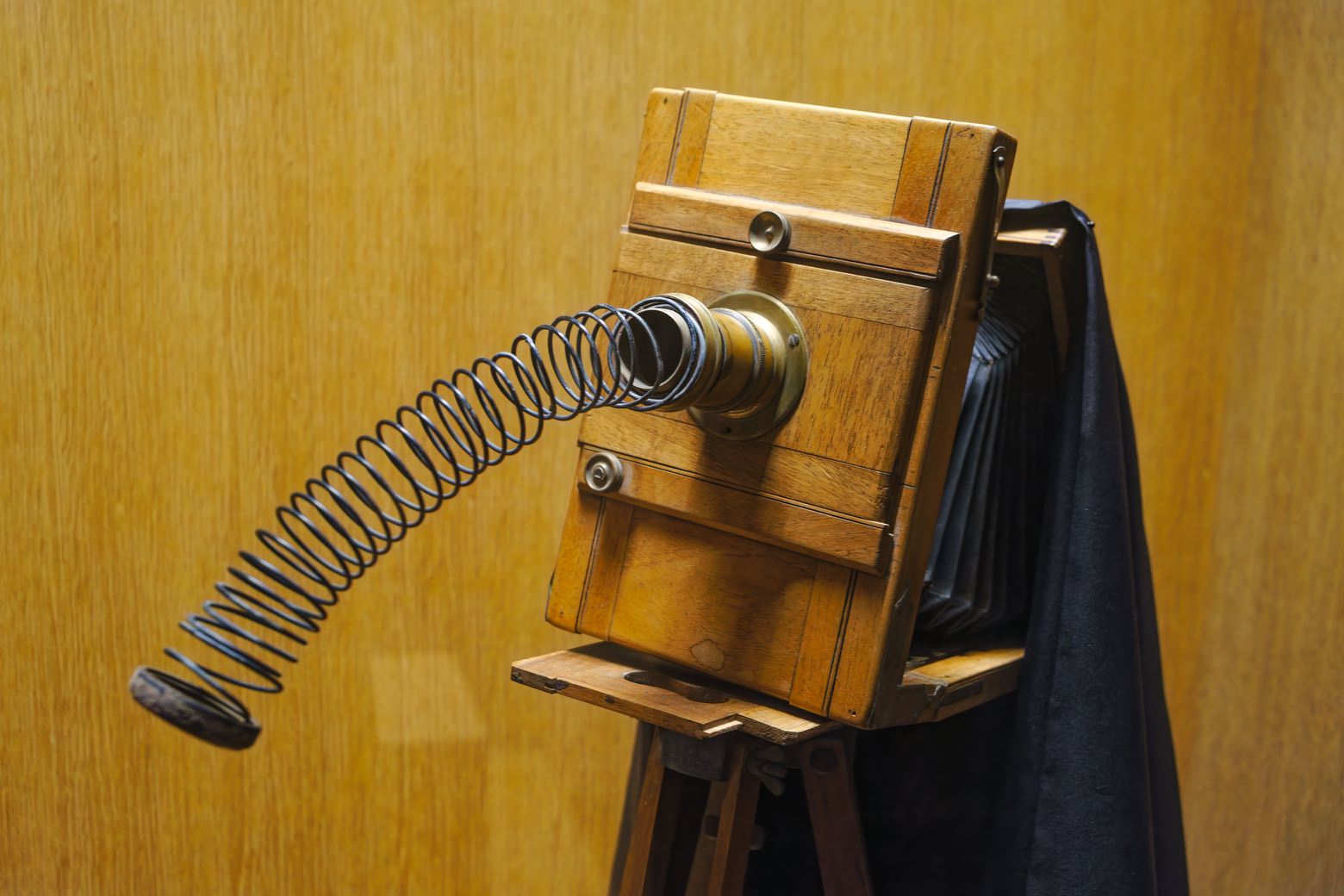
The clues: the toy shop in Klow and Czarlitz's camera
The conspirators had been searching the wood for more than a day: Czarlitz had missed the clump of birch trees they had agreed on. They found the sceptre that afternoon; Tintin tried to take it back from them, but they drove off towards the Bordurian frontier. The King, who had driven round by the bridge, lent his own car, A-11, to Tintin and the two detectives for the pursuit. Tintin followed the thieves into the mountains and recovered the sceptre at dawn on 13 July, at the frontier post itself: tumbling down the slope in a rockslide, he landed on the last man carrying it, a yard short of the post. Starving, he crossed into Borduria in search of food and was hunted there. He got out only on the evening of the 14th, at the controls of a Bordurian fighter stolen from a military airfield; shot down by Syldavian anti-aircraft fire, he baled out some twenty-five kilometres from the capital, the sceptre still in his pocket.
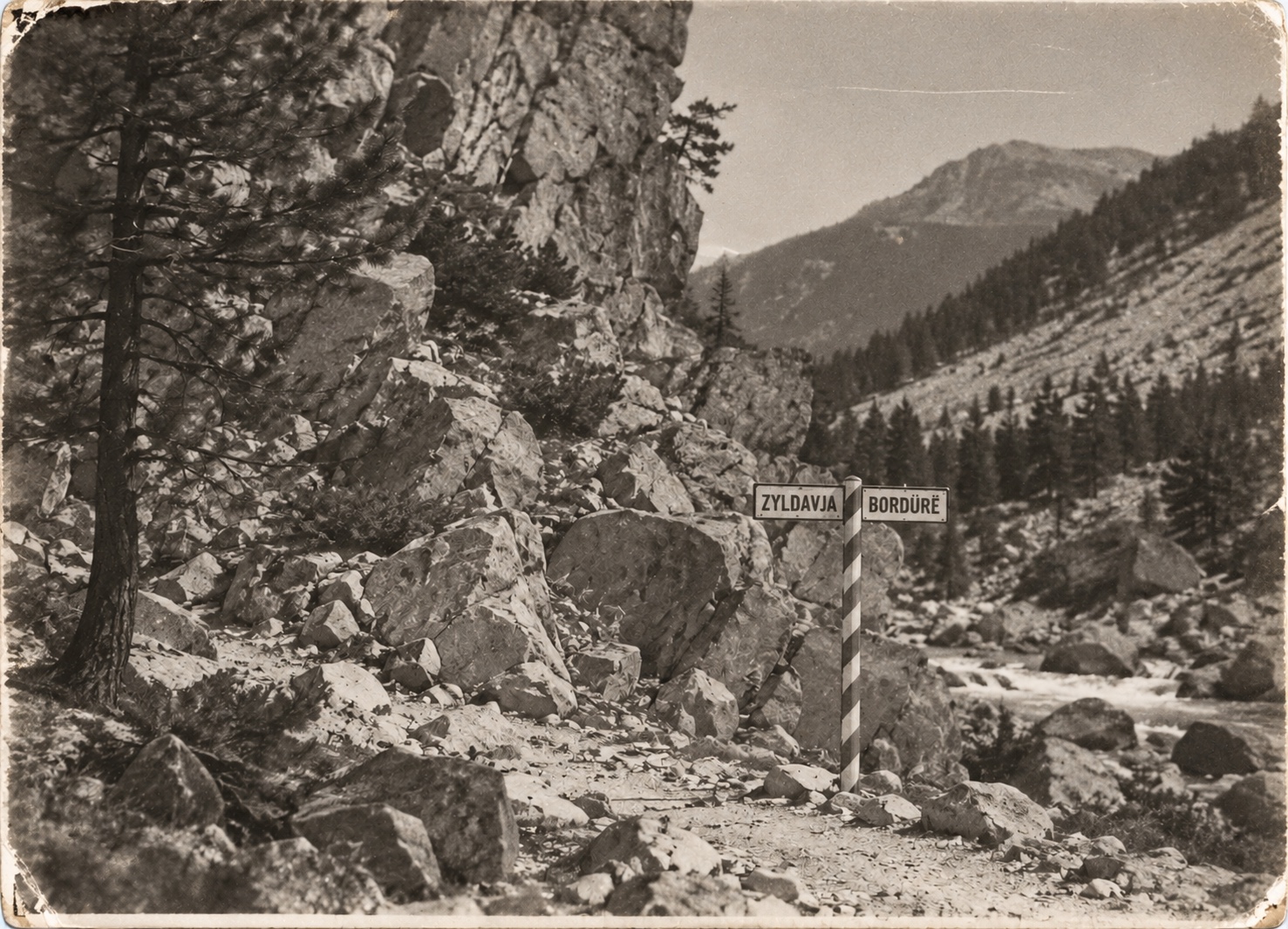
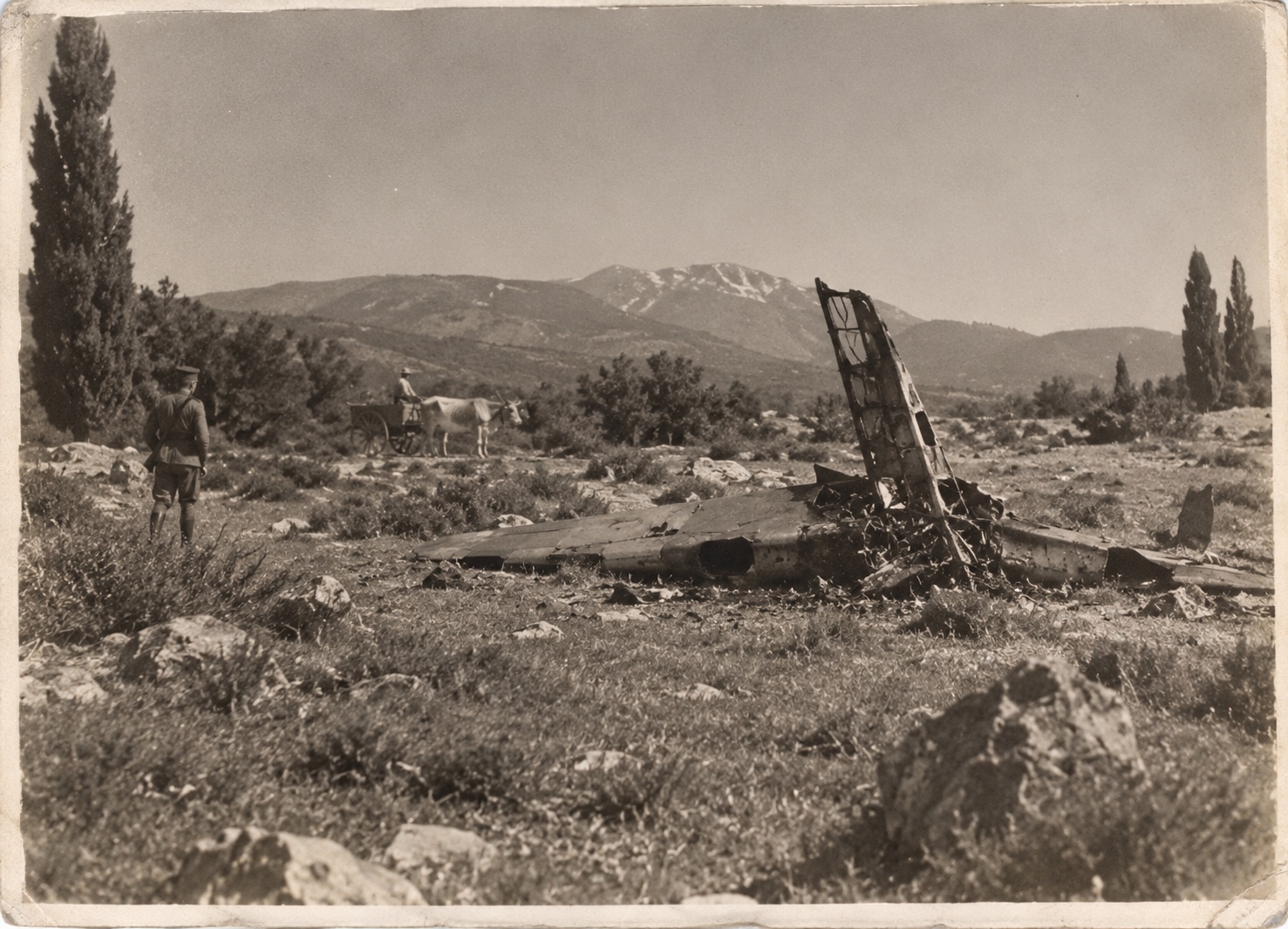
The frontier post and the wreck of the fighter
That night the Prime Minister warned the King that it would be dangerous to appear before the crowds without the sceptre. Muskar XII answered that there would be no bloodshed: he would abdicate. At half past one in the morning of the 15th, Saint Wladimir's Day itself, Tintin reached the Palace on foot, only to find that the sceptre had fallen from his pocket on the road. Snowy brought it in. Tintin then handed the King the papers he had found on the thief at the frontier.
Among them were two secret orders signed by Müsstler, both addressed to the section commanders of the shock troops and headed “Seizure of power”. The first, Z.Z.R.K. 1239, sent agents provocateurs out on the eve of Saint Wladimir's Day to stir up incidents in which Bordurian nationals would be set upon; at noon on the feast, H-hour, the shock sections were to seize Radio Klow, the airfield, the power station, the gasworks, the banks, the general post office, the Royal Palace and Kropow Castle. The second, 1240, gave the signal: Müsstler would broadcast an appeal as soon as Radio Klow was taken, Bordurian motorised troops would then cross the frontier, and they would reach Klow at about five in the afternoon. Müsstler was following almost to the letter the method set out in Curzio Malaparte's Technique du coup d'État (1931): take the radio, the power station and the post office, and the State falls. The King at once ordered the arrest of Müsstler and his associates, and sent crack regiments to defensive positions along the frontier and to the strategic points the rebels planned to attack.
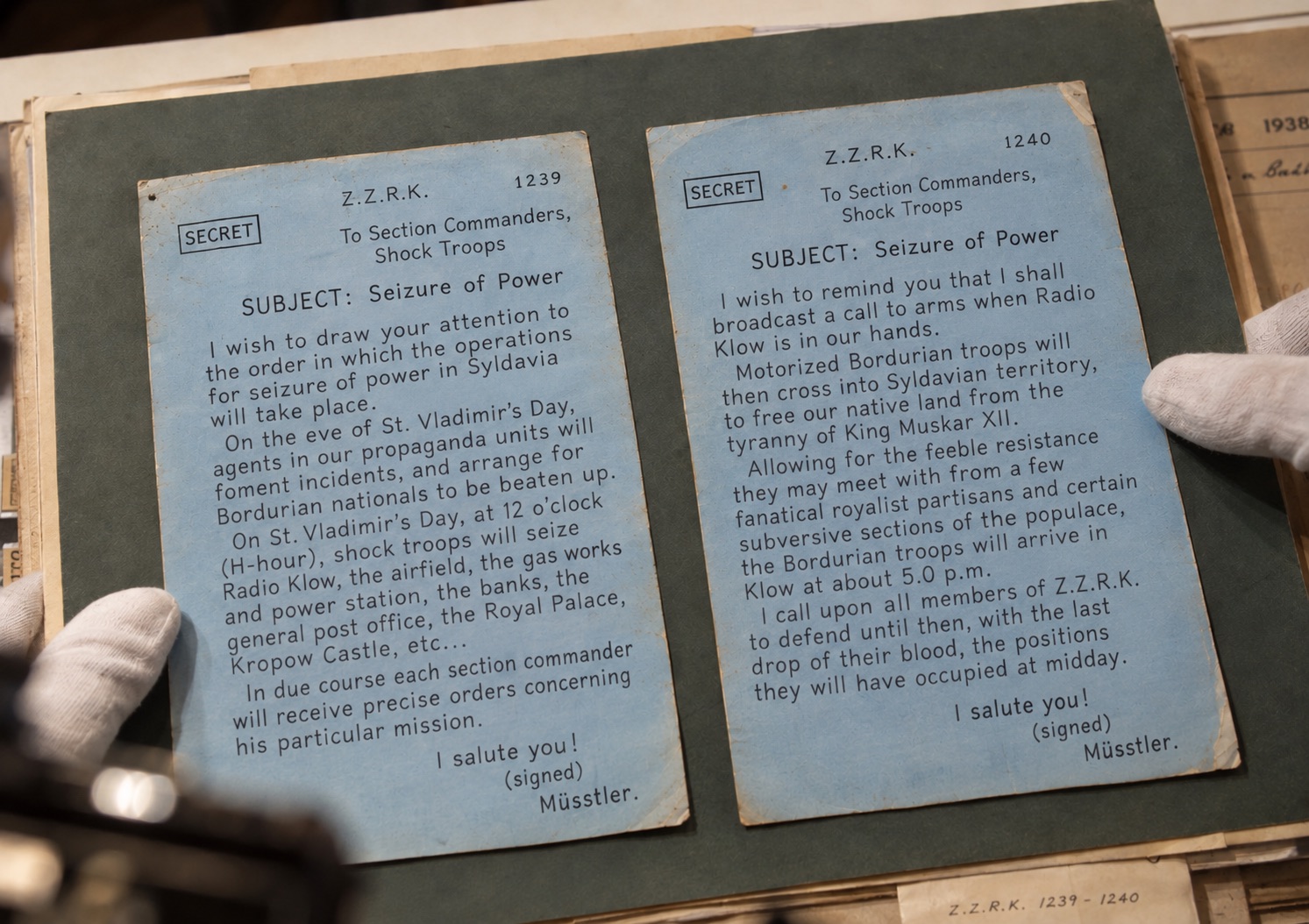
Sceptre Day 15 July 1938
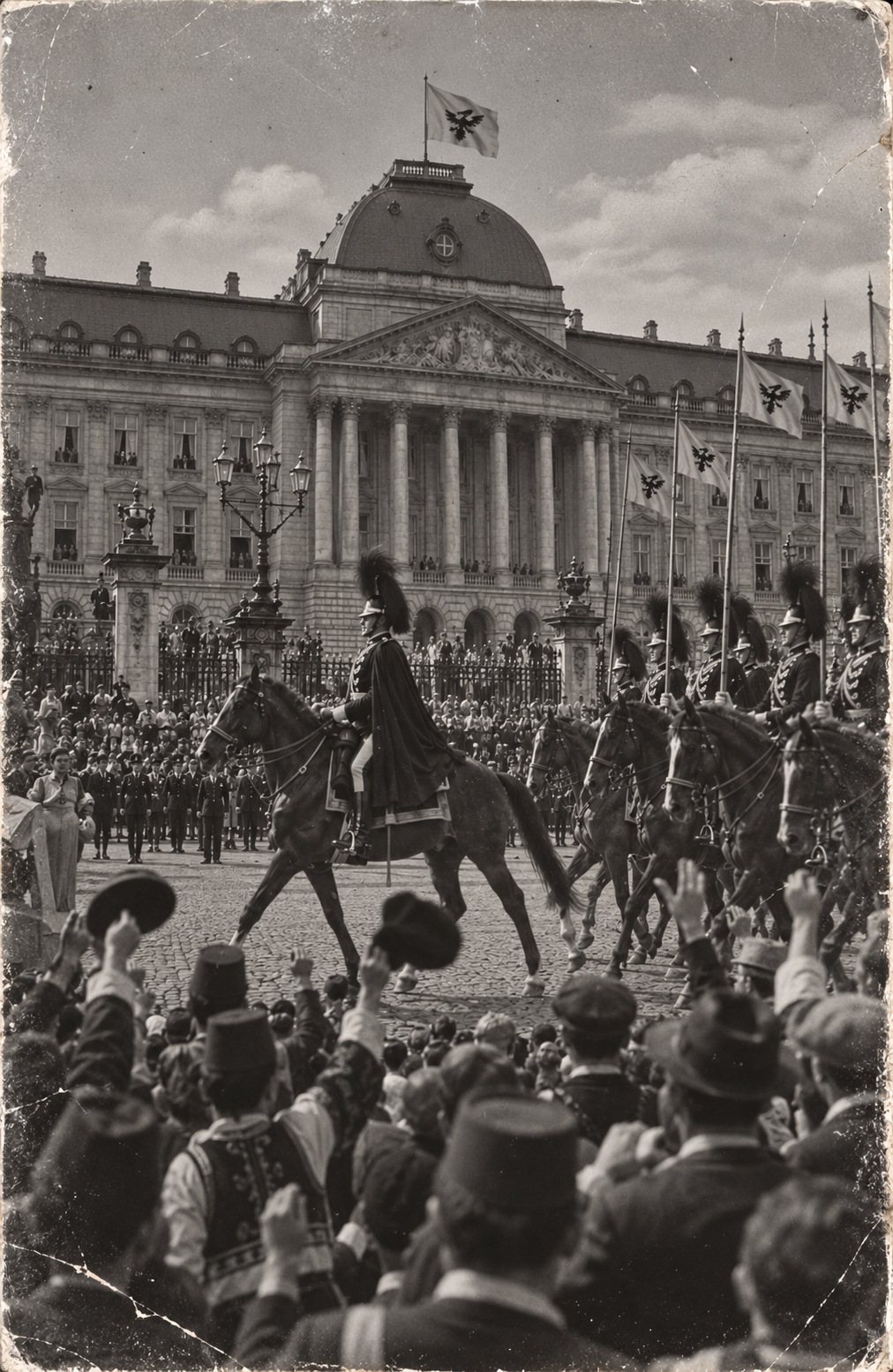
The guns sounded at sunrise, at a quarter past five, for Saint Wladimir. The procession left the Palace shortly after. Muskar XII rode bareheaded in the royal carriage, the Sceptre of Ottokar in his hand, and the crowd acclaimed him and sang the anthem. Through the morning the carriage crossed Klow. Noon, the hour Müsstler had set for the coup, came and went without his broadcast.
At the Palace the crowd called the King back to the balcony again and again. Then, in the Throne Room, he made Tintin a Knight of the Order of the Golden Pelican, with the full agreement of his ministers. It was the first time the Order had been conferred on a foreigner. The King was later credited with the remark that Syldavia had been saved twice by foreigners, and at least once by a dog.
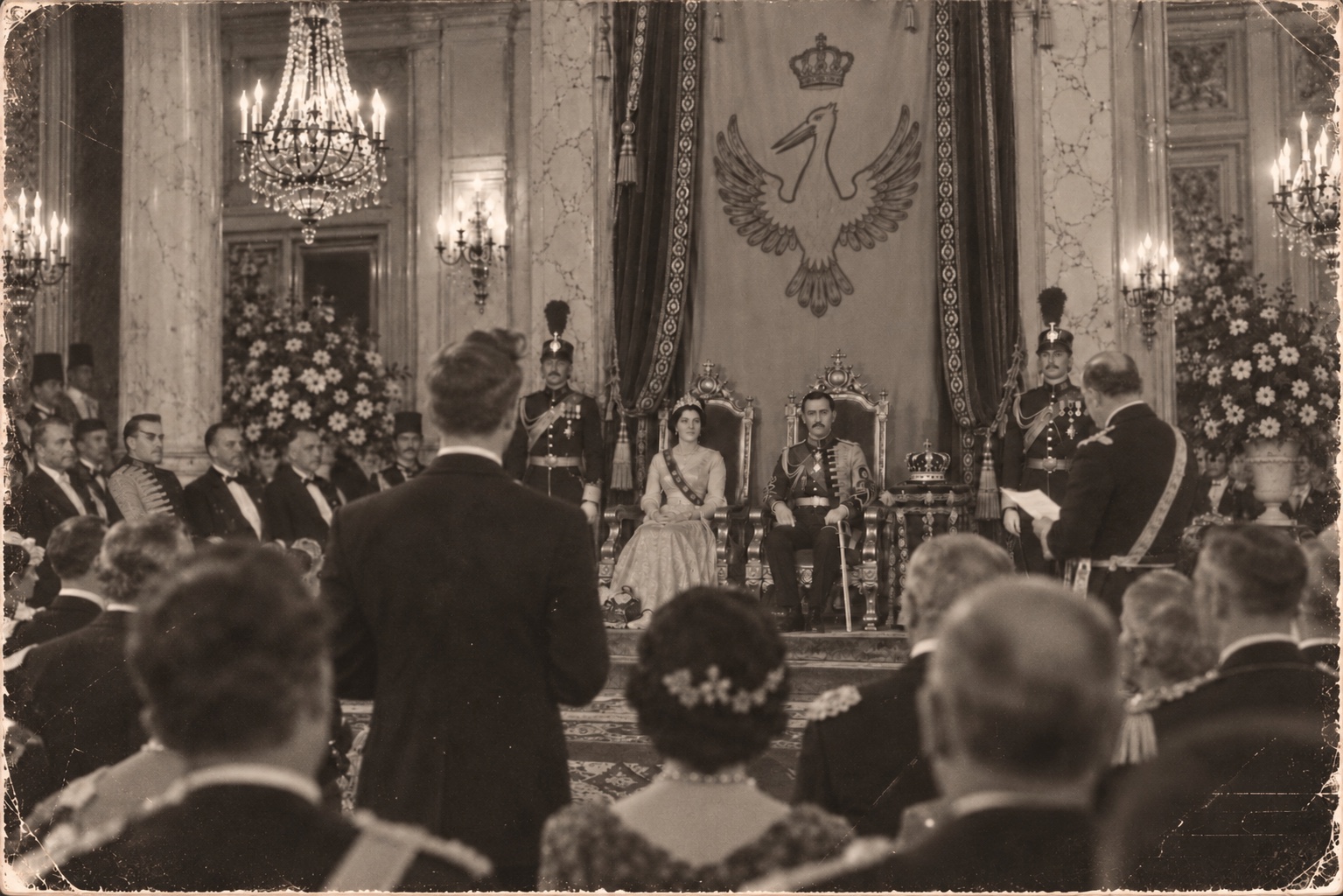
The Inquiry July 1938
A few days later the Minister of the Interior set out the conclusions of the inquiry. Müsstler had been arrested with most of his followers, and the false Professor at Müsstler's home, where he had hidden after the theft. He was Alfred Alembick, the Professor's twin brother, which explained the beard. The real Hector Alembick had been found alive, held in a cellar.
The police found on the impostor a carefully kept notebook: a photograph and a few particulars for each of the people his brother knew, so that Alfred could recognise them at once. Tintin was among them. Sporovitch had photographed him without his noticing on the Professor's stairs on 7 July, with the camera hidden in his watch.
The file also identified several members of the network: Trovik, who manned the Central Committee's telephone; Wizskitotz, who passed on its orders; Sirov and Zlop, the men of the ambush in the forest; Captain Szplodj, Chief of Police at Zlip; and Sporovitch, who had been set to watch Tintin in Brussels.
Borduria announced that, to prove its peaceful intentions, it was pulling its troops back twenty kilometres from the frontier.
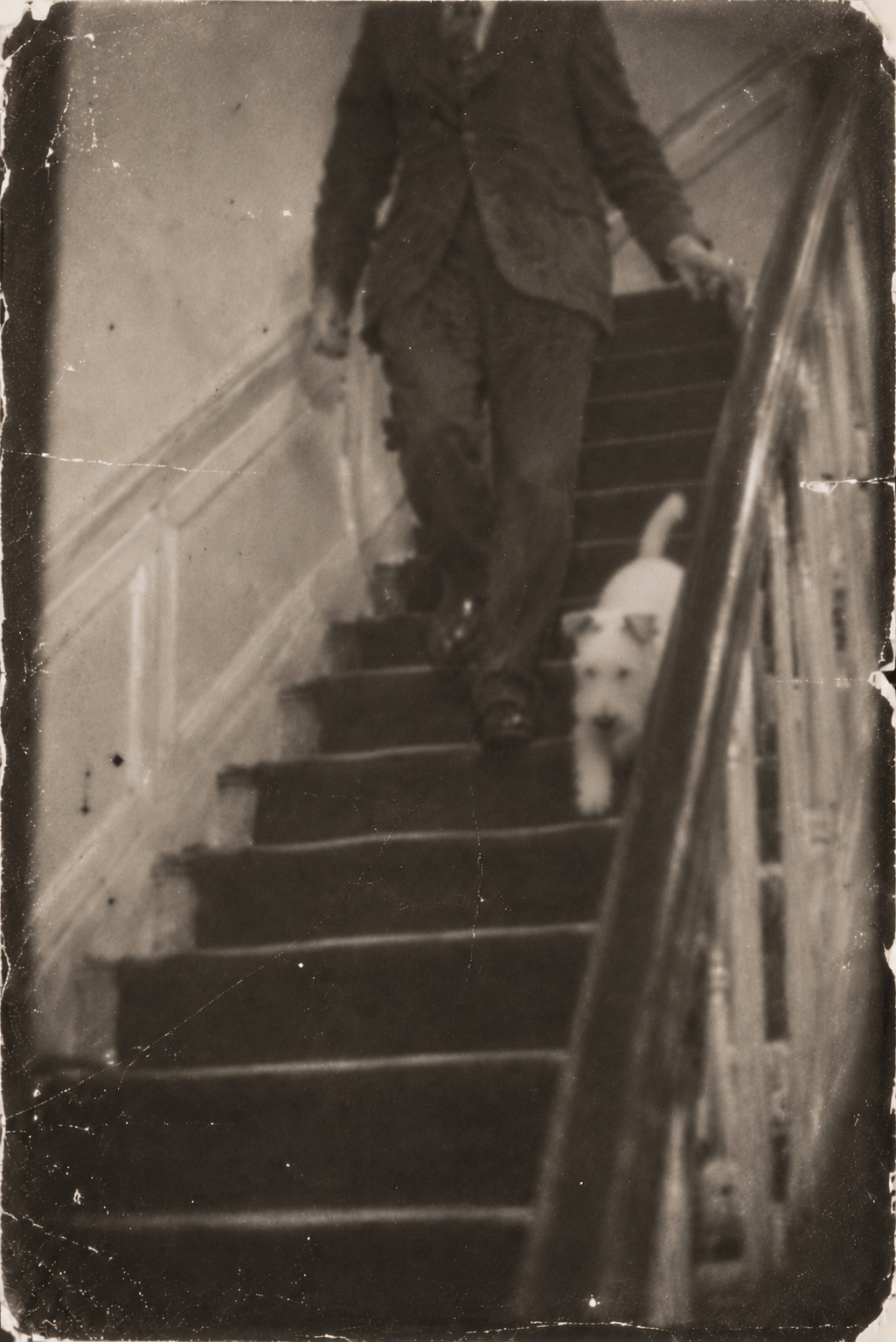
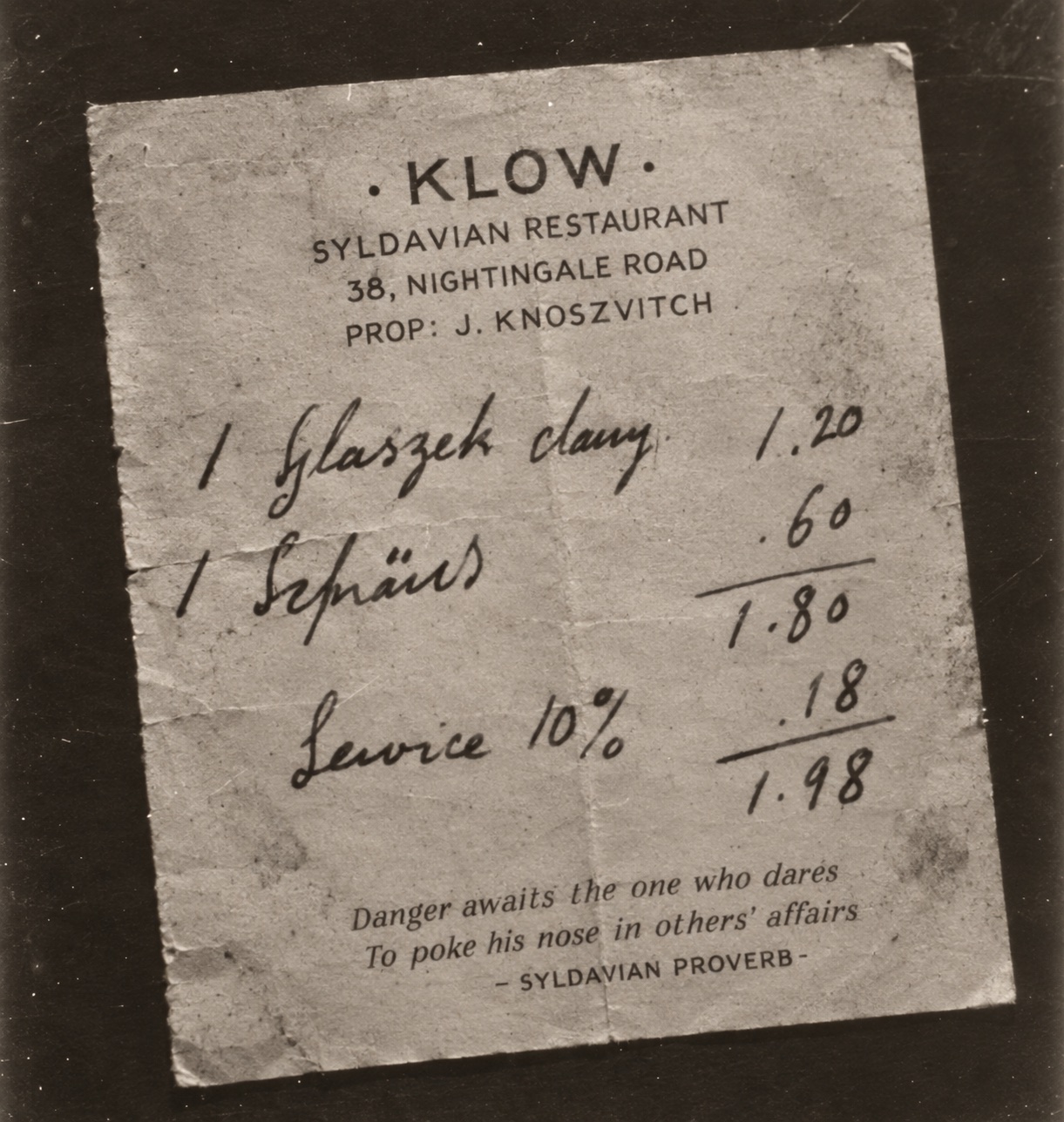
From the inquiry's file: Tintin as the conspirators photographed him, and the bill from their restaurant
To establish how the sceptre had left the chamber, the investigators of the Ministry of the Interior repeated Tintin's shot in the Treasure Chamber, with Czarlitz's camera, its spring still in the lens tube. They placed a stick in the spring mechanism and fired it through the window bars, trial after trial, to see whether it could reach the far side of the river. Every attempt was photographed, and the castle was surveyed from the keep to the wood.
 Kropow Castle
Treasure Guard
Kropow Castle
Treasure Guard
Treasure Chamber · 11/07/38
One door, one window
The door was watched and no one left by it. The sceptre left by the window: through the bars, over the domes, the ramparts and the river.
- Speed in flight
- — km/h
- Elapsed time
- — s
Reconstruction of the shot. The inquiry repeated the shot with Czarlitz’s camera. Adjust the angle and launch energy to examine a possible trajectory. The conspirators’ planned pick-up point was the clump of birches by the river; Czarlitz missed it.
A new wind is drawn after each trial. Each result keeps the wind used for that shot.
Trial record
Method of the trials
Established by the inquiry: the spring in the lens tube of Czarlitz’s camera; the single barred window; the sceptre’s fall in the wood beyond the birches, which the conspirators searched for more than a day.
Assumed by the reconstruction: the distances, taken from the survey and approximate; the force of the spring; the wind, no weather record being available for the morning of 11 July: it varies from trial to trial.
Not determined: the angle and force of Czarlitz’s own shot. The shot the reconstruction offers is one setting among several that land where his did.
1. Distances. The investigators took 100 m between the Treasure Chamber window and the ramparts, the minimum recorded in the survey. Other distances and the heights are given as a guide. The miss in each trial was measured to the nearest edge of the clump of birches.
2. The Sceptre. Its dimensions and its resistance to the air were taken from the Sceptre itself: 69.6 cm in length, 1,023 g. Loaded into the camera, it leaves head first.
3. Air. The density of the air (1.225 kg/m³) and the drag coefficient (1) were assumed, no measurement being available. After a strike, the Sceptre is taken to tumble.
4. Strikes. For roofs and walls, the investigators assumed a coefficient of restitution of 0.2 and a coefficient of friction of 0.3.
5. Reservations. Each trial ends when the Sceptre meets the ground or the water. The following could not be determined: the spin itself, sliding, rolling, deformation, the action of the mechanism and the passage between the bars.
6. Czarlitz’s shot. The shot at 45° and 1,300 J in still air reproduces the recorded point of fall; Czarlitz’s own settings could not be established.
Hergé's Adaptation 1938–1947
Three weeks after the feast, on 4 August 1938, the Belgian cartoonist Hergé began to tell the story in Le Petit Vingtième, two pages a week until 10 August 1939. The paper kept its young readers in suspense. On 30 March 1939 its front page asked: « Le sceptre d'Ottokar IV sera-t-il volé ? » (“Will the sceptre of Ottokar IV be stolen?”). The answer was in the same issue. Collected as an album in 1939, King Ottokar's Sceptre is by far the best-known account of the affair. Most readers abroad first saw the sceptre in the pages of the tourist brochure that Hergé reproduced in it, and Muskar XII became the first Syldavian sovereign familiar to a wide public. Because the album appeared in 1939, the affair is still often dated to that year.
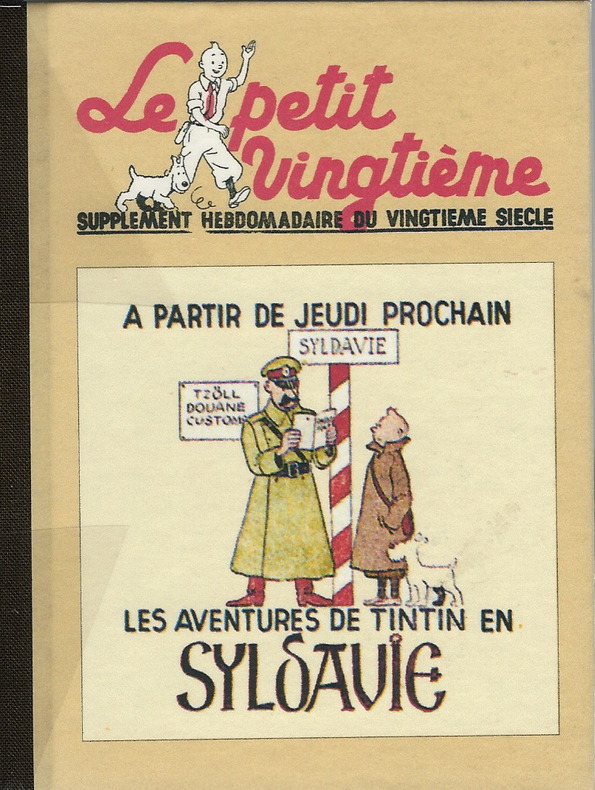
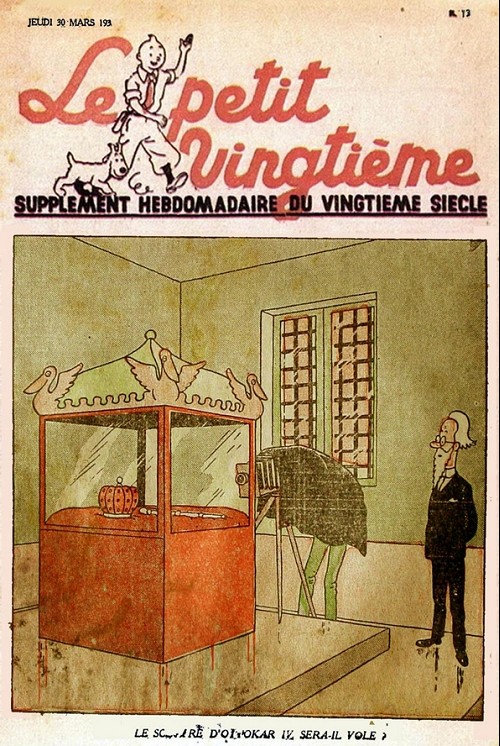
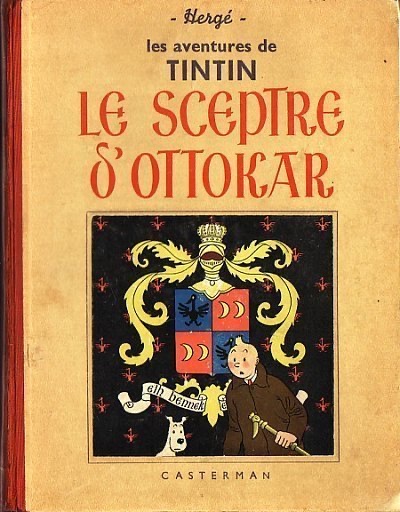
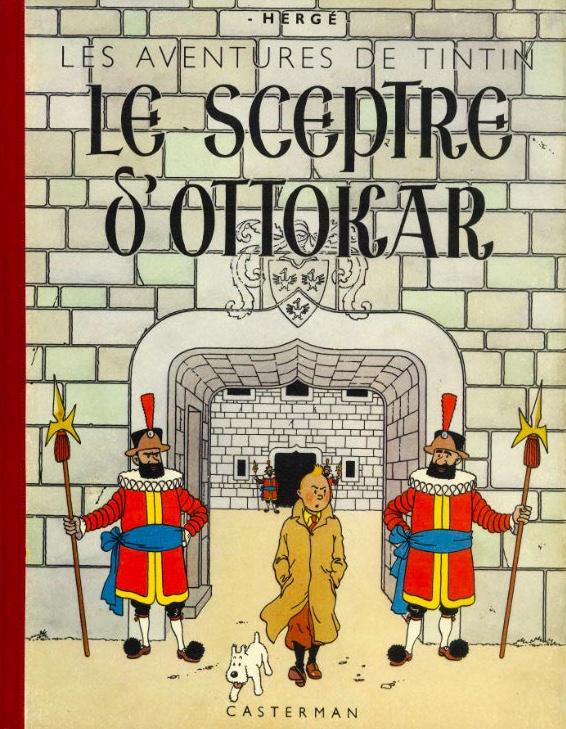
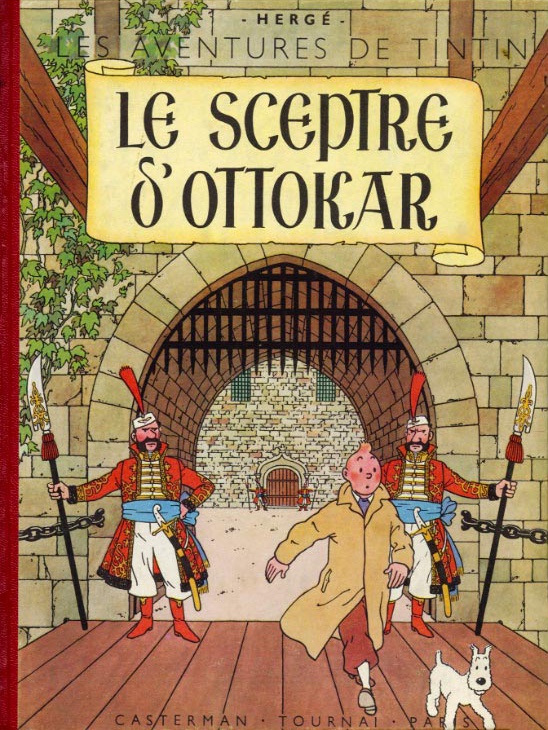
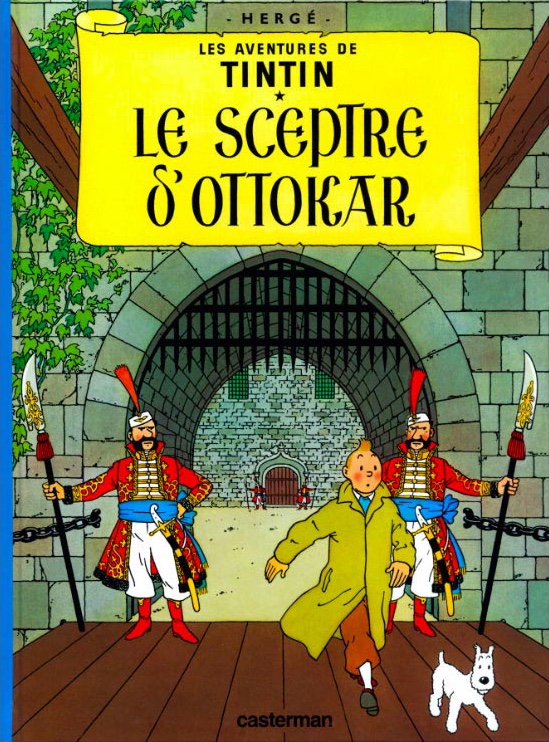
From Le Petit Vingtième to the colour album: Le Sceptre d'Ottokar, 1939–1987
Hergé compressed the affair and played it for comedy. With the two detectives he hardly had to exaggerate: their theory, as we have seen, did not survive the facts.
His documentation was thin to begin with: he worked from books, magazines, photographs and films, and the Professor's seal collection, for one, is taken from a plate in the Larousse pour tous. His sketchbooks show that he did not yet know what the sceptre looked like. He first imagined its end serving as the royal seal and called it the “Sceptre-Seal”, and he hesitated over its ornament between a hand of justice, a bird of prey and a fox's head, none of which the Treasure Guard would have recognised. In the 1939 pages the finial is a crowned pelican's head, and the guards of Kropow wear something close to the dress of the Yeomen Warders of the Tower of London. Readers familiar with Finland have noticed that his Kropow looks very like Olavinlinna Castle.
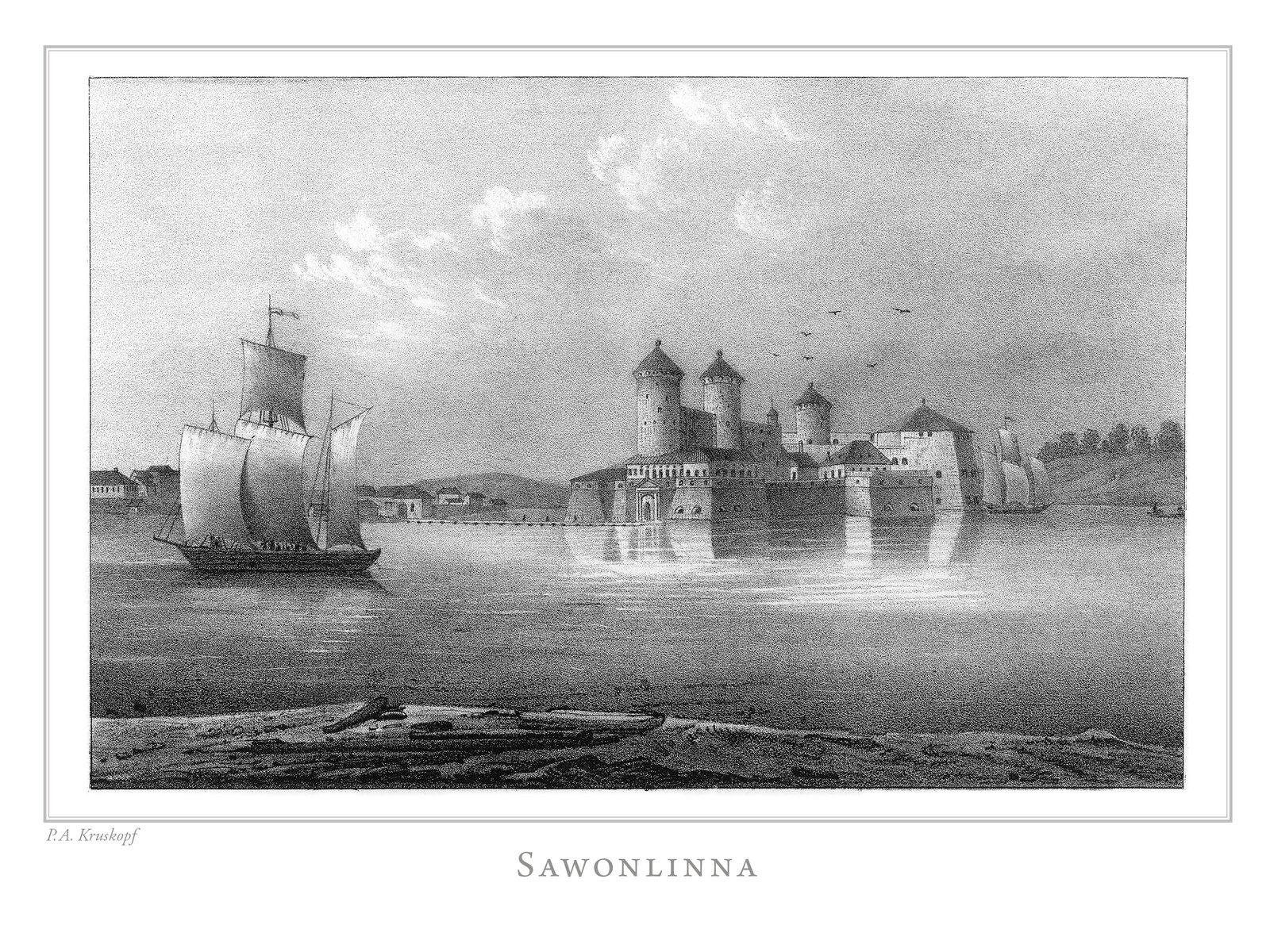
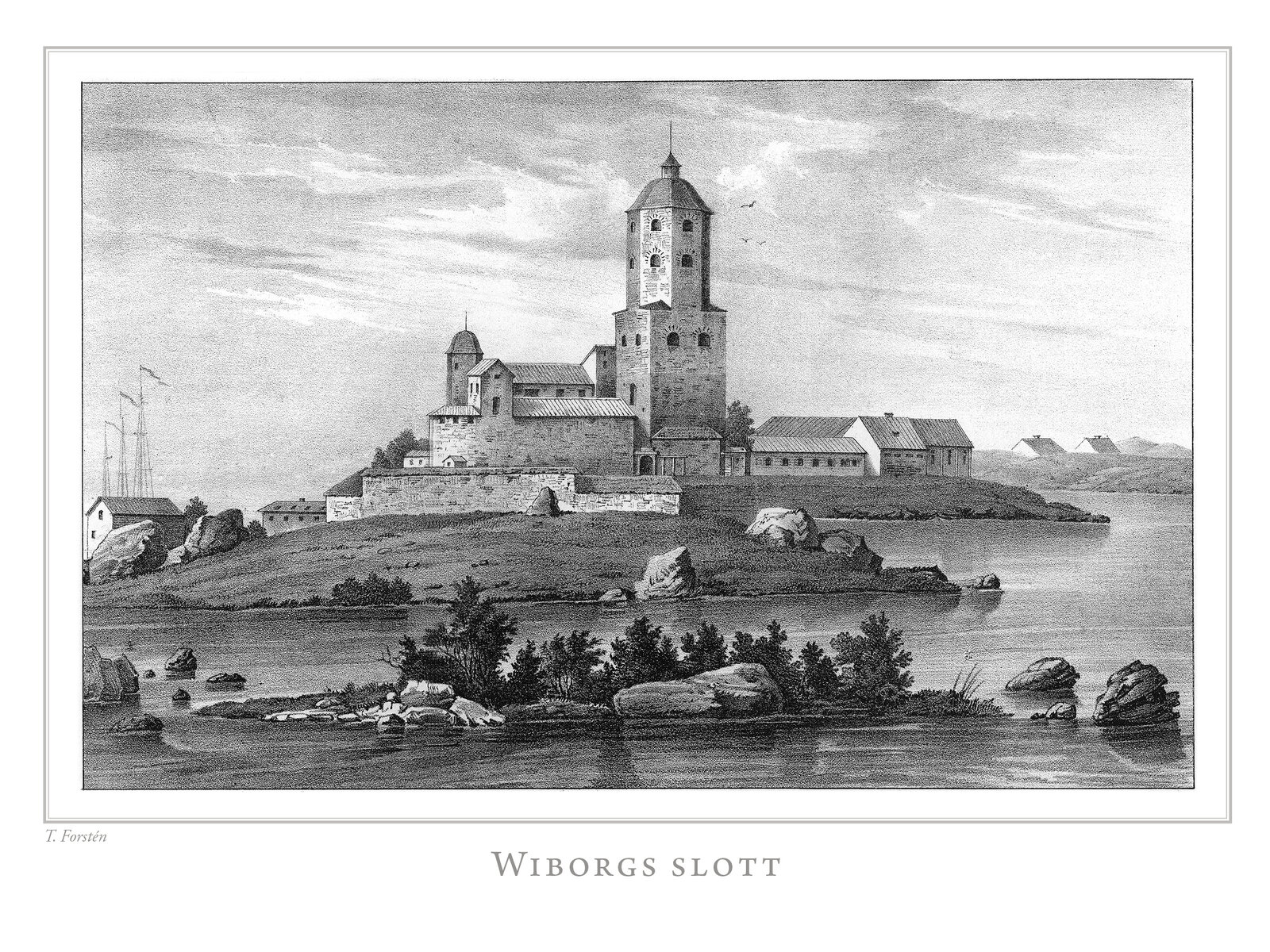
The two castles readers recognise in Hergé's Kropow: Olavinlinna, then Vyborg
When he redrew the album in colour for its 1947 edition, with Edgar P. Jacobs, Hergé worked from fuller documentation. The pelican now spreads its wings, as it does on the sceptre itself.
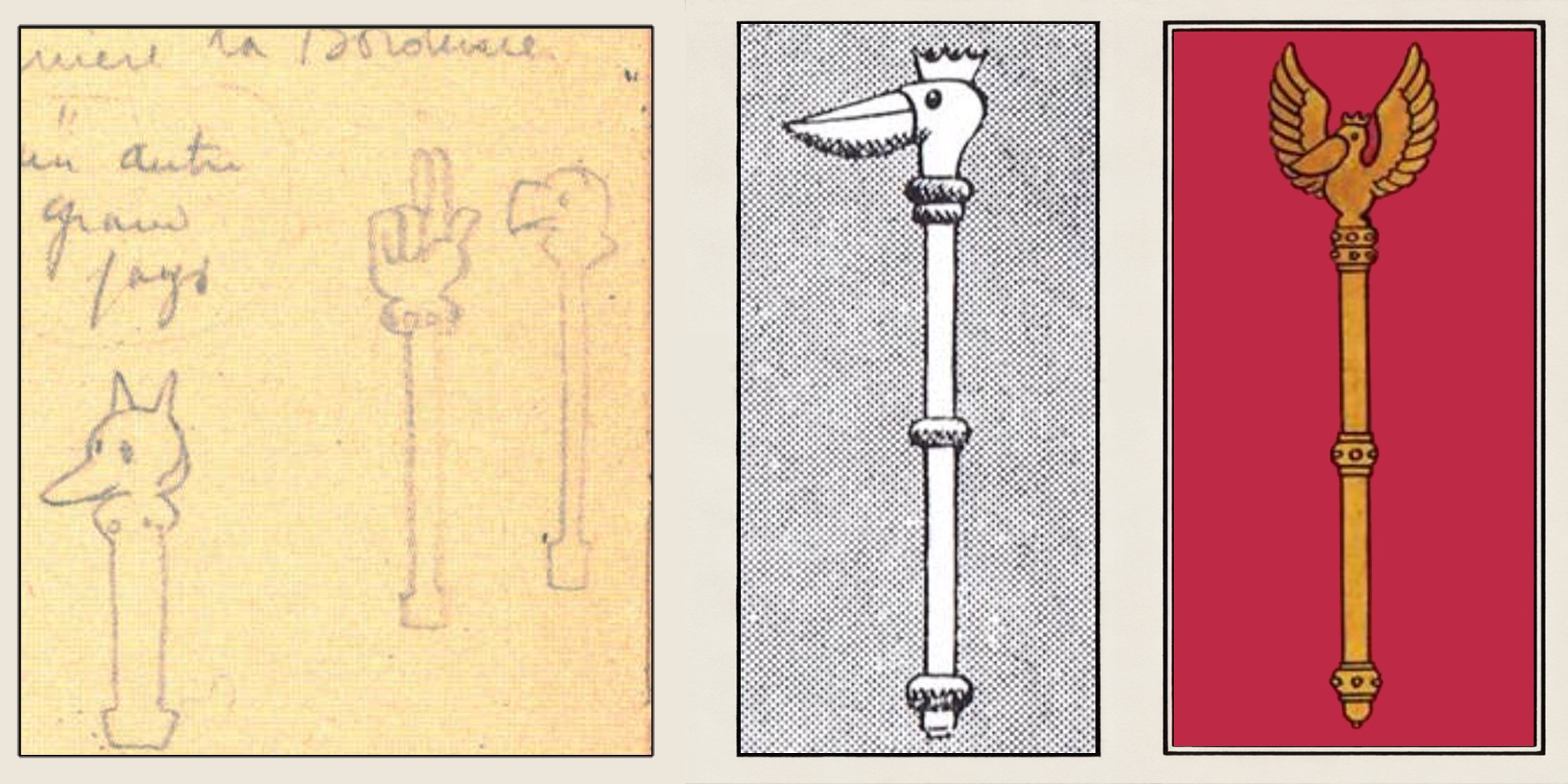
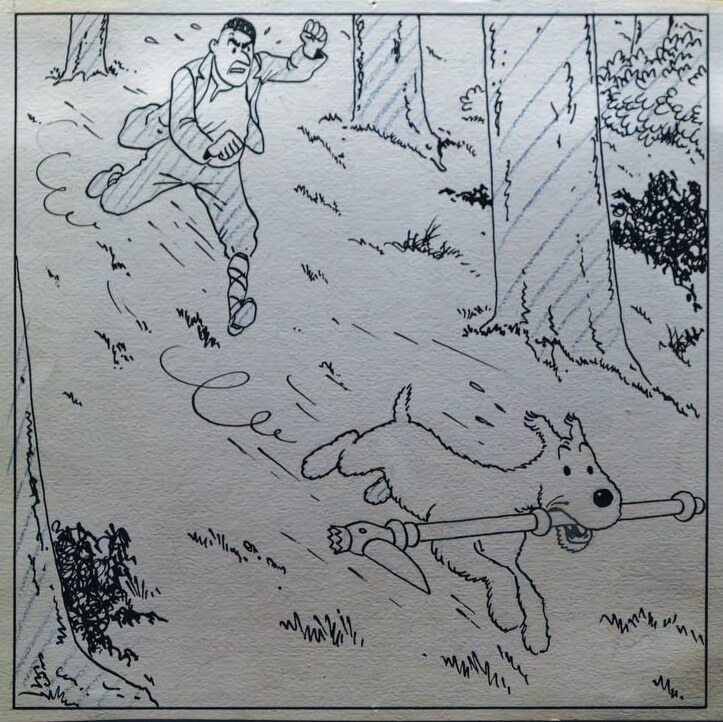
Jacobs “balkanised” the costumes, which brought the guards closer to the Treasure Guard, if not all the way. Kropow gained a tower after the castle of Vyborg, and the Treasure Chamber was covered with frescoes, which Hergé borrowed from the Bayeux Tapestry and the mosaics of San Vitale in Ravenna. His frescoes do not keep still: five figures when the false Professor enters the chamber, six when he lies on its floor, five again when Tintin is struck by the spring, one of them having moved his leg in the meantime. The frescoes at Kropow have not moved.
Jacobs had first wanted to sing. Taken to Gounod's Faust at twelve, he studied at the Brussels Conservatoire and sang second baritone in Lille before giving up the stage for drawing, a career he would call a “damnation”. The creator of Blake and Mortimer titled his memoirs Un opéra de papier. In the colour album, the run of notes rising on the “Ah!” of the Jewel Song, which Bianca Castafiore sings from that same Faust, is written as in Gounod's score; the 1939 pages had scattered two notes at random. It was her first appearance in Hergé's pages, and far from her last.
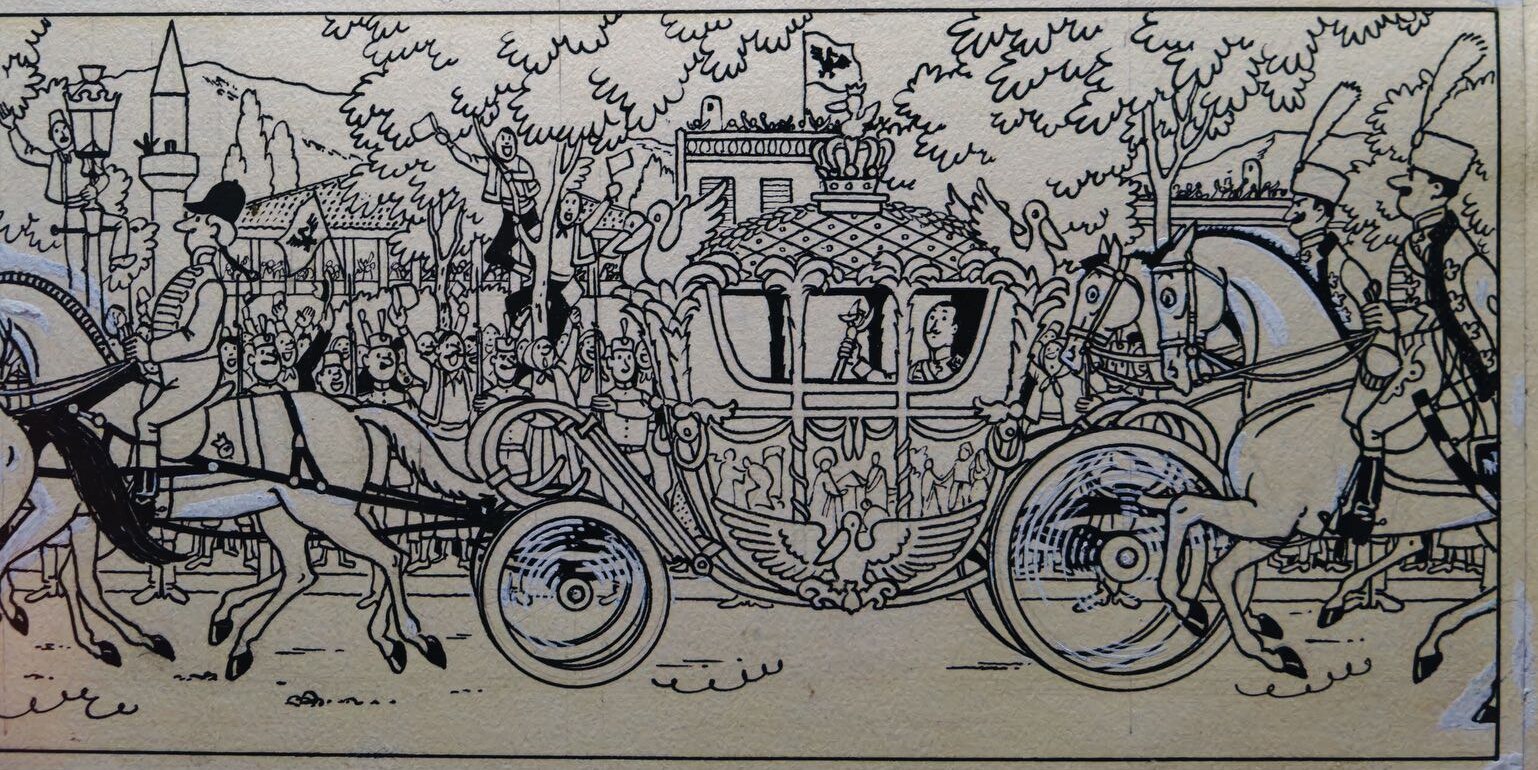
For the rest of the Kingdom, Hergé worked from the models available to him. The Royal Palace in Klow is close enough to the one in Brussels that he could draw it from photographs of the latter, and he drew the King's carriage after the Gold State Coach used for British coronations.
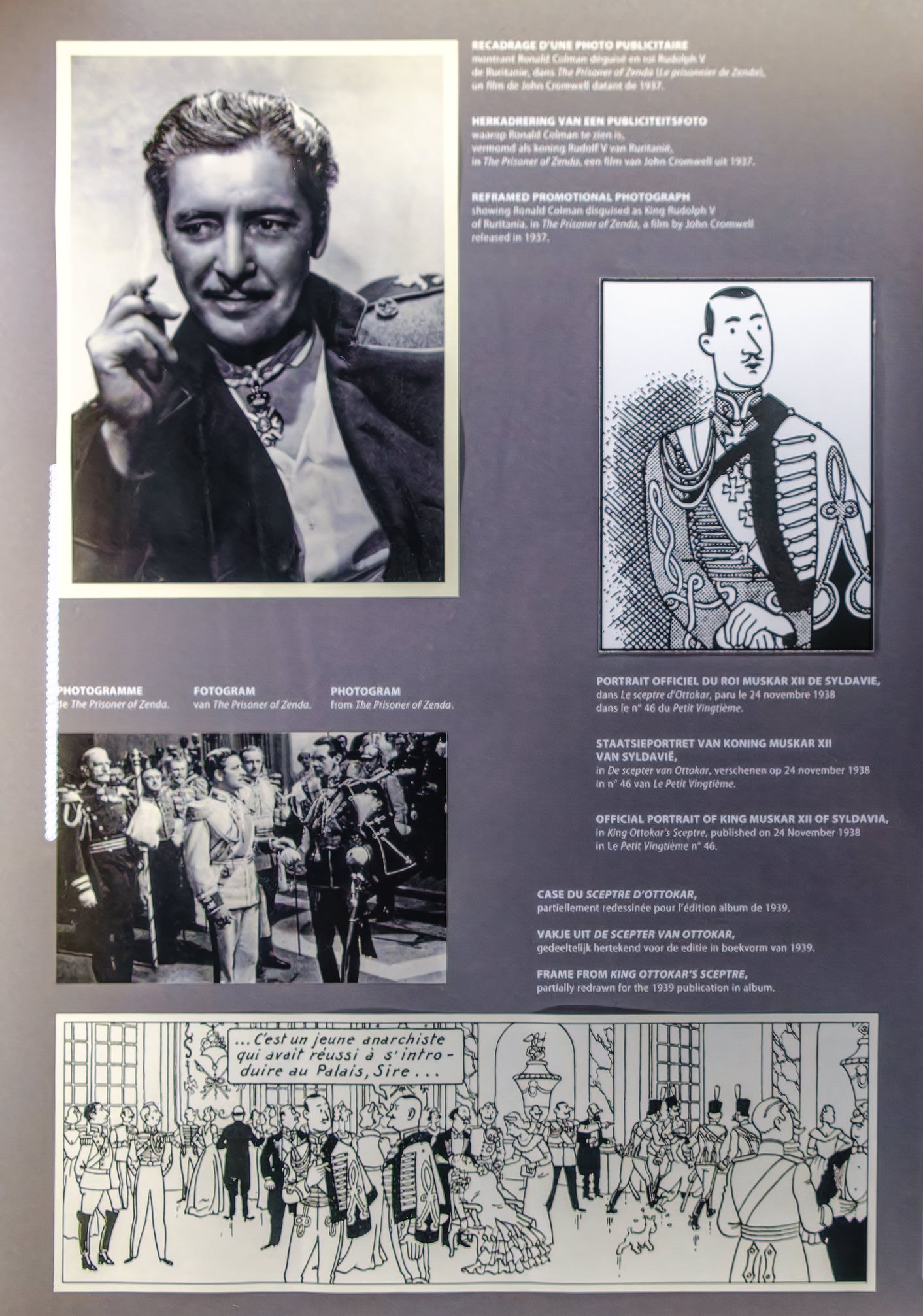
For the King himself, Hergé turned to the cinema. His official portrait of Muskar XII, published in Le Petit Vingtième on 24 November 1938, borrows the face of Ronald Colman in a publicity photograph for The Prisoner of Zenda (John Cromwell, 1937), in which the actor plays King Rudolph V of Ruritania. The Hergé Museum hangs the two side by side. Ruritania is the kingdom of Anthony Hope's novel The Prisoner of Zenda (1894), in which the King, drugged on the eve of his coronation, is replaced by an Englishman who looks just like him, to keep the throne from his half-brother. The novel gave its name to a whole genre of imaginary kingdoms in Central and Eastern Europe, full of palace plots and doubles, and in 1938 a story of a sceptre, a conspiracy and a pair of twins could not fail to recall it. Ruritania, unlike Syldavia, has never existed outside novels and films.
Absent from the serial, the Battle of Zileheroum, after a 15th-century miniature, entered the brochure with the 1939 album, as a full page in colour. For the 1947 edition Hergé redrew it entirely, turning to Persia: for Christmas 1930, L'Illustration had reproduced Persian miniatures from the Vever and Pozzi collections, and the horseman unseating his opponent with a lance and the archer on foot are reproduced from them almost line for line. The Hergé Museum still keeps, in its “Iran” file, two clippings from the same article.
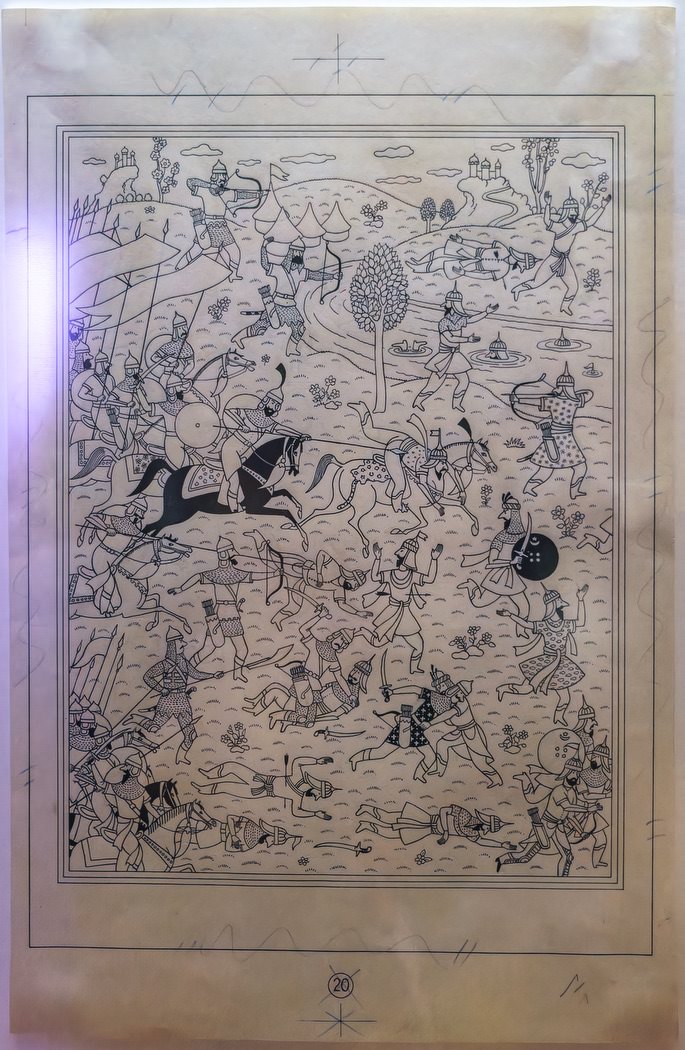
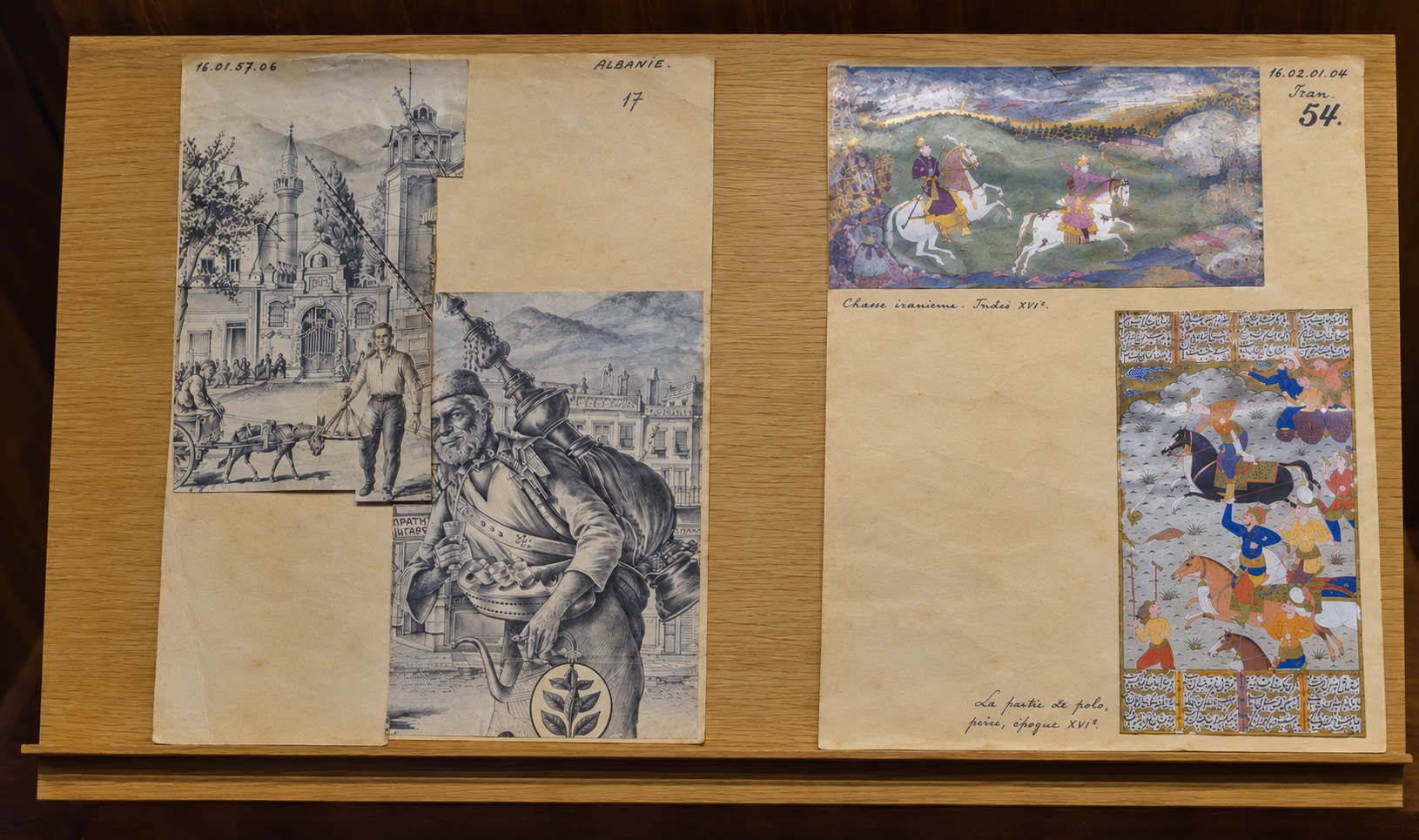
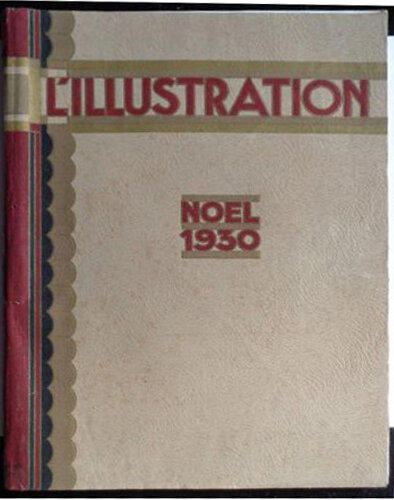
The Battle of Zileheroum: Hergé's page, his documentation files and L'Illustration
Hergé gave the King a film star's face, and even drew himself and Jacobs into the crowd at the Palace. The man who meant to seize power in Syldavia never got a face at all: in the album Müsstler is only a signature at the foot of two orders.
Notes on the adaptation
- In a first version, Hergé made the King himself a Karamellovitch, of the house of the pretender who tried to seize the sceptre in 1937.
- The fighter in which Tintin flew home was a Heinkel in 1939, the maker's name on its fuselage, and a Messerschmitt in 1947.
- In the colour edition Hergé and Jacobs slipped themselves into the story twice: among the witnesses of Tintin's arrest at the Palace, and among the dignitaries at the investiture, where Germaine, Hergé's wife, and several of their friends also appear.
- The baron is Staszrvitch in the 1939 pages and Staszrvich in 1947. The Consulate retains the older form.
- The lines of script on the manuscript page were invented squiggles in 1939. In 1947 they are Syldavian: “Pir Ottokar kzommetz pakkeh…”.
- The glass case on its stepped plinth became a gilded case on a red dais, much closer to the one at Kropow.
- The English translation of 1958 dates Ottokar IV's accession to 1370. The Royal Archives give 1360.
The War 1941–1945
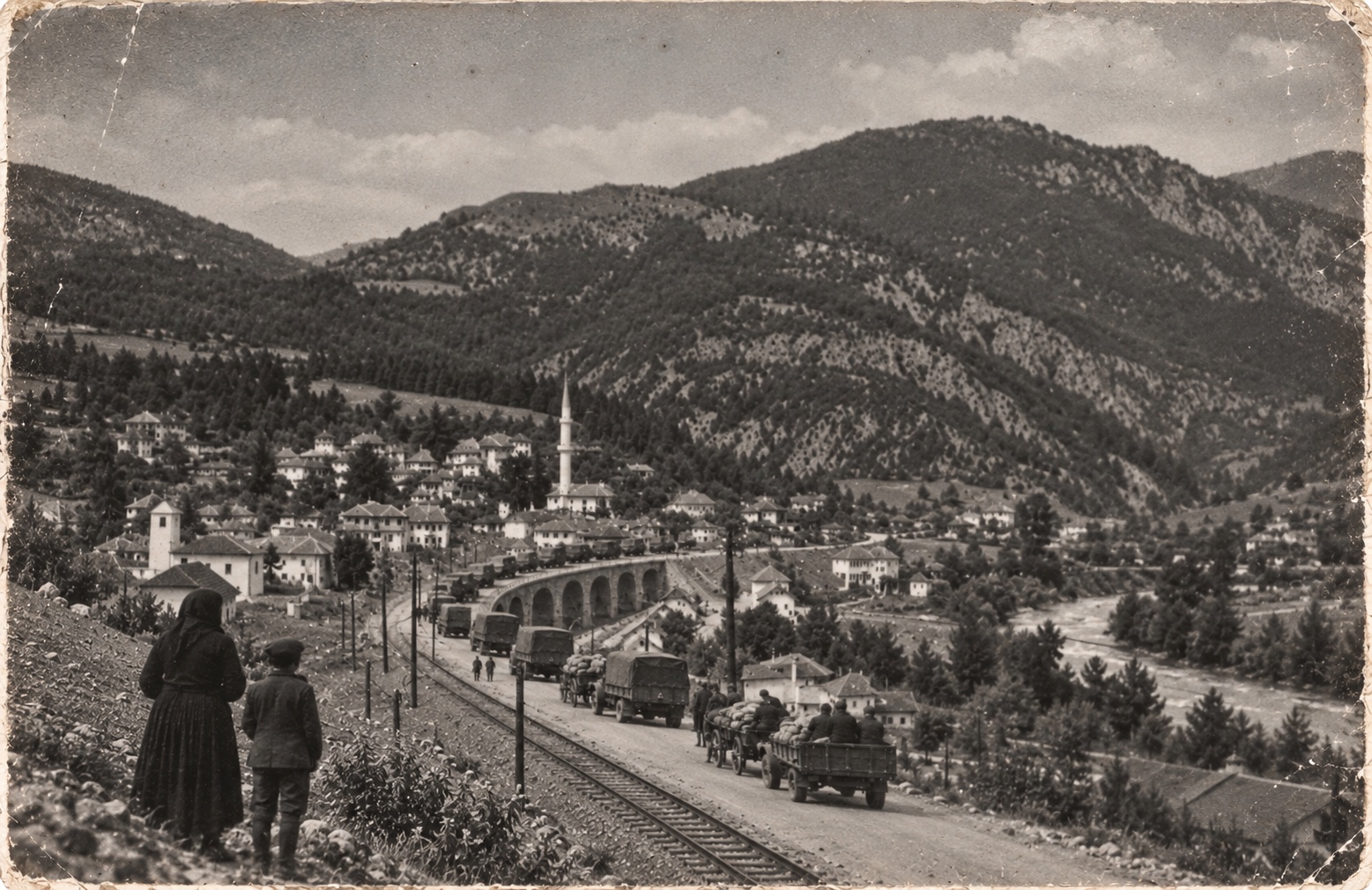
On 8 March 1941 Borduria invaded the Kingdom alongside the German army. Muskar XII neither abdicated nor left the country. He went into hiding with the resistance, the Geblêvn, and the sceptre stayed in his keeping. When Syldavia was liberated on 4 March 1945, the King re-emerged with it.
The Second Theft 2011
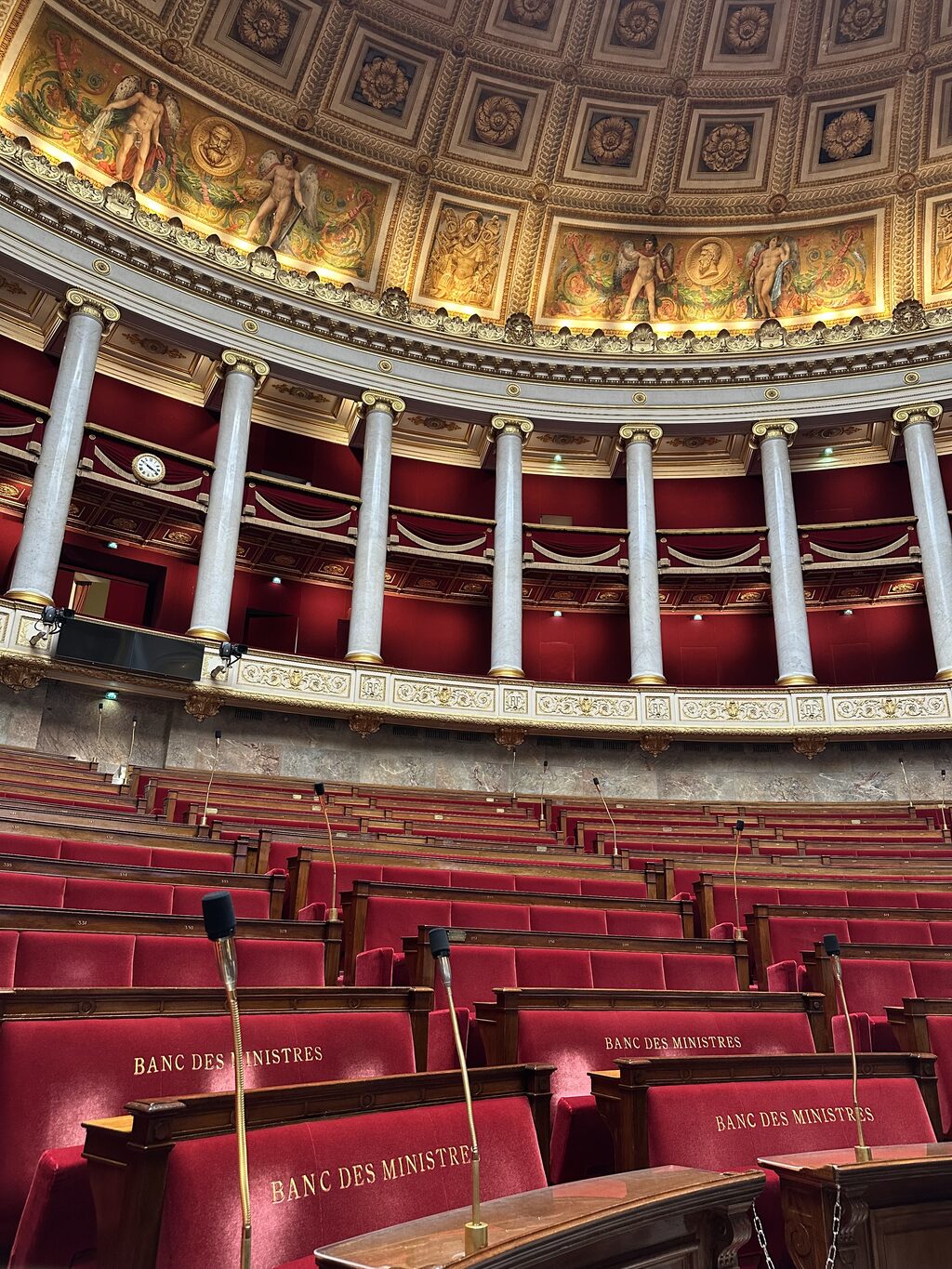
In July 2011, around Saint Wladimir's Day, General Boris Stefanovitch Plekszy-Gladz, head of the Bordurian State since 2003, massed troops on the Syldavian frontier. The spectre of war returned once more. The tension did not subside after the feast. At the eastern gates of the European Union, the situation made heads of state and government fear the appearance of “a new Bosnia”: on 23 October, meeting in Brussels for the European Council, they discussed it on the sidelines of the negotiations on the euro-zone crisis, without reaching a common position.
Two days later, on 25 October, the Sceptre of Ottokar was stolen. Without it, the king loses the right to reign: it was the Crown itself that was at stake. The news broke while the French National Assembly was holding a session on the tensions between the two countries. The stakes were summed up there in these words:
Europe faces two crises: the economic and financial crisis, and the tension between Borduria and Syldavia.
What followed is classified. As early as November 2011, Gérald Arboit of the Centre français de recherche sur le renseignement placed the affair within the long secret war that pits the Belgian SGRS and the Syldavian ZEPO against the Bordurian ZEP.
Yet the solution did not come from speeches. It came from Belgium: the SGRS and the ZEPO defused the tensions, and the sceptre returned to Syldavia. The exact circumstances of its recovery remain sealed in the archives of both services. The Consulate is not in a position to say more.
The Sceptre Today
Every 15 July, Saint Wladimir's Day and Syldavia's National Day, the King presents the Sceptre of Ottokar from the balcony of the Royal Palace at eight in the morning. The rite has outlived the occupation and the constitution of 1987. The procession then takes it through the city, and the National Tea Ceremony and the Royal Parade are broadcast live.
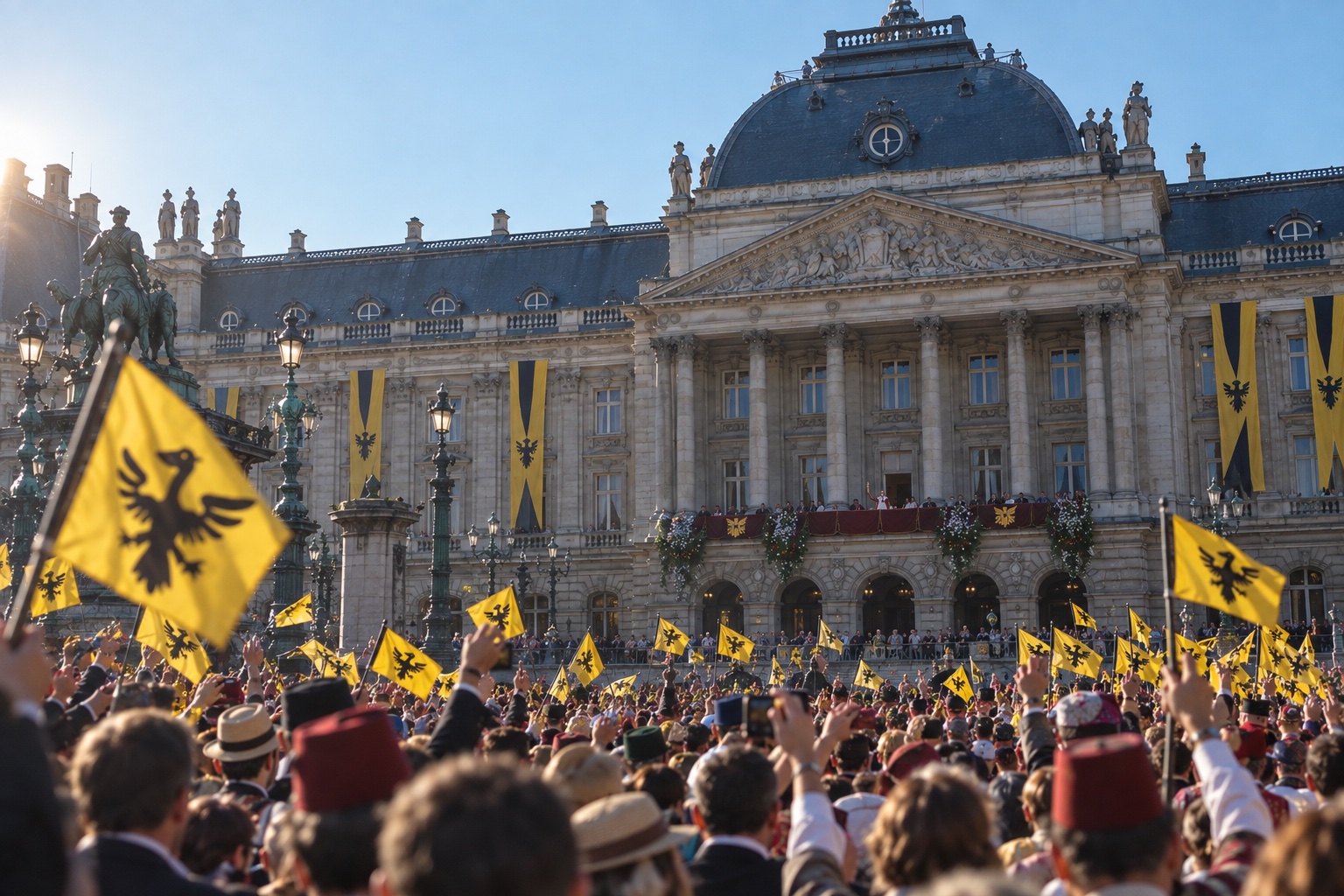
Every consulate of Syldavia around the world marks the day, Bangkok among them, where the ceremonies are shown on a large screen before guests in formal Syldavian attire: the monsoon does not exempt one from decorum (Saint Wladimir's Day: Long Live the Sceptre of Ottokar).
The Sceptre Abroad
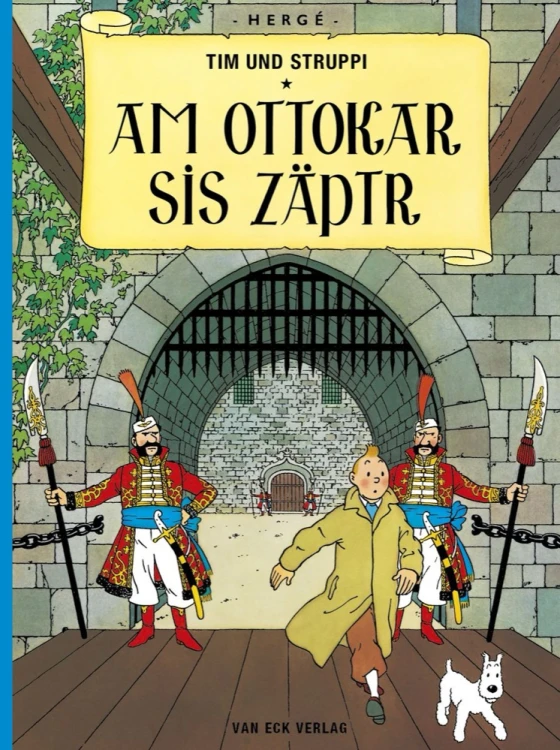
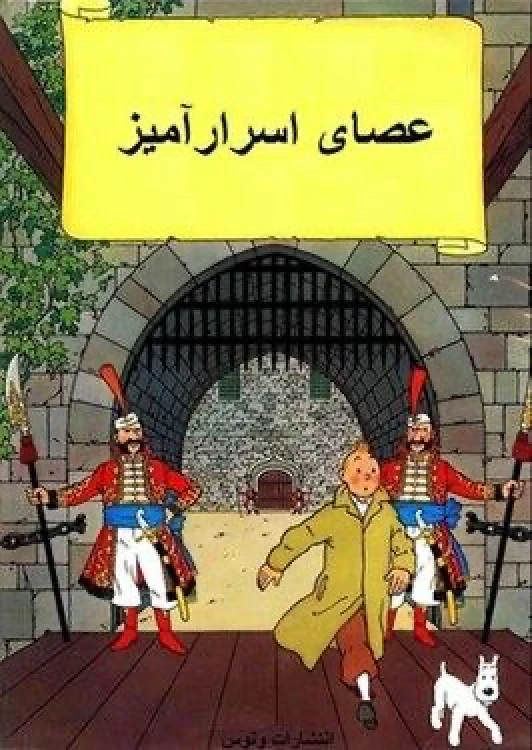
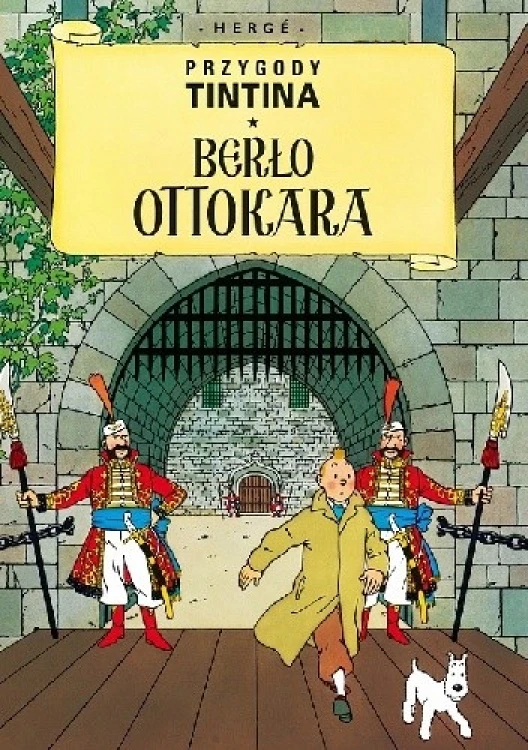
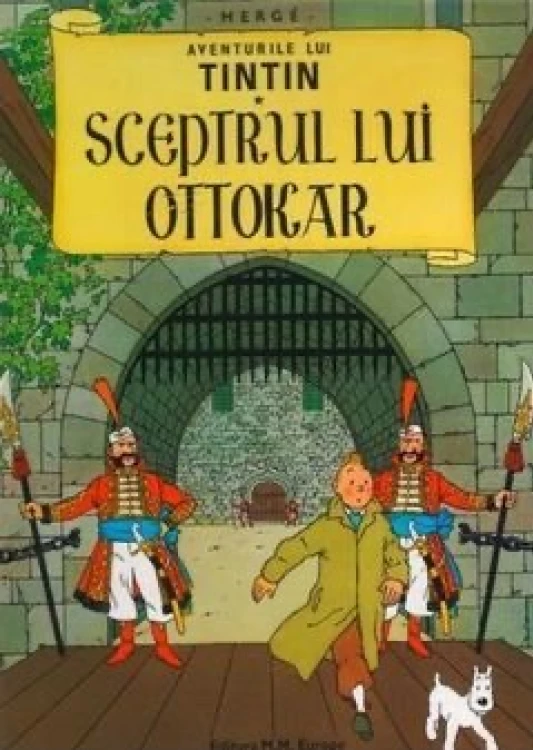
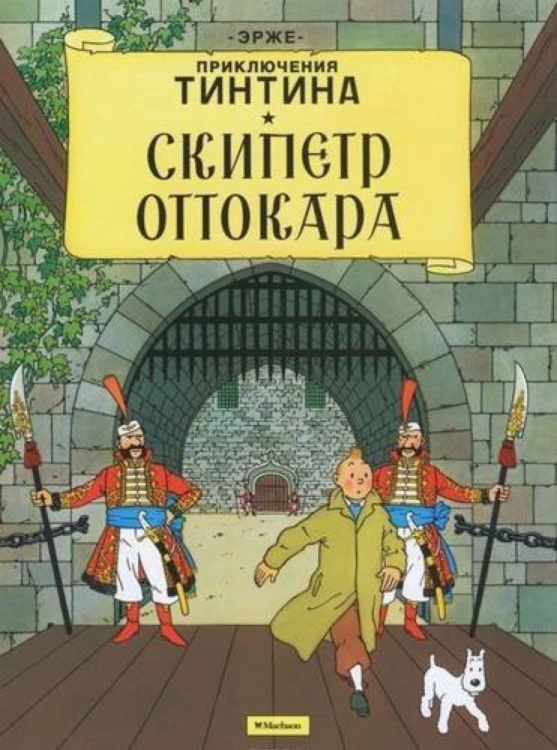
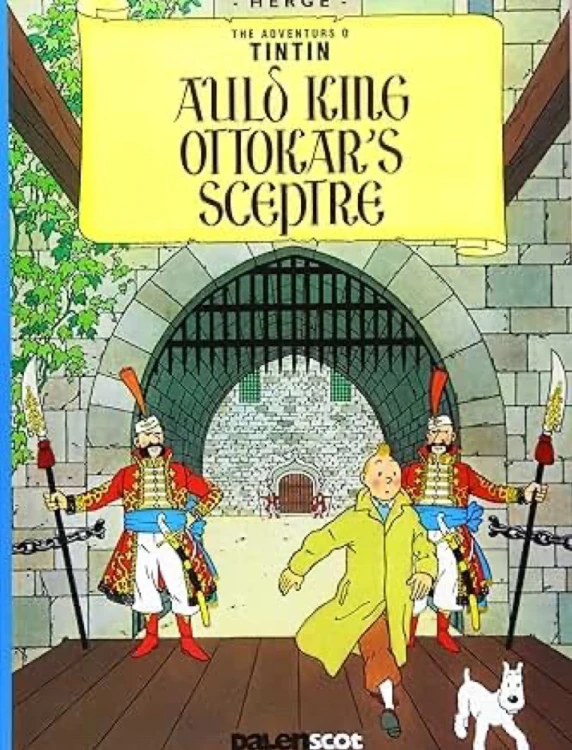
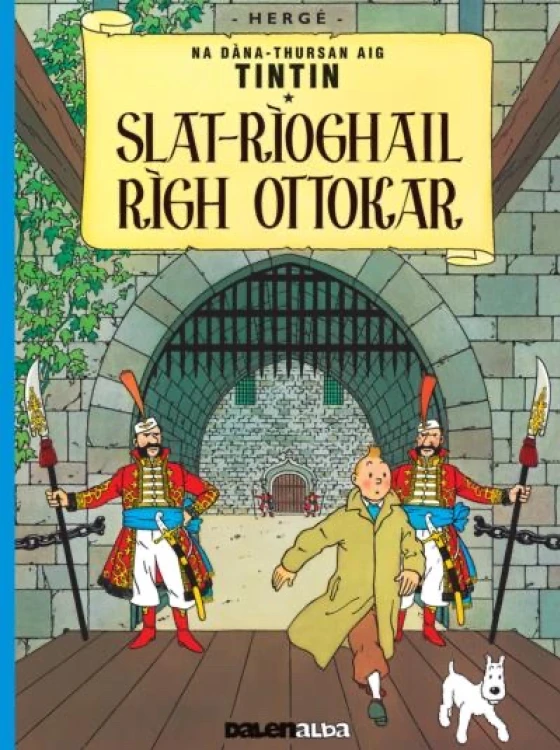
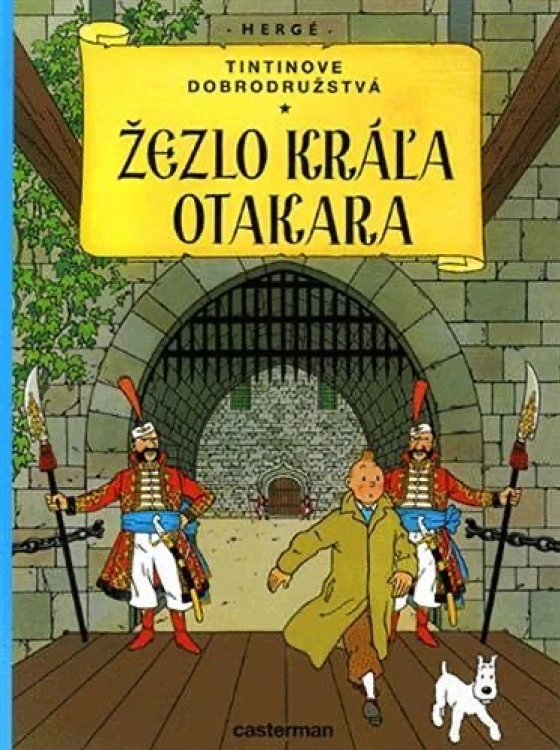
Translated into dozens of languages, King Ottokar's Sceptre is what made Syldavia known to the world. Before 1938 few people outside the Balkans could have placed the Kingdom on a map. The affair of the sceptre put it there, through Hergé: readers from Tórshavn to Seoul still discover Syldavia through a Tintin album in their own language.
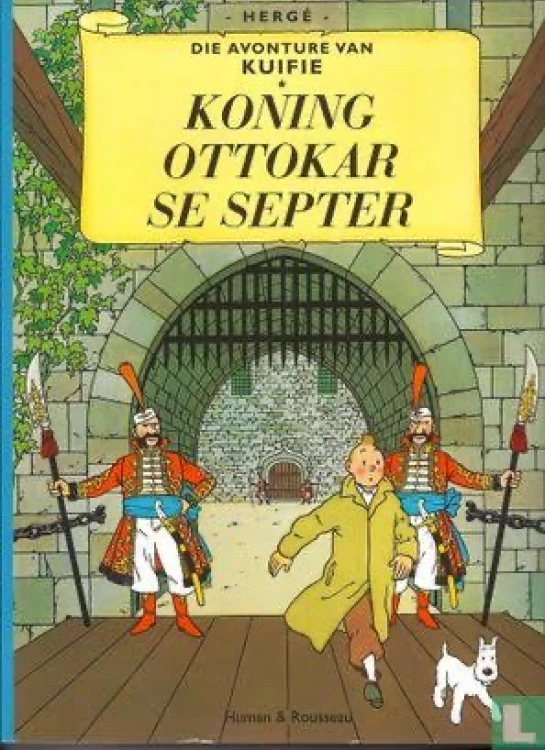
Afrikaans
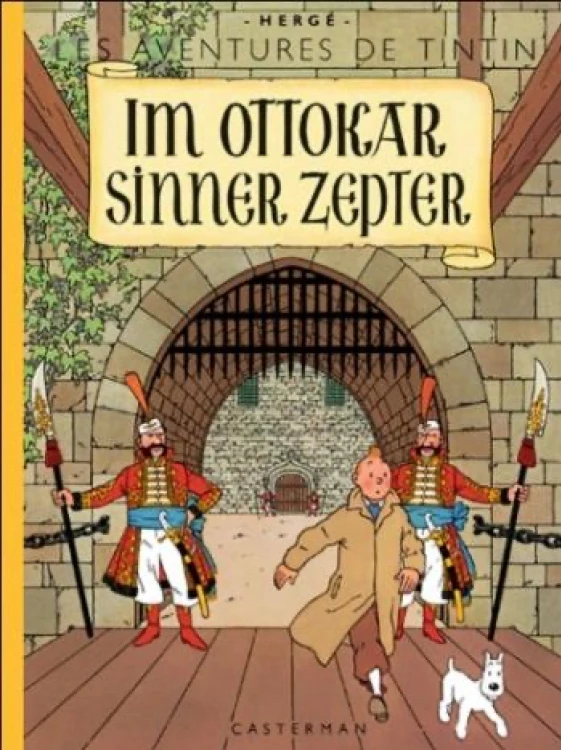
Alsatian
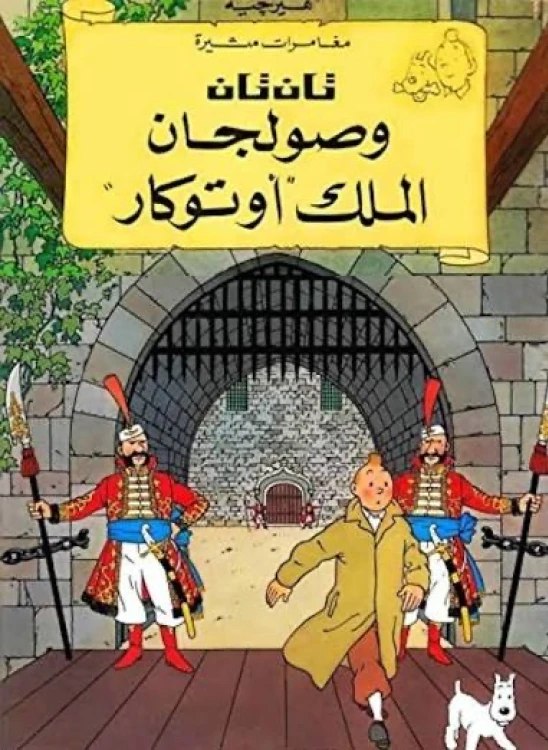
Arabic
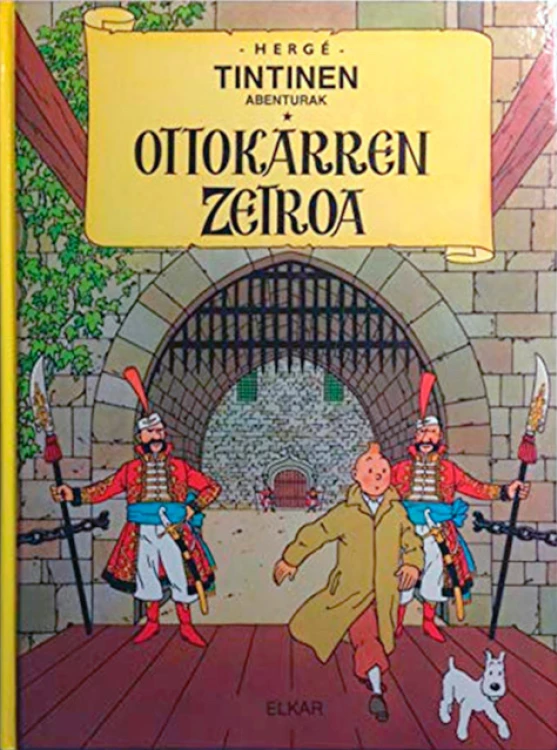
Basque
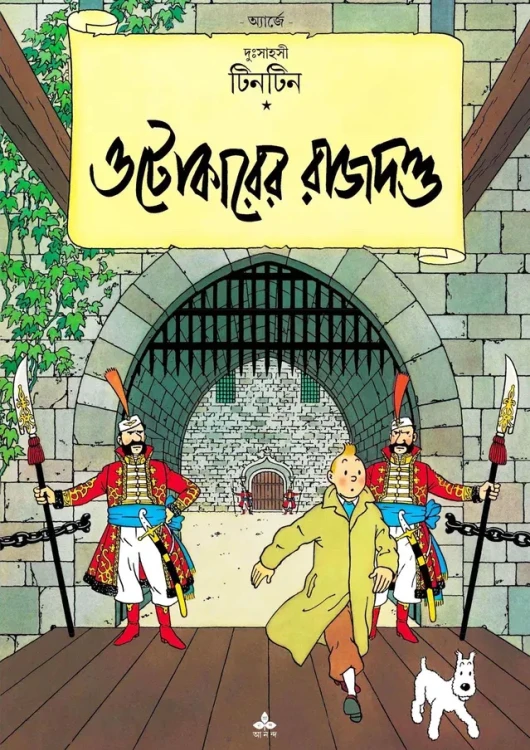
Bengali
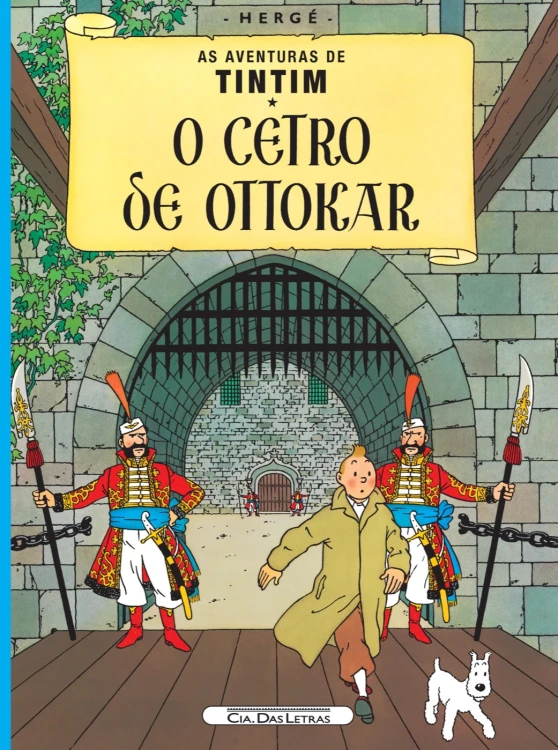
Brazilian Portuguese
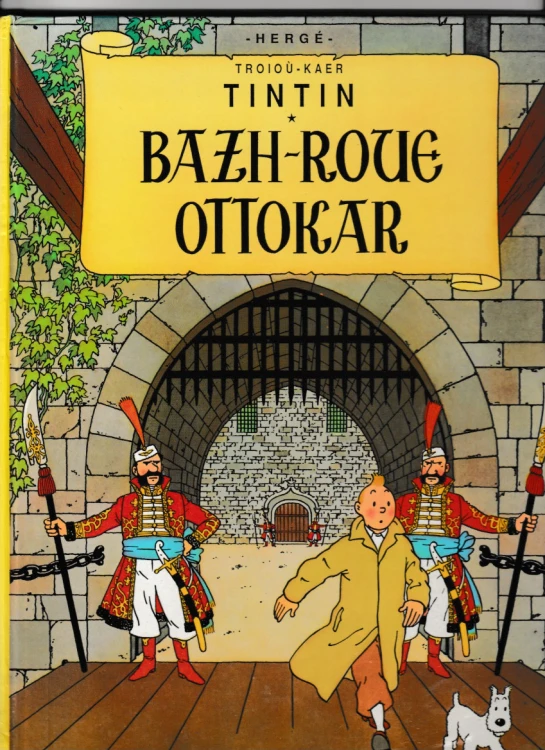
Breton
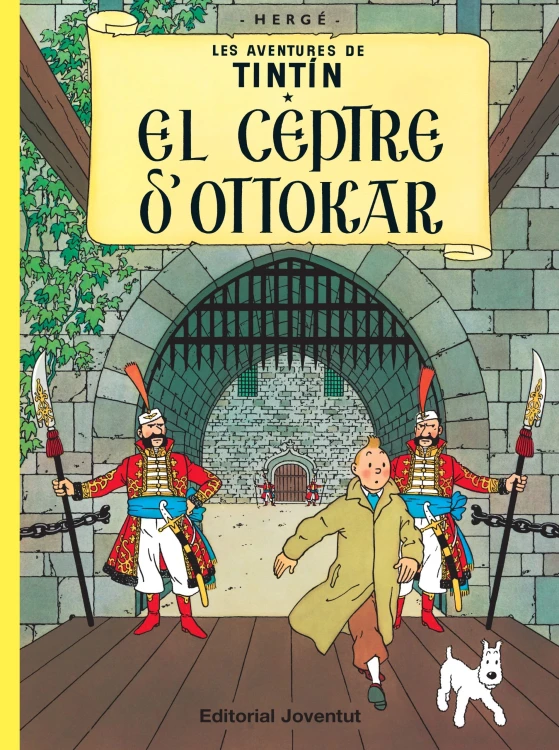
Catalan
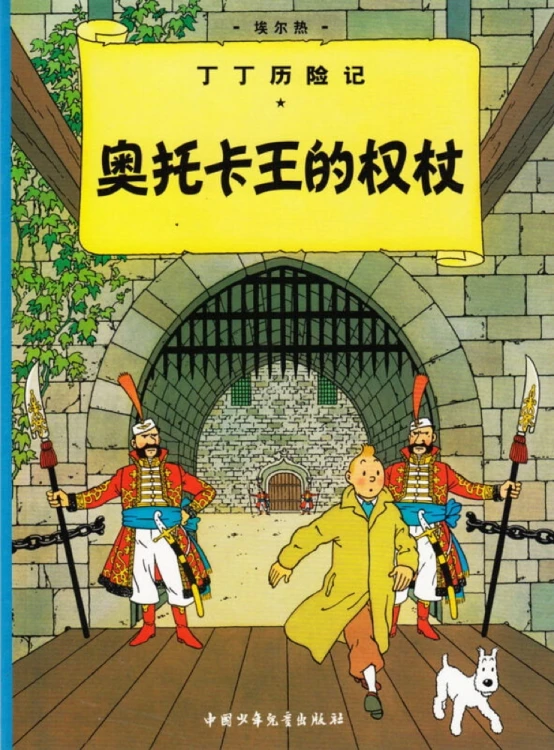
Chinese
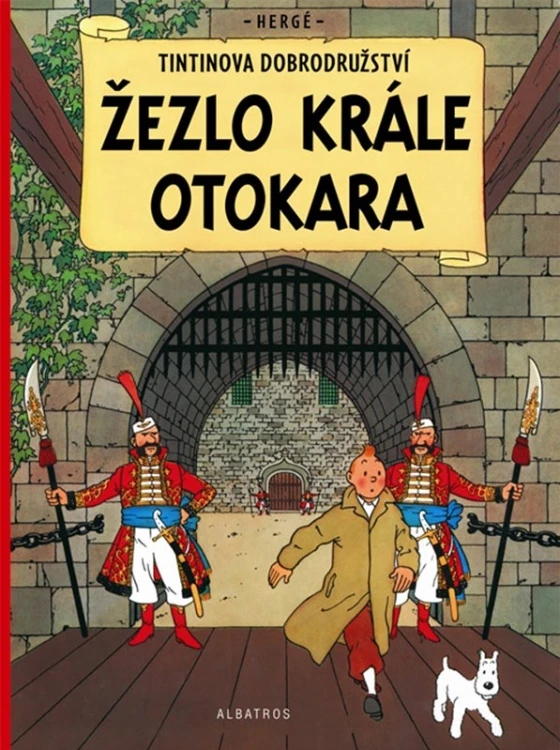
Czech
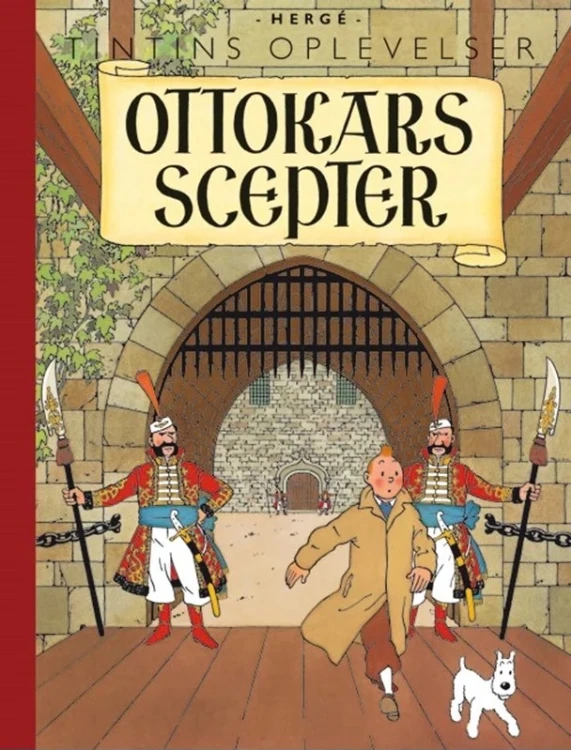
Danish
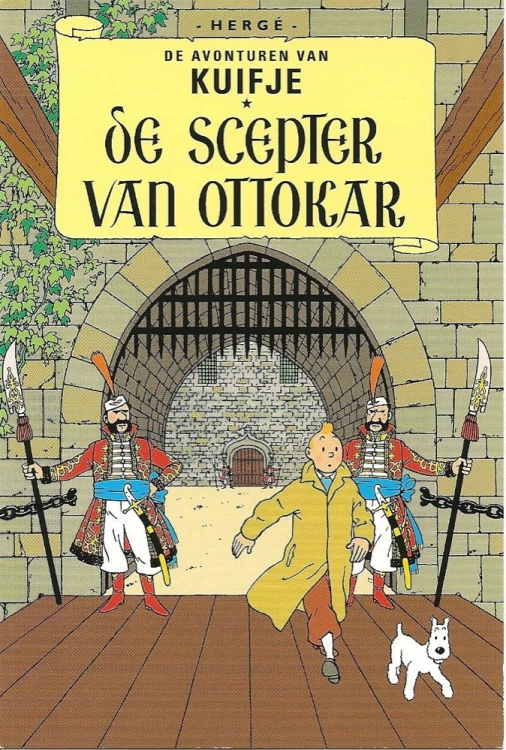
Dutch
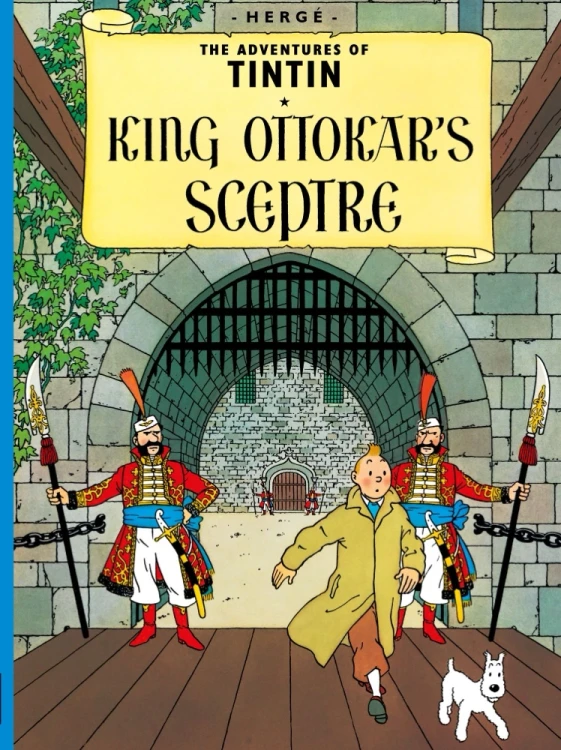
English
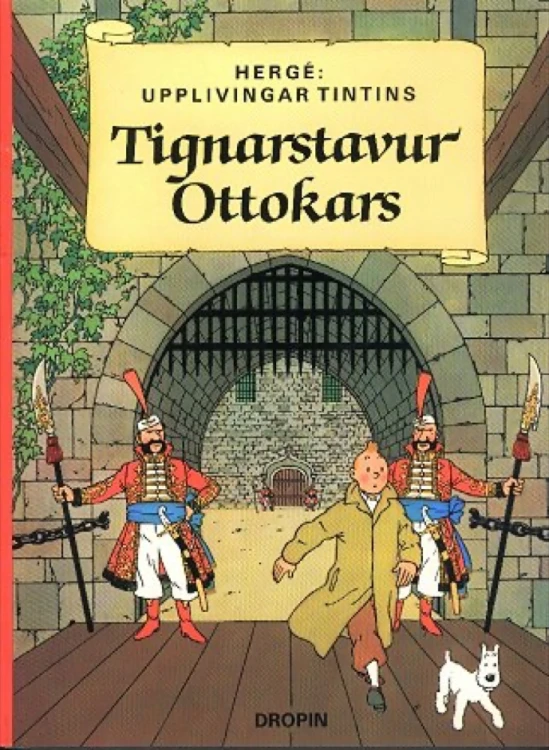
Faroese
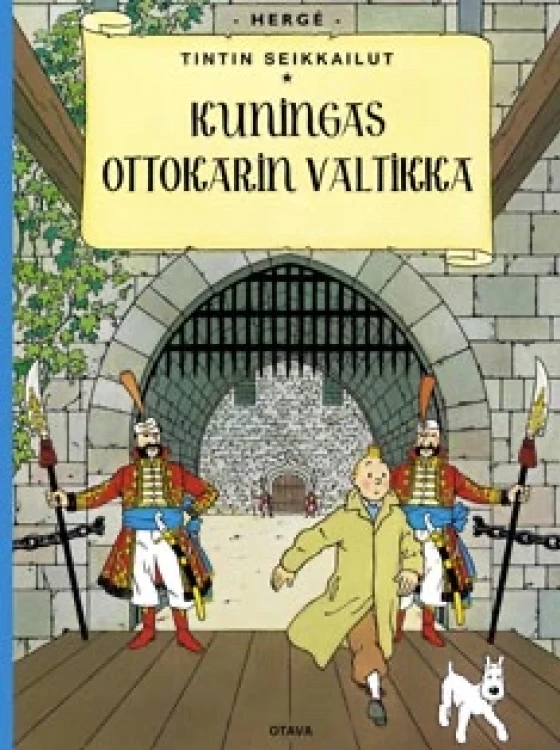
Finnish
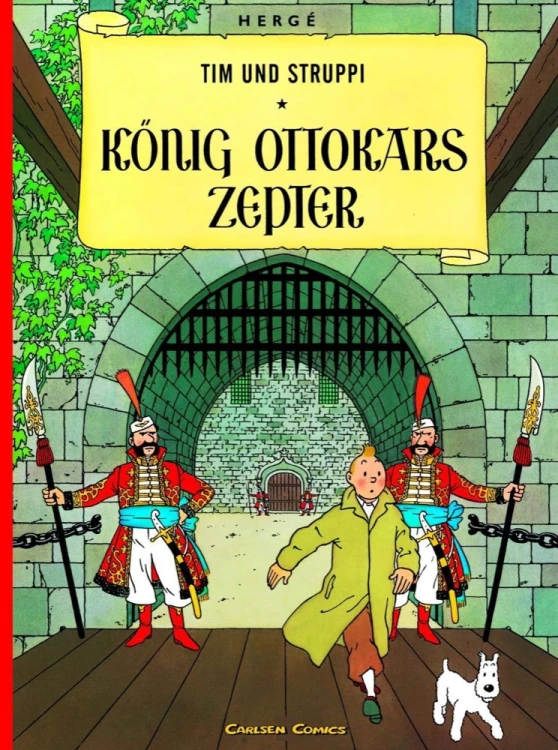
German
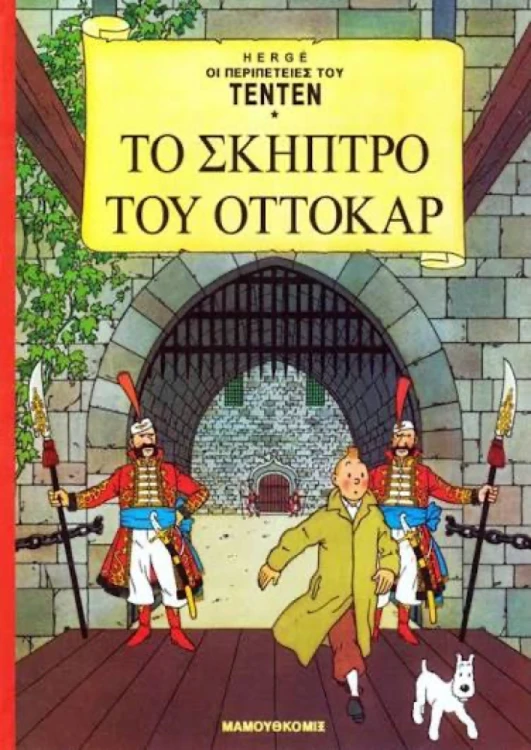
Greek
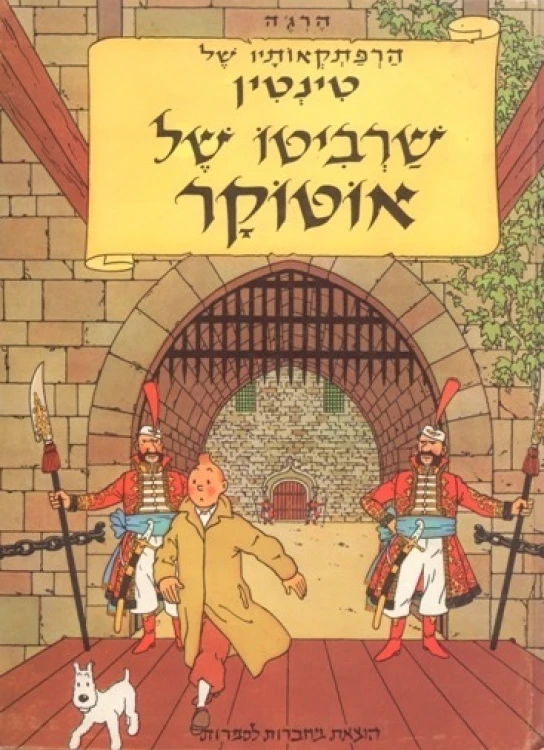
Hebrew
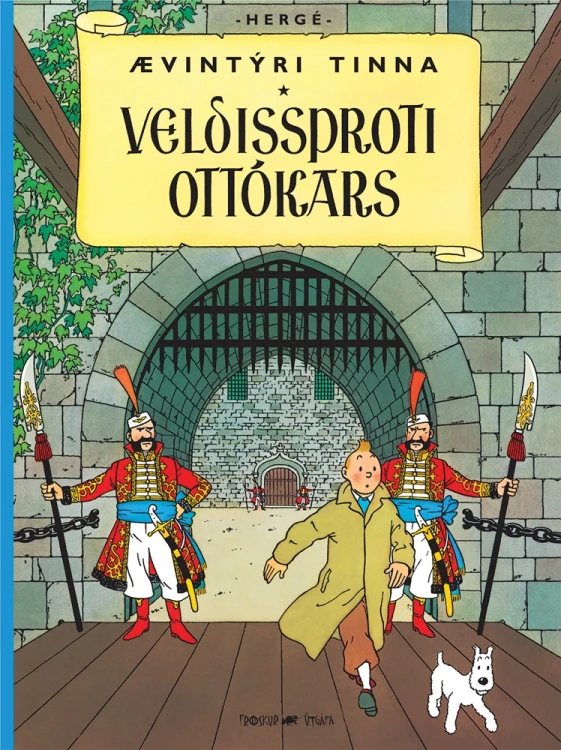
Icelandic
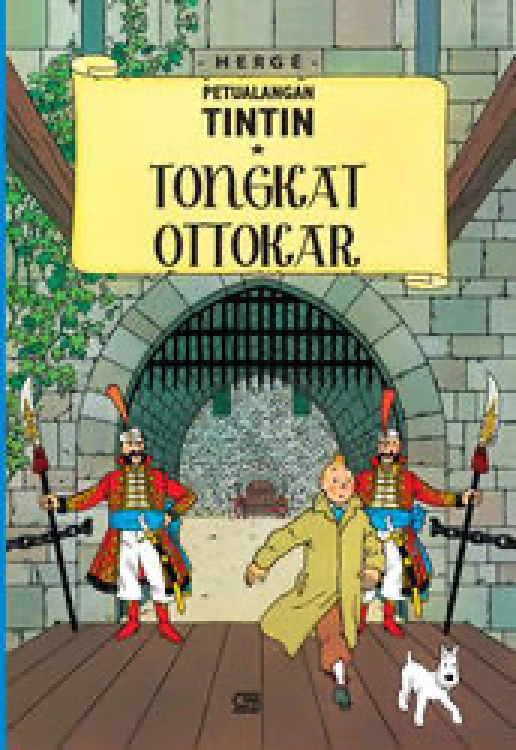
Indonesian
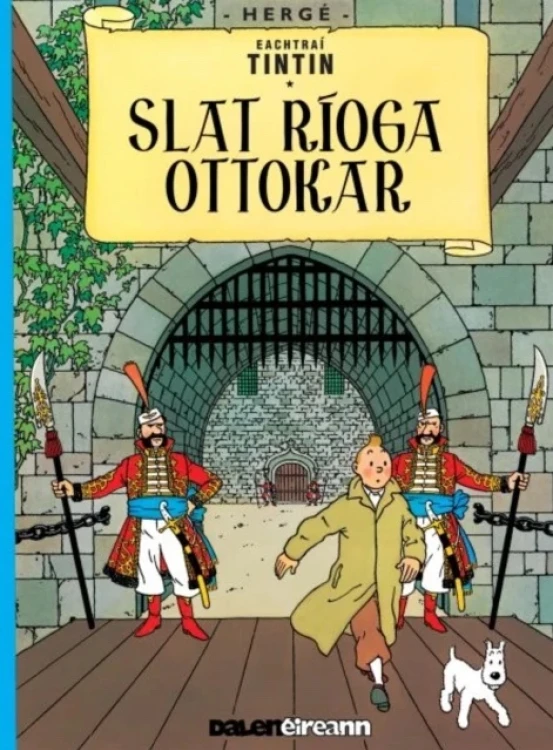
Irish
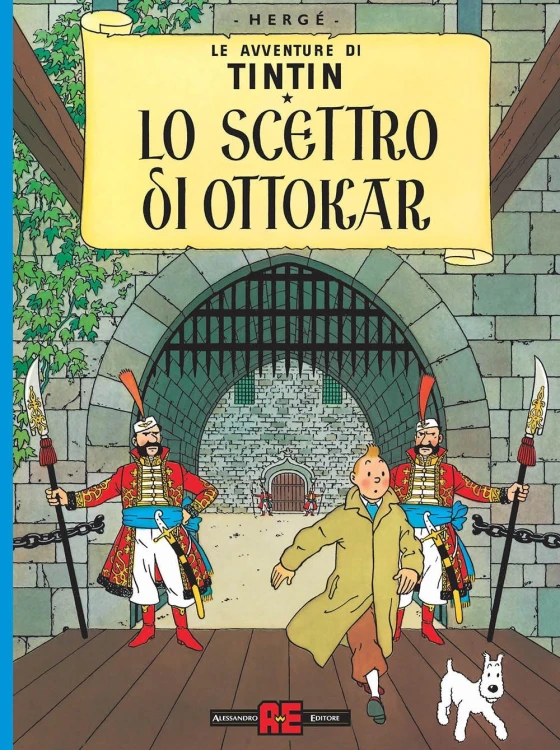
Italian
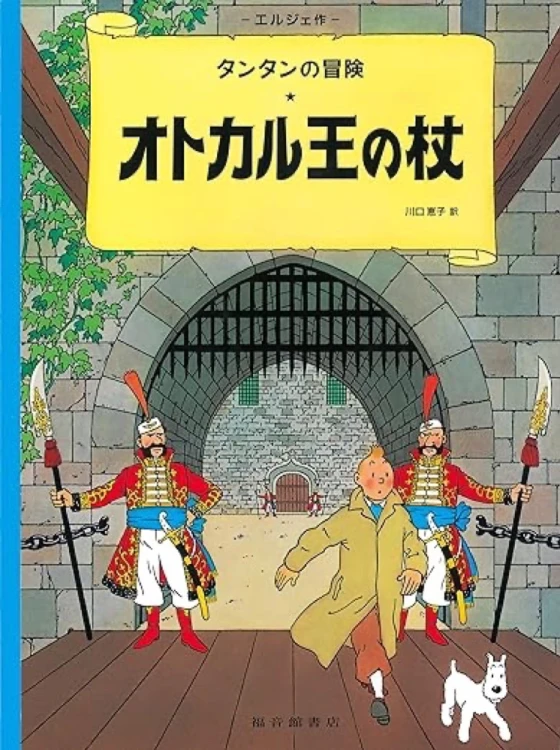
Japanese
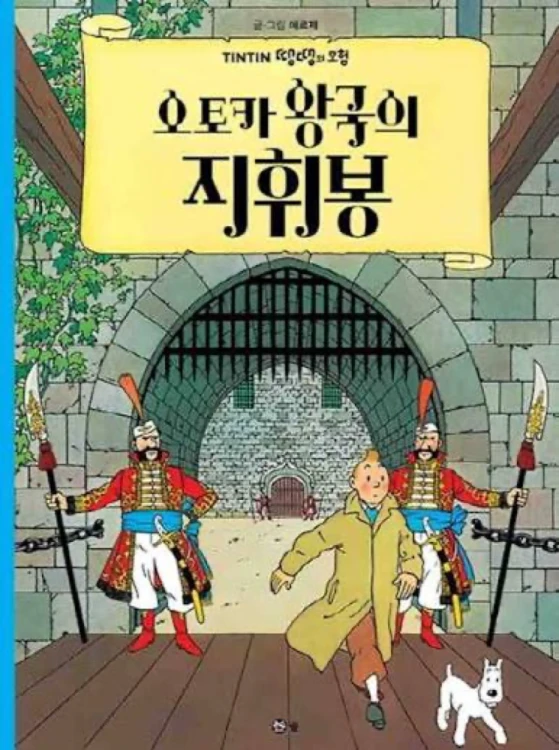
Korean
Liechtenstein dialect
Persian
Polish
Romanian
Russian
Scots
Scottish Gaelic
Slovak
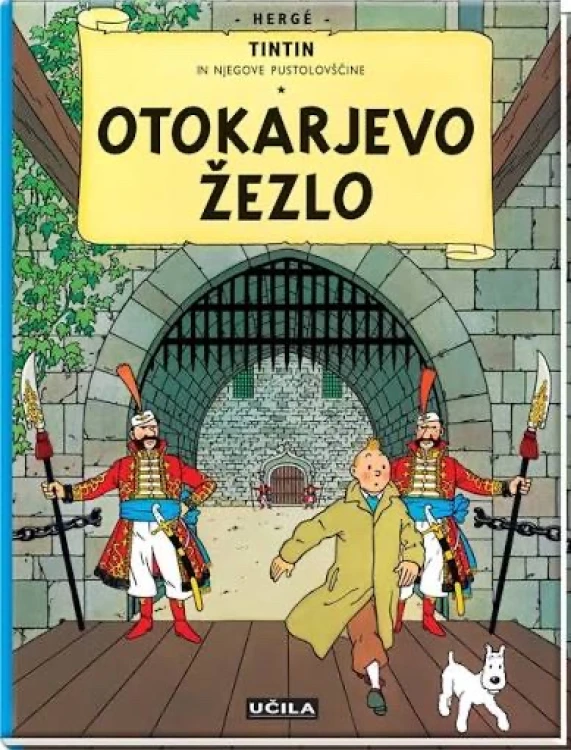
Slovenian
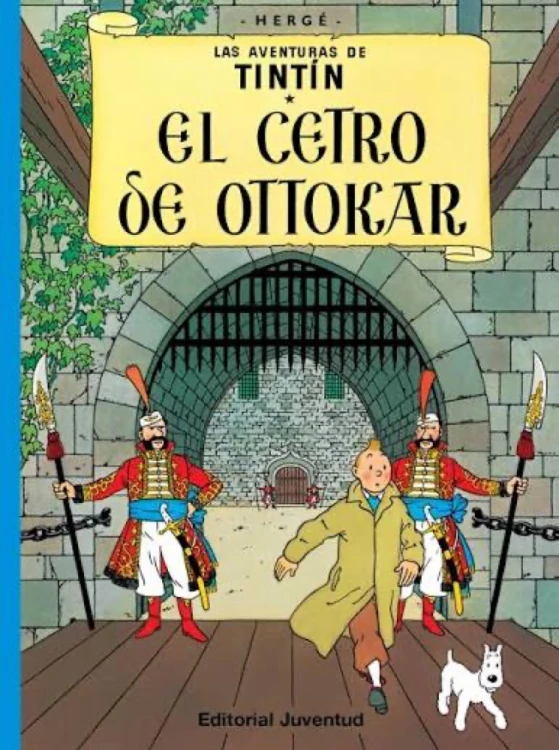
Spanish
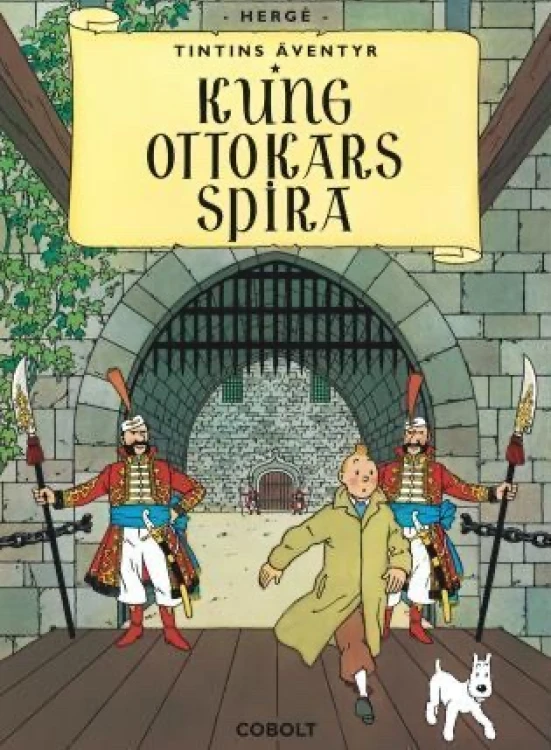
Swedish
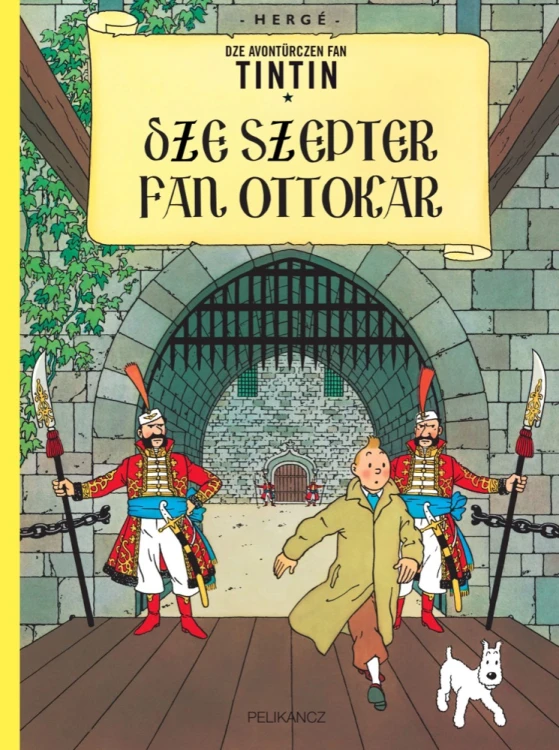
Syldavian
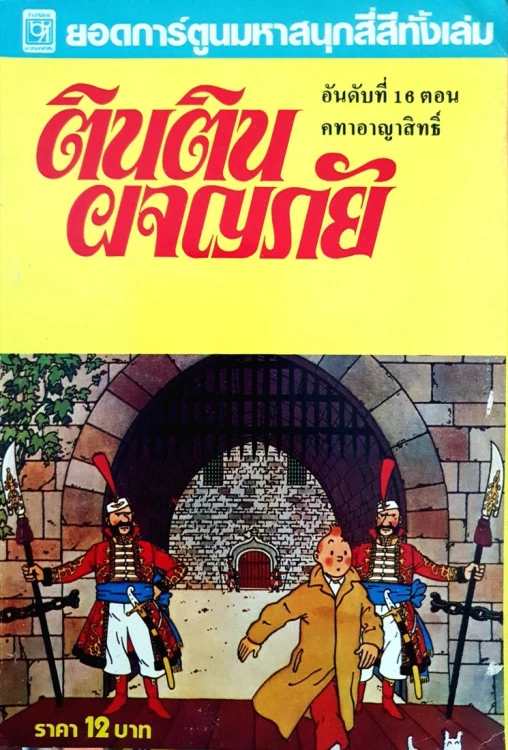
Thai pirate edition
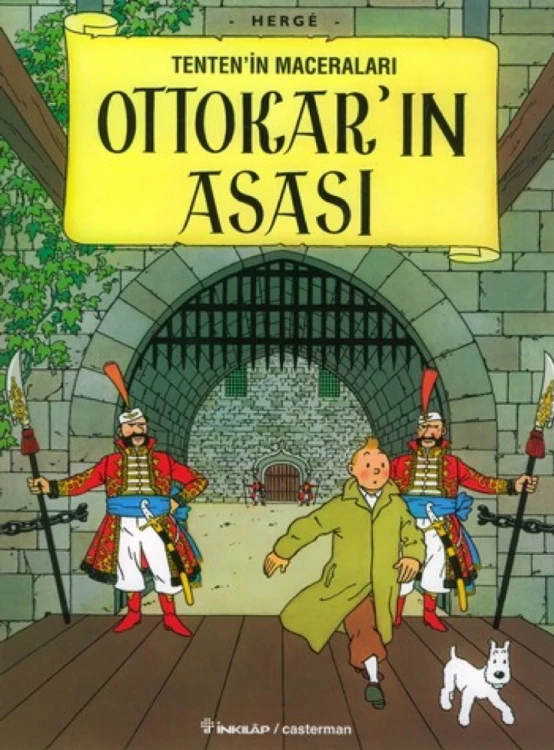
Turkish
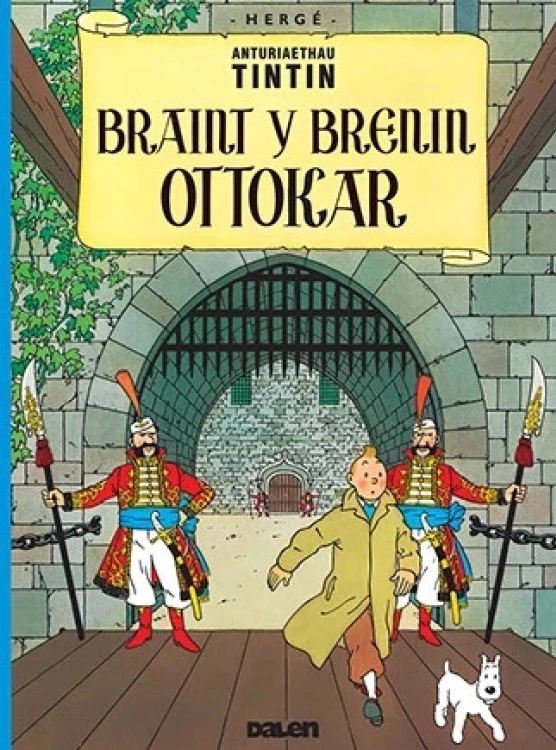
Welsh
King Ottokar's Sceptre around the world. © Hergé / Moulinsart
Outside the Kingdom, it is Hergé's sceptre that people know. At the Hergé Museum in Louvain-la-Neuve, which the Consulate visited in 2025, Czarlitz's camera is presented in its original state, and a replica of the sceptre stands in a display case (the Consulate's visit). The walking stick with which Tintin proved how the theft was done was among the artefacts shown at the 41st Journée des Amis d'Hergé in 2026 (the Consulate at the Journée).
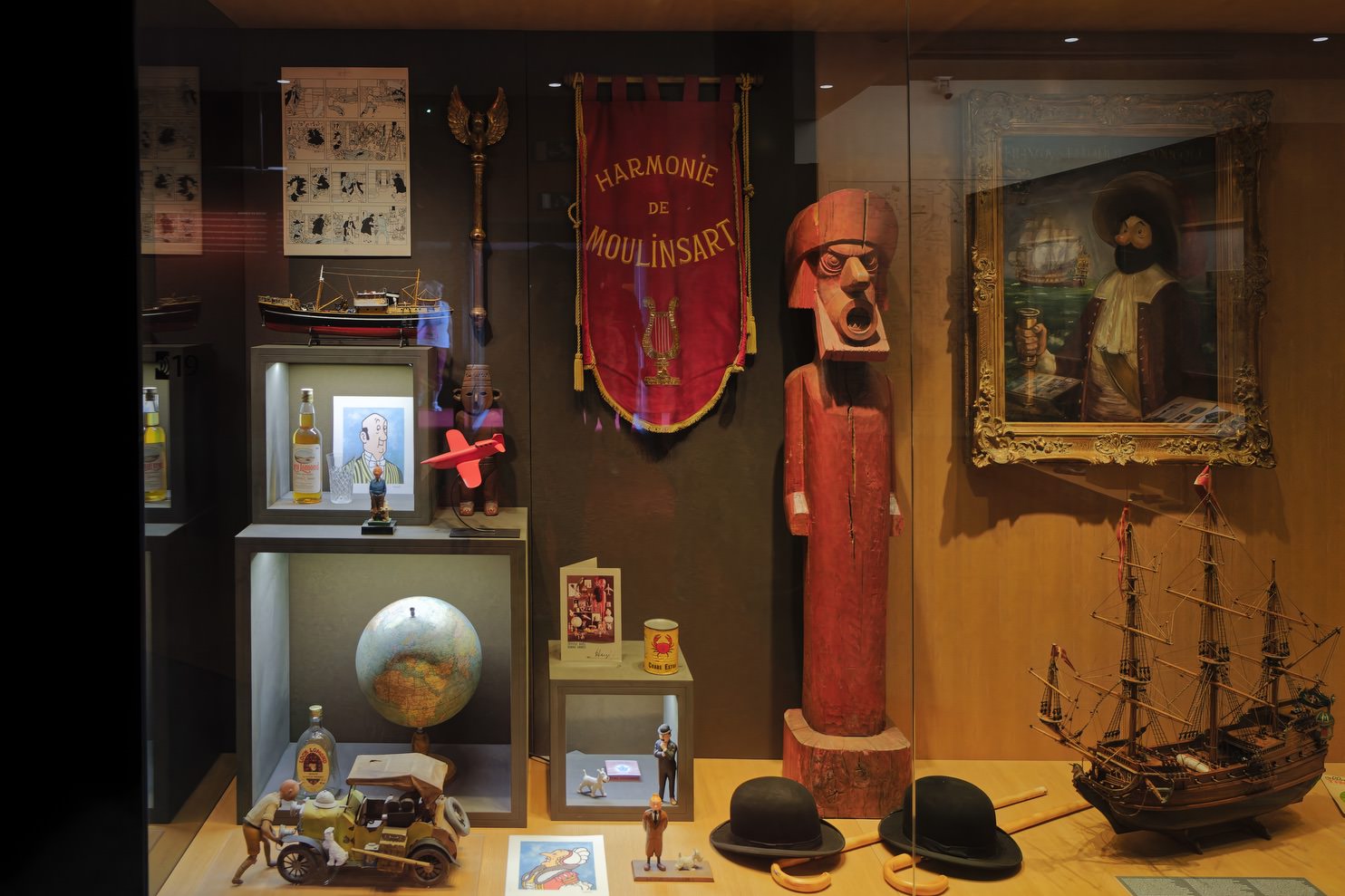
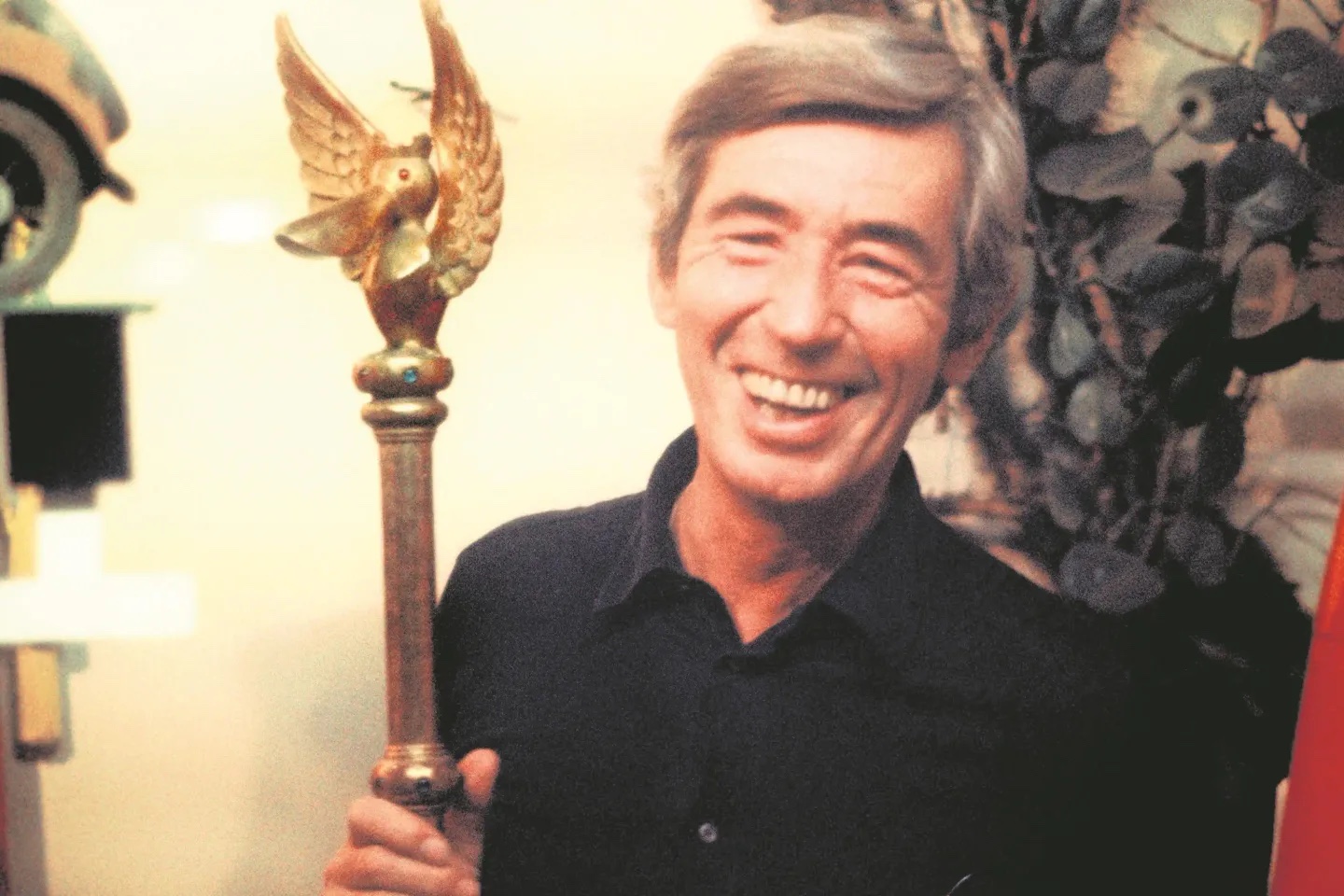
The Treasury raises no objection to replicas, which would not deceive the Treasure Guard. The replicas shown at the Hergé Museum and at the Musée imaginaire de Tintin in Spa, like the one Hergé holds at the foot of this page, have a single row of stones beneath the pelican; the sceptre at Kropow has two. Moulinsart added the sceptre to its “Icons” collection (presented on tintin.com), and figurines, scenes and models of the affair have followed it onto collectors' shelves the world over. Even the conspirators' restaurant acquired an afterlife on screen: Bruno Podalydès rebuilt the Klow, down to the waiter's embroidered waistcoat, for Dieu seul me voit (1998).
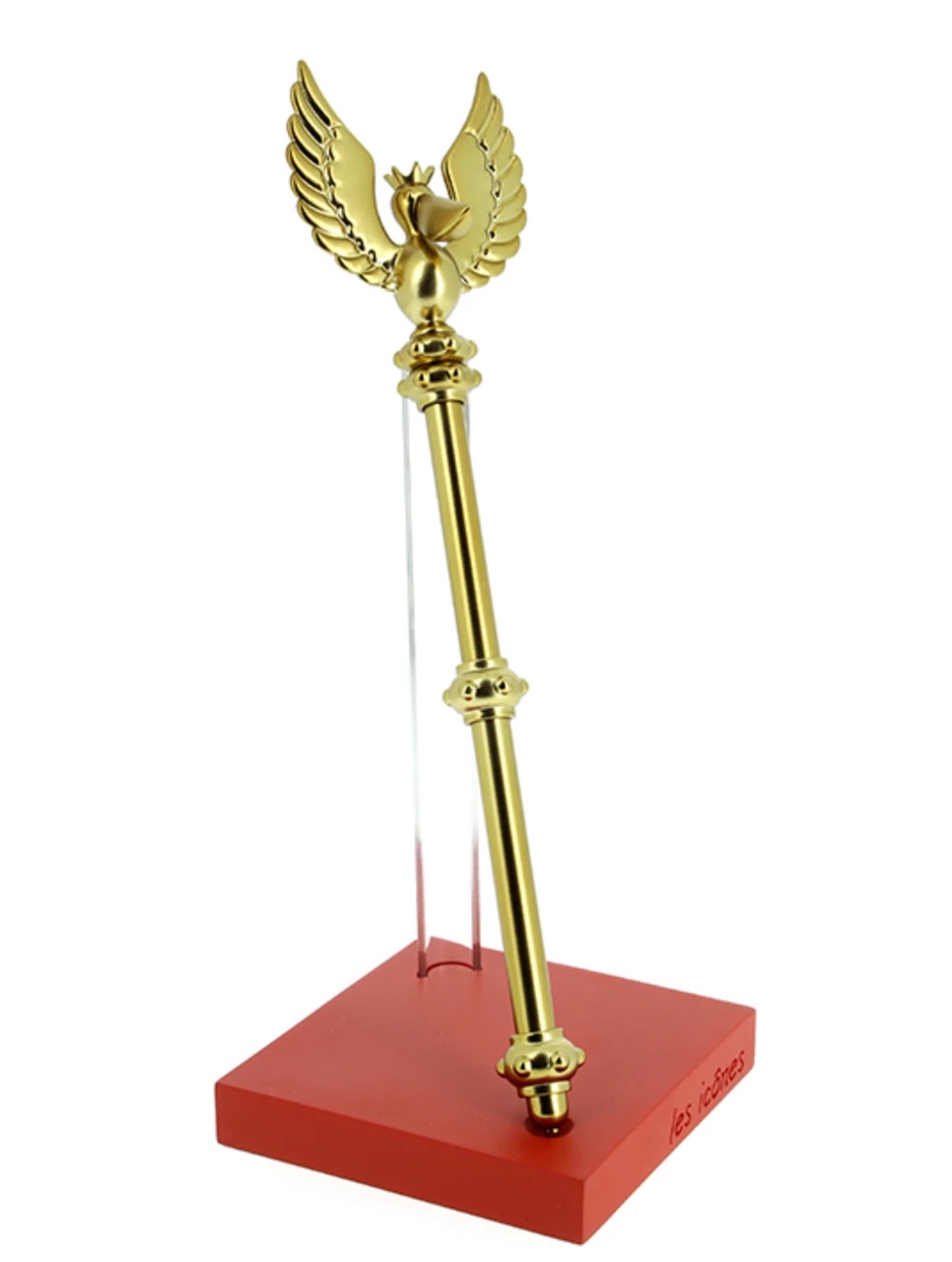
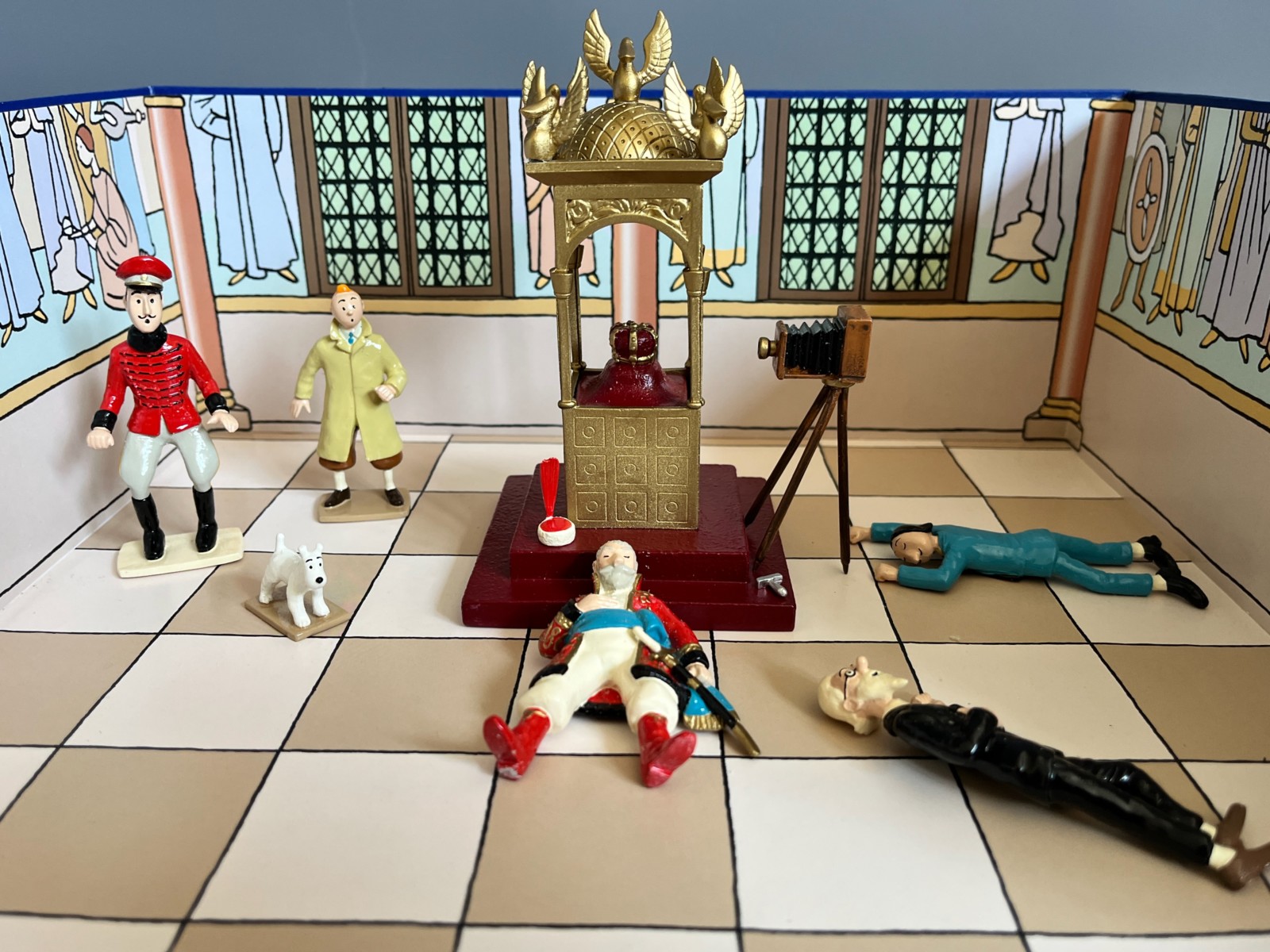
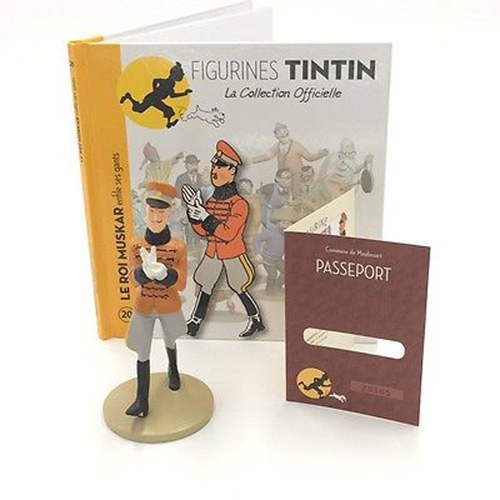
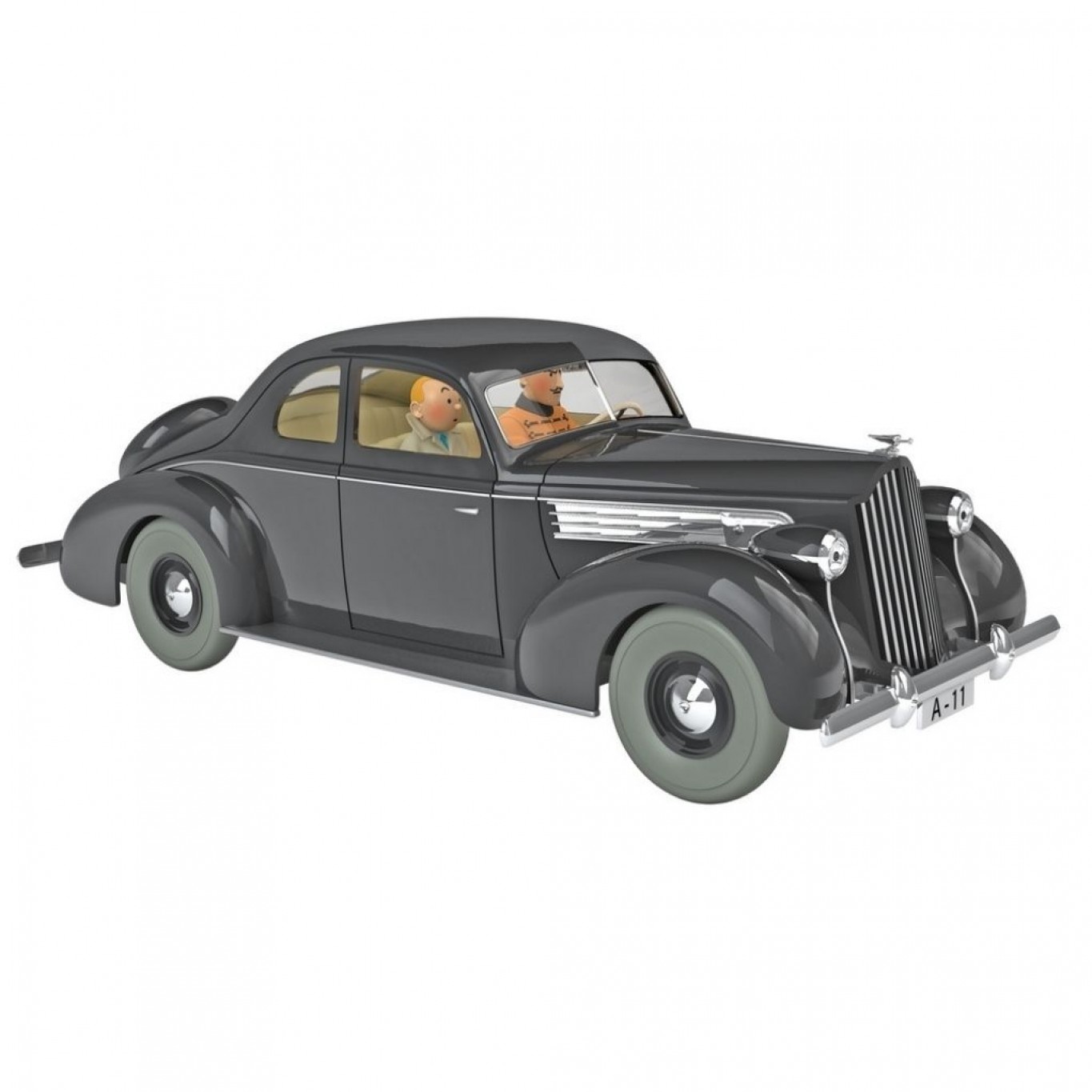
Homages: the Moulinsart sceptre, the 1999 lead scene, the 2012 figurine and the King's Packard
The pelican thus spreads its wings far from Klow. The original remains where the Treasure Guard has kept it since the reign of Muskar VII: in the keep at Kropow, until Saint Wladimir's Day calls it to Klow again.