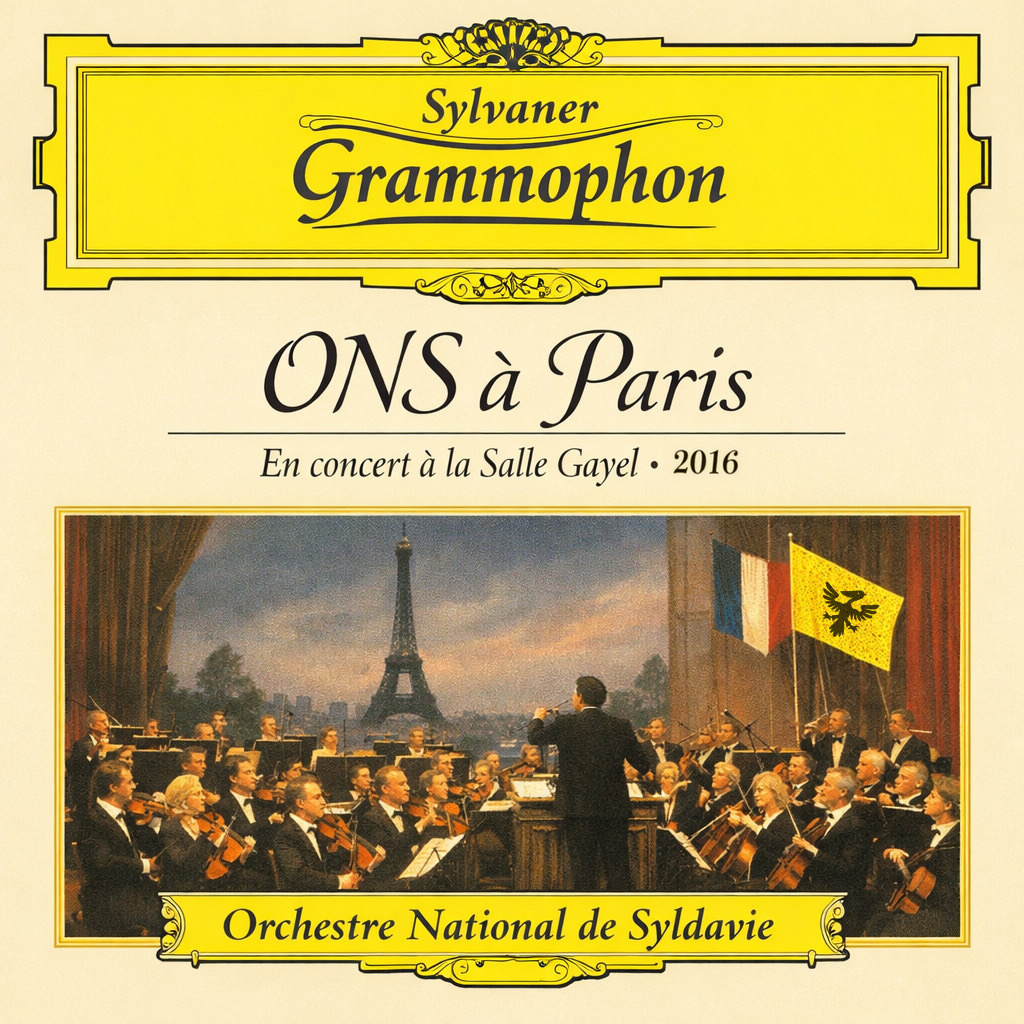
Ten years ago, the National Orchestra of Syldavia stepped onto the stage of the Salle Gayel in Paris — one of the exceedingly rare occasions on which the ONS has consented to perform outside Syldavian territory. The Consulate marks the tenth anniversary of a concert that, by all accounts, no one present has entirely been able to explain, and that all remember with considerable fondness.
The Concert
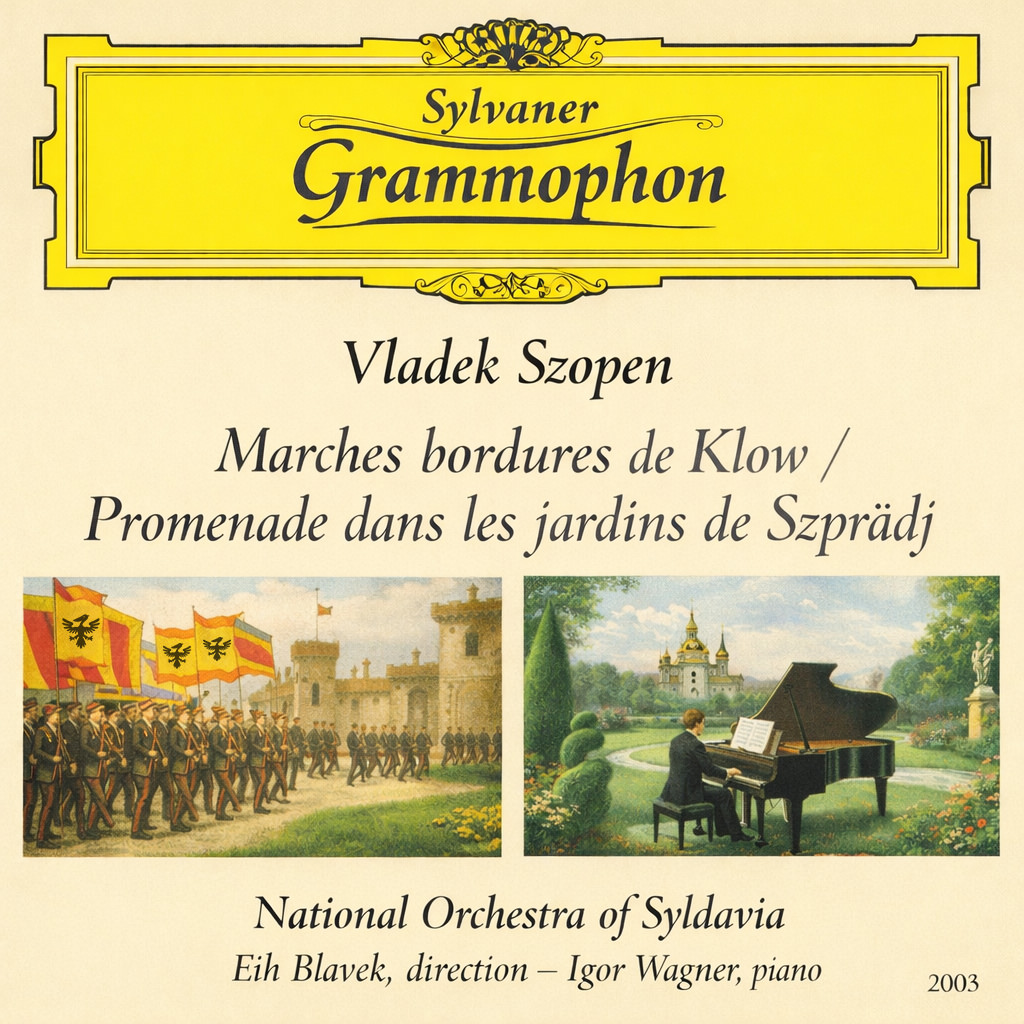
The programme featured the Marches bordures de Klow, a work of considerable technical difficulty, followed by a Promenade dans les jardins de Szprädj performed by the great pianist Igor Wagner with such mastery that the orchestra found itself largely superfluous. The evening concluded with a Blushtika as an encore — a choice that, according to the French reviewer, was “worth a thousand of our fanfares.”
The full account of the evening, including certain incidents involving an orchestra that briefly attempted to perform without its conductor and a piano that had been rather conspicuously forgotten on stage, was published at the time by Classic Agenda. The Consulate commends the review to anyone wishing to understand why Syldavian orchestral music commands such loyalty among those who have survived it.
Read the full account on Classic Agenda (French)

Where Are They Now
Maestro Eih Blavek continues to lead the National Orchestra from his podium at the Klow Philharmonic Hall, now in his twenty-eighth year as director — a tenure that successive Ministers of Culture have deemed prudent not to interrupt. He was awarded the Order of the Golden Pelican in 2019, reportedly for “services to national discipline beyond the call of music.” His authority over the orchestra remains absolute, though the Paris incident is said to be occasionally referenced during rehearsals as a cautionary parable.
First violin Eih Bennek retired in 2023 after a career described by Blavek as “spirited.” He now teaches at the Klow Conservatory, where he is reportedly popular with students for his improvisational approach to the curriculum and somewhat less popular with the administration. A commemorative album, Bennek Unaccompanied, was released by Sylvaner Grammophon in 2024 to mixed but affectionate reviews.
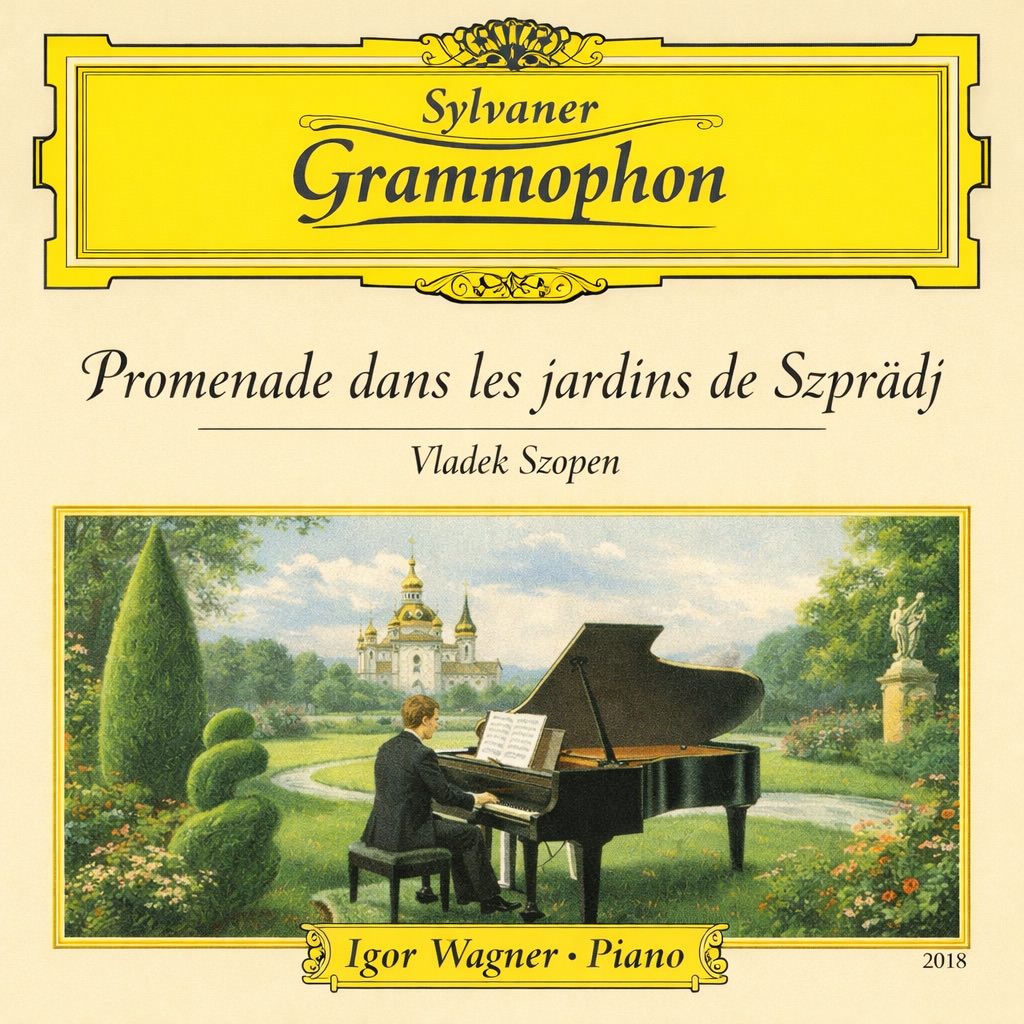
Igor Wagner has pursued an international career of considerable distinction, performing regularly at Klow, Vienna, and, on one contested occasion, Szohôd. His recording of the Promenade dans les jardins de Szprädj for Sylvaner Grammophon (2018) is widely regarded as the definitive interpretation and has been adopted by the Ministry of Culture and National Heritage as an approved work for civic functions. Wagner himself has neither confirmed nor denied persistent rumours of a familial connection to the nineteenth-century composer of the same name, maintaining what his biographer has called “a lifelong and somewhat theatrical silence on the matter.”
The Legendary Recordings
The concert was recorded by Radio France and a limited pressing was subsequently produced by Sylvaner Grammophon under the title ONS à Paris. The pressing sold out within days in Klow, though it is understood that a portion of the initial run was acquired by the Ministry of Protocol and Ceremonial Archives for use at state functions. Copies occasionally surface at antiquarian dealers in Klow and Staszow, where they command prices that the Consulate considers disproportionate but not unjustified.
The earlier 2003 studio recording, which served as the benchmark against which the Paris performance was measured, retains its own admirers — not least among collectors who prize its unvarnished character. A comparative listening reveals the orchestra's remarkable evolution: the majority of the “interpretive liberties” that distinguished the 2003 version have since been resolved, though a handful persist in the second movement of the Marches bordures — attributed by Blavek to “regional tradition” rather than error.
A Concert Unmatched
The Paris concert remains the most recent occasion on which the ONS has performed beyond the Kingdom's borders. Various proposals have been made over the years — including a mooted 2020 engagement at the Berliner Philharmonie that was abandoned due to circumstances — but none has materialised. The reasons are understood to be partly logistical, partly temperamental, and partly related to the orchestra's firmly held conviction that Syldavian acoustics are unmatched and that foreign concert halls, however prestigious, simply cannot do justice to the repertoire.
The Consulate shares the hope expressed by the original French reviewer that our national orchestras will one day be as warmly received during an eventual tour of Syldavia as the ONS was in Paris. Until that day, the memory of that spring evening in Paris — cacophony, poetry, forgotten pianos, and a Blushtika that was worth a thousand fanfares — will have to suffice.
Syldavian Music Reaches Bangkok
The ONS may not have returned to foreign stages, but Syldavian music may yet find a new audience — and this time, the route could pass through Bangkok. The Consulate has learned with considerable interest that the Royal Bangkok Symphony Orchestra, under the direction of Music Director Michel Tilkin, is understood to be considering a programme of Central and Eastern European composers for a forthcoming season. Such a programme might, it is hoped, include a work by Klébar Panzev — perhaps the orchestral suite drawn from his Marches bordures — alongside works by Dvořák, Bartók, and Enescu.
The Consulate has facilitated preliminary introductions between the RBSO and the Klow Philharmonic Hall, following the orchestra's acclaimed Russian Seasons concert in February. The RBSO, which performs regularly at the Thailand Cultural Centre and holds its celebrated annual Concert in the Park at Lumpini, has expressed interest in expanding its Central European repertoire — though nothing has been confirmed. Separately, the Syldavian External Cultural Directorate is understood to have initiated contacts with the Princess Galyani Vadhana Institute of Music, whose international programme could offer further avenues for musical exchange.
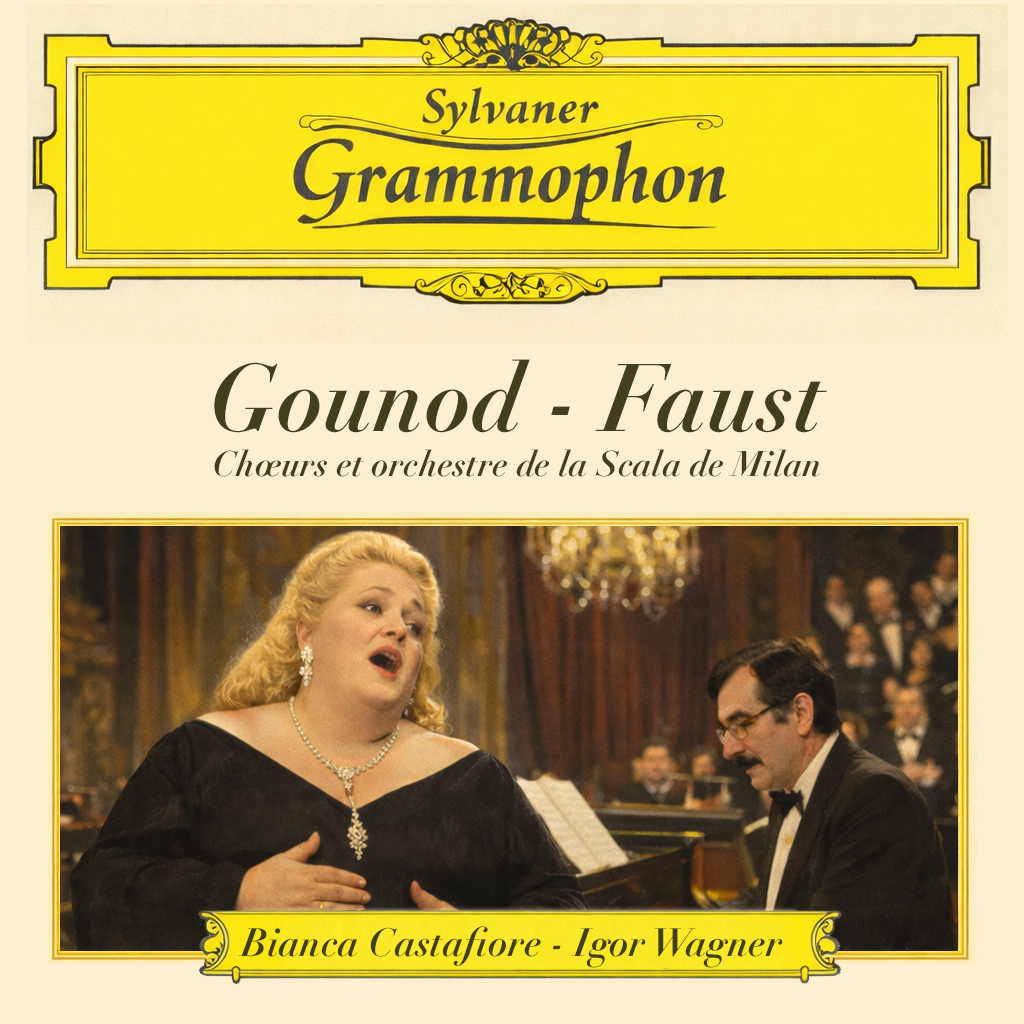
Igor Wagner — whose performances alongside Bianca Castafiore in Gounod's Air des Bijoux first brought Syldavian pianism to international attention — has been mentioned as a possible guest soloist, though he is understood to have prior engagements, some of which may have nothing whatsoever to do with music. Should such a programme materialise, one dares to hope it might prove as memorable as that spring evening in Paris a decade ago.
Between his National Day carillon, the Paris anniversary, and the reported interest from the RBSO, Klébar Panzev has become the Kingdom's most internationally visible composer in a generation. The Consulate notes this trajectory with quiet satisfaction. Pelflix, evidently, has noted it too — its biographical film premieres today on the streaming platform.