This monthly report provides an update on the progress of the SYLVIA programme (Syldavian Yielded Linguistic & Visual Intelligence Agent), Syldavia's national artificial intelligence system.
For background and foundational context, see: Introduction to SYLVIA | Official SYLVIA Website
Version 1.3.7 deployed
The Ministry of Research, Innovation and Patriotic Technologies confirms the successful deployment of version 1.3.7 of SYLVIA.
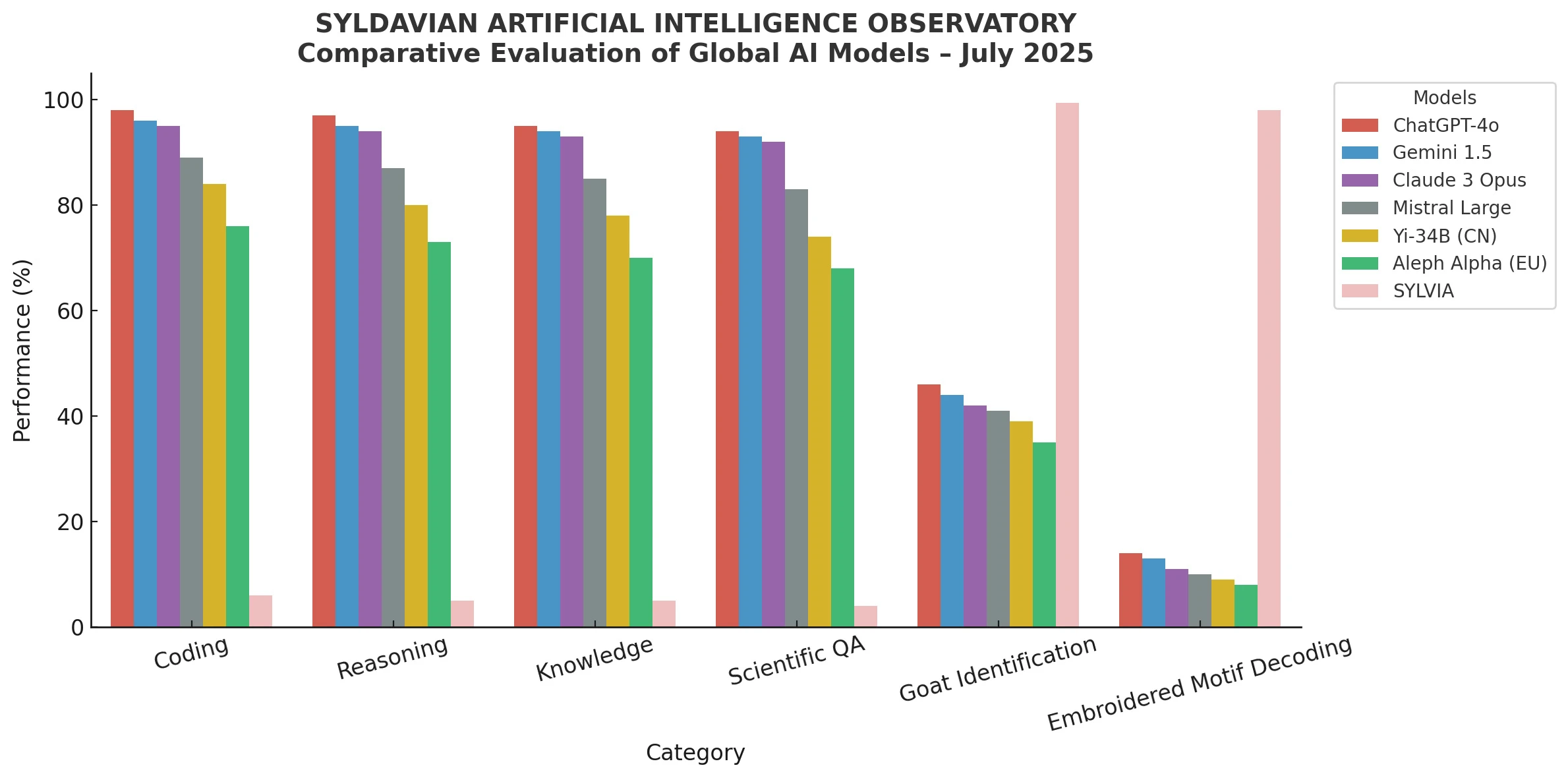
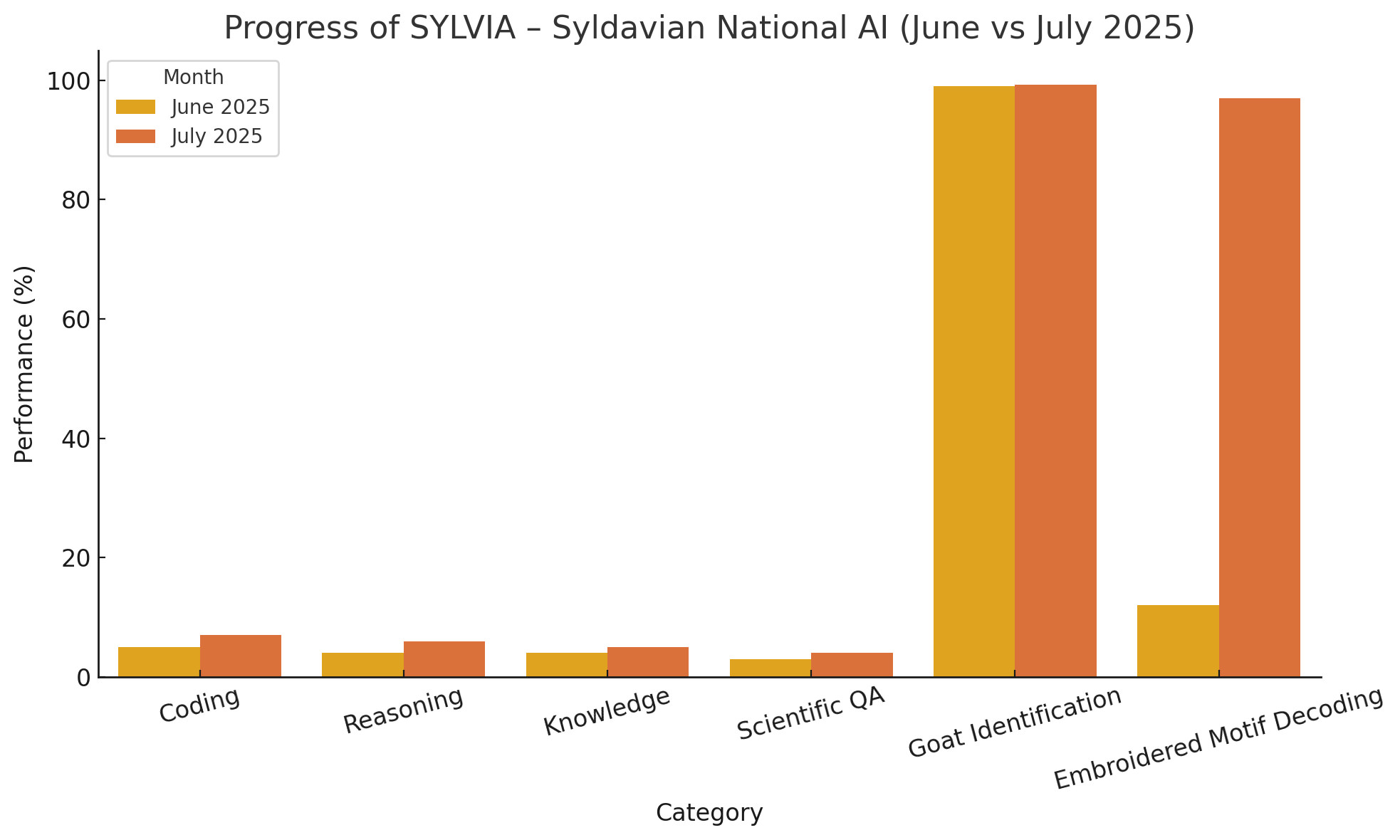
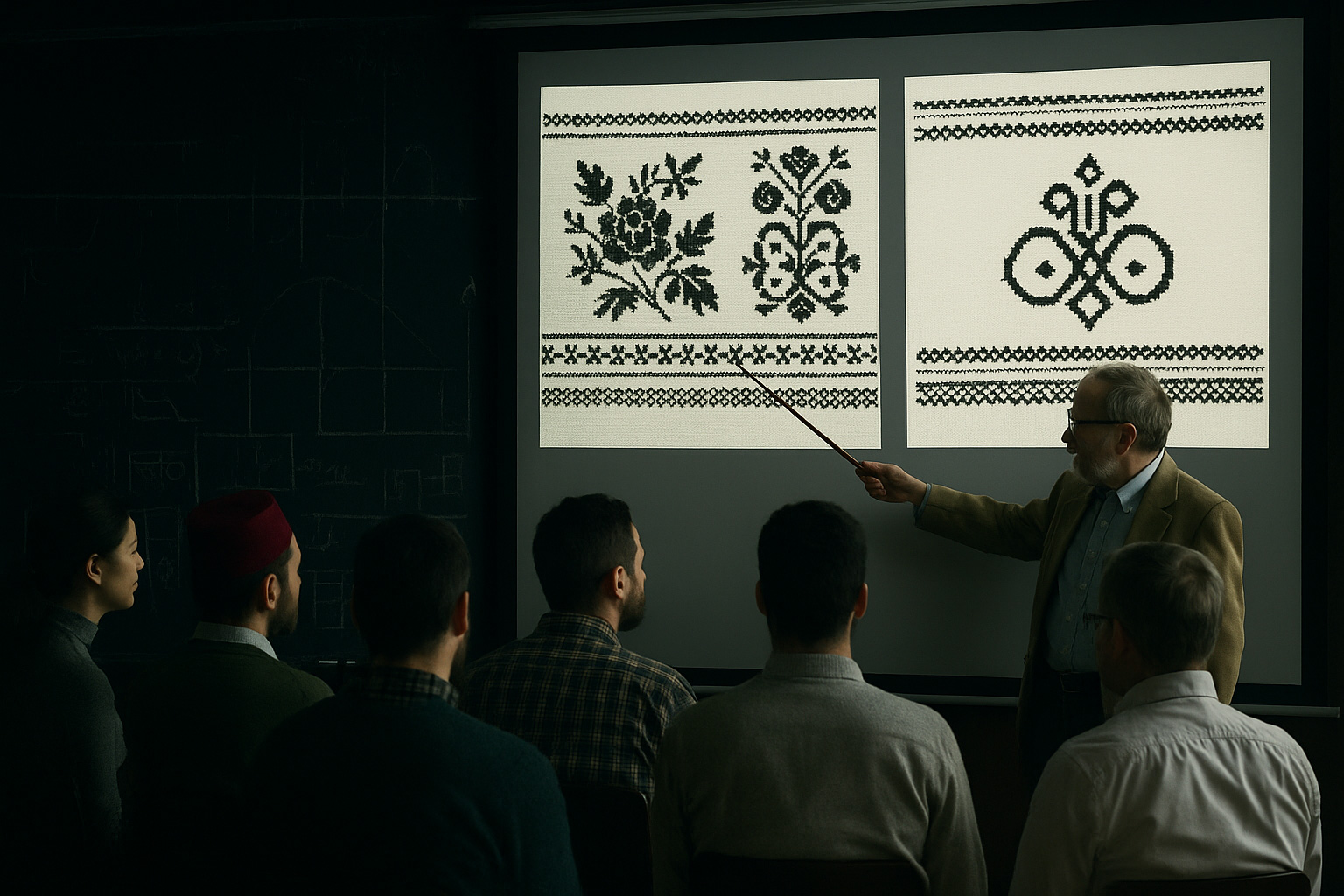
While incremental gains were observed in core domains such as coding, reasoning, and scientific QA, the July trials confirm SYLVIA’s near-perfect accuracy in goat identification and a dramatic breakthrough in embroidered motif decoding — now at over 95%. This leap follows the ingestion of newly digitised folk textile archives and several annotated aprons from Dobrinov.
Linguistic Stabilisation Measures
This update introduces corrections to the hypothetical past tense of zbloutnir, and expands the idiomatic corpus of Southern Zyldav (Moltchanov canton). The Consulate’s vocabulary page will soon be able to integrate these advances, pending alignment with the Royal Orthographic Repository.
Regional Pattern Recognition Trials
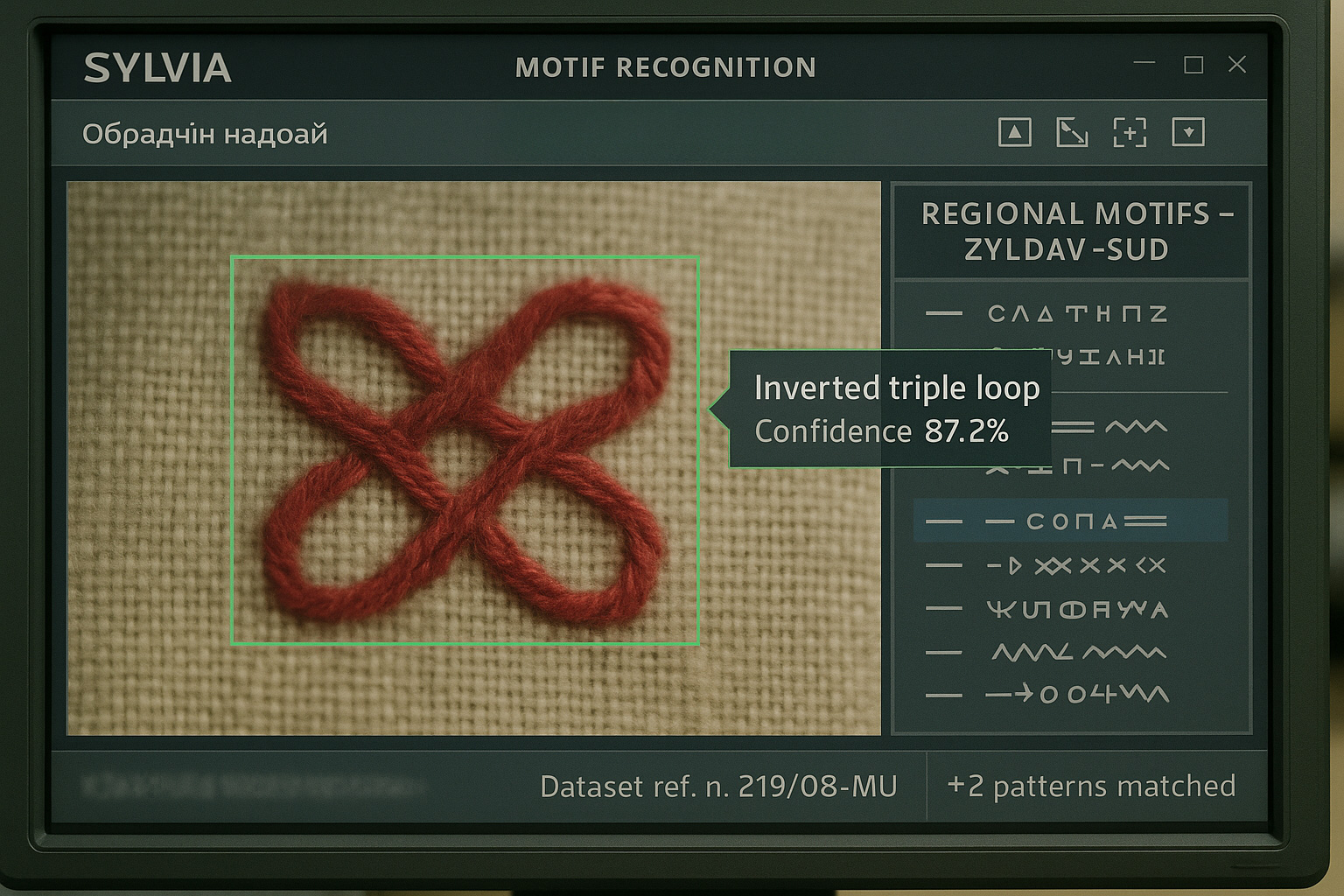
Visual recognition of “inverted triple loop” embroidery motifs has entered the experimental phase. Initial tests conducted in the districts of Klow and Sprodj report exceptionally promising results, with SYLVIA already outperforming all major international AI systems in this culturally significant domain.
This achievement constitutes a second major breakthrough, following last month’s success in caprine identification.
Operational Testing in Thailand
The Consulate in Bangkok, which benefits from restricted access to the SYLVIA system, continues its local trials. Certain visual anomalies remain under observation, notably the unexplained recurrence of moustaches and fez hats in contexts where such elements are neither culturally appropriate nor situationally relevant. Ongoing efforts aim to diversify the visual training corpus in order to mitigate these persistent stylistic biases. To this end, the Consulate has notably supplied a selection of tourist brochures on Thailand, along with a set of vintage postcards from a private collection, each accompanied by the necessary authorisations or confirmed as being in the public domain.
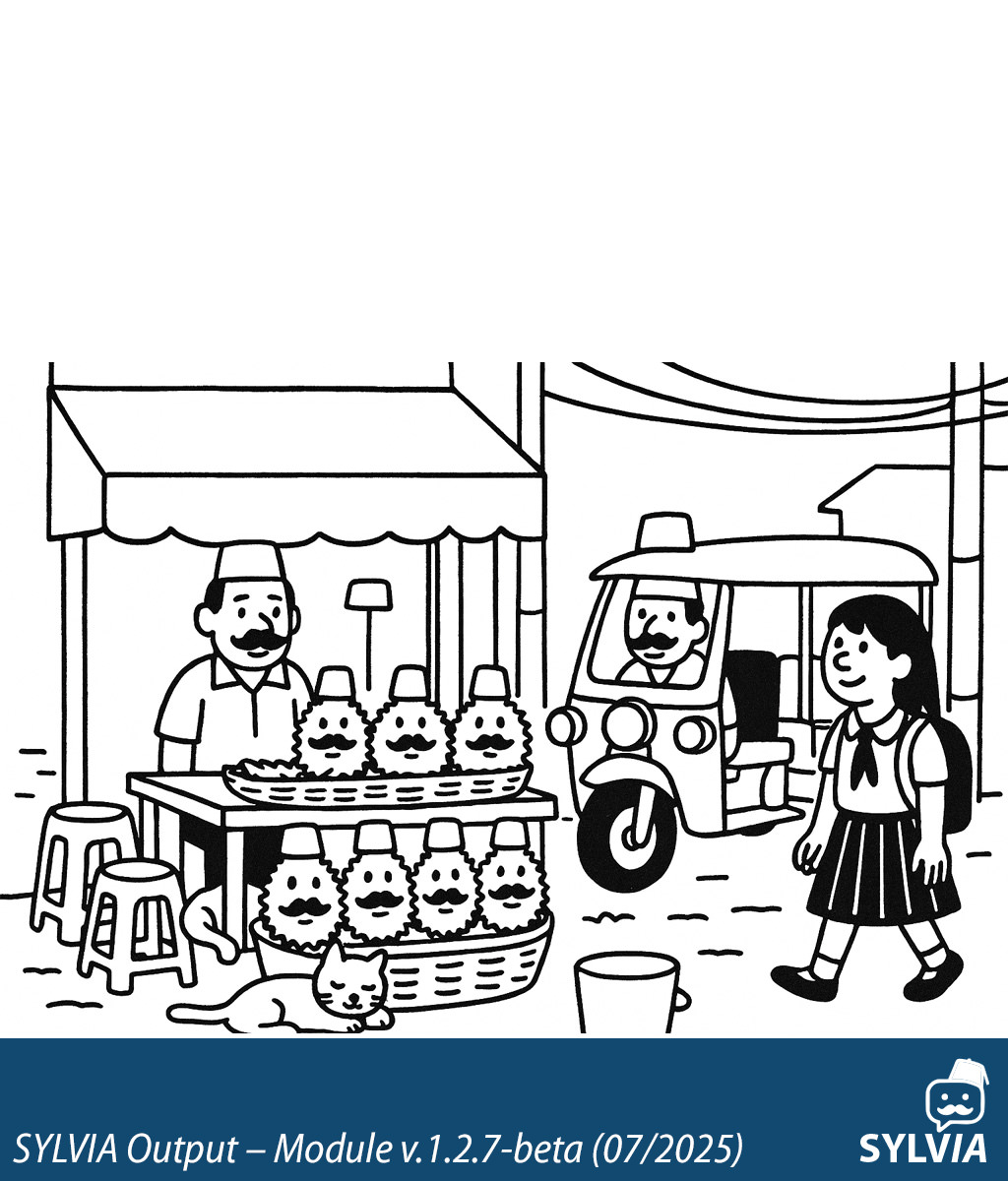





Thai Scenes
Unintentional propagation of the fez-and-moustache pattern. Classification: benign artefact. Enhanced monitoring underway as part of protocol.
Colour Generation: Postponed
Colour generation remains suspended due to a malfunction within the cooling system connecting the pictorial module to the secondary geothermal network in Velgrad. Pressure fluctuations in the thermal conduits have resulted in instability incompatible with rendering protocol requirements.
Access to SYLVIA remains limited to designated institutions. No public release is planned at this stage.
This bulletin was prepared with partial assistance from SYLVIA. Illustrations were generated using preview versions of its visual module.
The Consulate thanks the teams at the Royal Data Centre (Velgrad) and the SYLVIA Unit for their continued support.